José Mandojana
From this contributor

A new look at walking in early childhood: Q&A with Rujuta Wilson
Quantifying toddlers’ gaits promises to improve autism diagnosis and intervention.
A new look at walking in early childhood: Q&A with Rujuta Wilson
Catherine Lord: Lessons from a storied career in autism research
Catherine Lord's career has been defined by relationships: with mentors, protegees and, above all, with autistic people and their families.
Catherine Lord: Lessons from a storied career in autism research
Beyond the bench: A conversation with Michael Gandal
Michael Gandal, who studies the genetics of brain conditions, offers unusual advice on team building: Lock everyone up in a room together.
Beyond the bench: A conversation with Michael Gandal
Explore more from The Transmitter
Is it time for neuroscience to shift its focus from a computational mind to a navigating mind?
Andrea Hiott explains her navigational approach to the mind, and why now is the time to embrace seemingly paradoxical findings in neuroscience.
Is it time for neuroscience to shift its focus from a computational mind to a navigating mind?
Andrea Hiott explains her navigational approach to the mind, and why now is the time to embrace seemingly paradoxical findings in neuroscience.
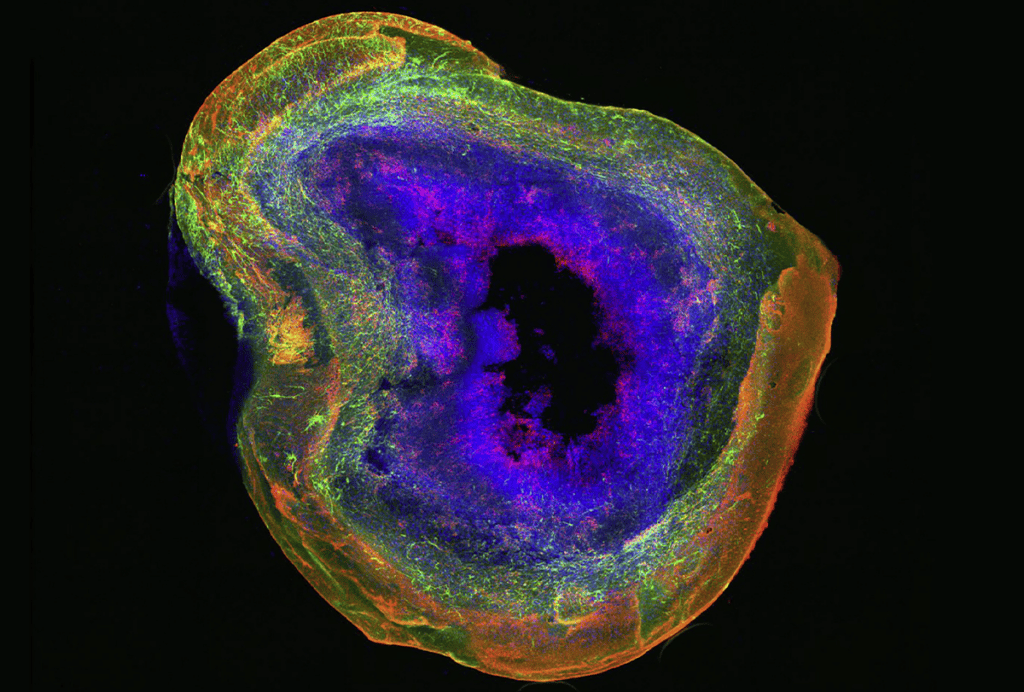
Human brain organoids come of age—but still have room to grow
The U.S. government has touted organoids as an alternative to animals for studying the brain. The model has improved since its debut in 2013, but scientists are still working to overcome key limitations: immaturity, consistency and the lack of vascularization.
Human brain organoids come of age—but still have room to grow
The U.S. government has touted organoids as an alternative to animals for studying the brain. The model has improved since its debut in 2013, but scientists are still working to overcome key limitations: immaturity, consistency and the lack of vascularization.

Finding neuroheterogeneity’s sweet spot
Once thought to be detrimental to memory processing, neuronal diversity—at the right ‘Goldilocks’ dose—is a new boon to theoretical neuroscience.
Finding neuroheterogeneity’s sweet spot
Once thought to be detrimental to memory processing, neuronal diversity—at the right ‘Goldilocks’ dose—is a new boon to theoretical neuroscience.