Subthalamic nucleus
Recent articles
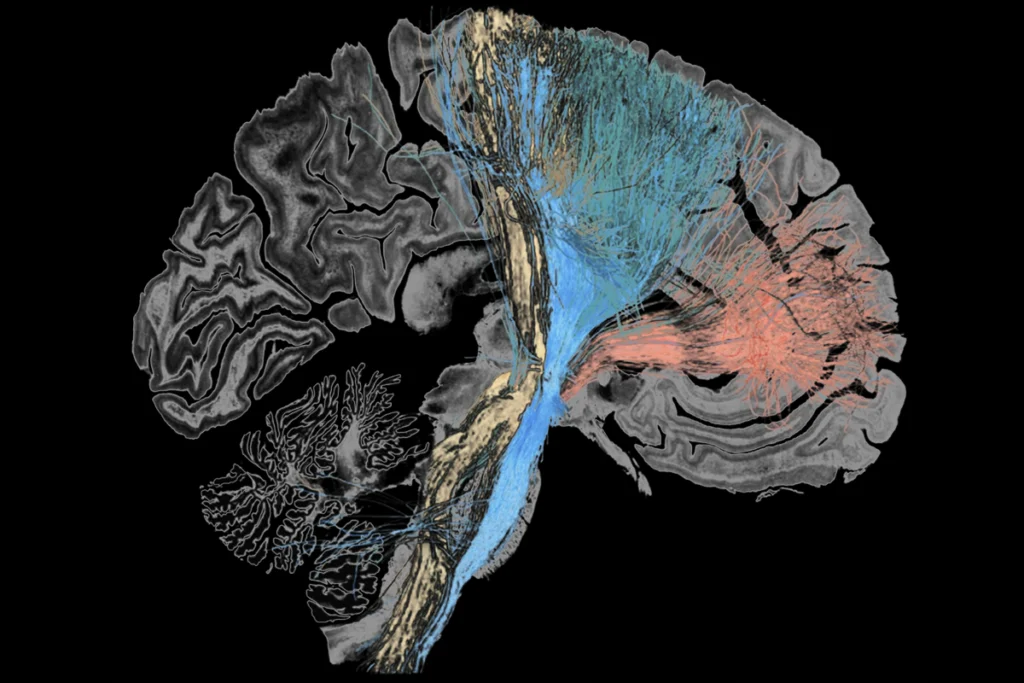
Drafting a ‘dysfunctome’: Faulty connections to subthalamic nucleus characterize disparate brain disorders
Different circuits between the millimeters-wide structure and the cortex go awry in Tourette syndrome, obsessive-compulsive disorder, dystonia and Parkinson’s disease, a new study of human brain scans suggests.
Drafting a ‘dysfunctome’: Faulty connections to subthalamic nucleus characterize disparate brain disorders
Different circuits between the millimeters-wide structure and the cortex go awry in Tourette syndrome, obsessive-compulsive disorder, dystonia and Parkinson’s disease, a new study of human brain scans suggests.
Explore more from The Transmitter
Finding neuroheterogeneity’s sweet spot
Once thought to be detrimental to memory processing, neuronal diversity—at the right ‘Goldilocks’ dose—is a new boon to theoretical neuroscience.
Finding neuroheterogeneity’s sweet spot
Once thought to be detrimental to memory processing, neuronal diversity—at the right ‘Goldilocks’ dose—is a new boon to theoretical neuroscience.
COVID-19 and influenza effects in pregnancy; and more
Here is a roundup of autism-related news and research spotted around the web for the week of 19 October.
COVID-19 and influenza effects in pregnancy; and more
Here is a roundup of autism-related news and research spotted around the web for the week of 19 October.
What to do when traditional mechanistic approaches no longer work
Many complex behaviors have stubbornly resisted mechanistic explanations. Deciphering them will require new approaches—and perhaps a new concept of “understanding.”
What to do when traditional mechanistic approaches no longer work
Many complex behaviors have stubbornly resisted mechanistic explanations. Deciphering them will require new approaches—and perhaps a new concept of “understanding.”