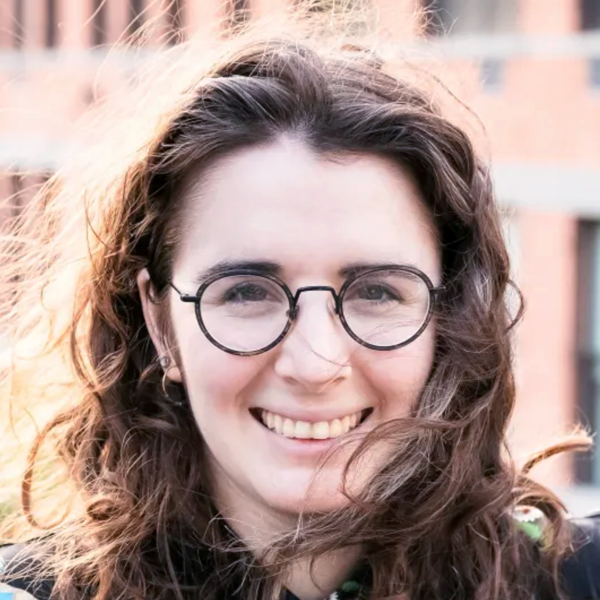
Kim Stachenfeld.

Kim Stachenfeld

Staff research scientist, Google DeepMind
Adjunct assistant professor, Columbia University

Kim Stachenfeld is staff research scientist at Google DeepMind and adjunct assistant professor at Columbia University’s Center for Theoretical Neuroscience. Her research bridges neuroscience and artificial intelligence, focusing on AI-inspired models of neural computation and the use of AI tools to understand brain data.

Stachenfeld earned her Ph.D. in computational neuroscience from Princeton University in 2018 and a B.S. in chemical and biological engineering and B.A. in mathematics from Tufts University in 2013. Her work has been featured in The AtlanticQuanta MagazineNautilus and MIT Technology Review. In 2019, she was recognized by MIT Technology Review as one of its Innovators Under 35 for her research on predictive representations in the hippocampus.

Explore more from The Transmitter

A blue comment bubble is pinned down by crisscrossing red threads and pins.

Neuroscience conference policy draws confusion, apology

NeurIPS organizers apologized and altered course after issuing a policy that barred submissions from researchers at U.S.-government-sanctioned institutions.

By Dalmeet Singh Chawla
27 March 2026 | 5 min read
Assembloids in a petri dish.

Funding for animal research alternatives reaches ‘inflection point’

The United States and Europe are dedicating hundreds of millions of dollars in funding to advance novel alternative methods, but not all neuroscientists see this as a positive step.

By Claudia López Lloreda
26 March 2026 | 4 min read
Illustration of a laptop computer superimposed over a scroll.

‘Friction-maxxing’ in school: Students should read primary literature, not AI summaries

Trainees need to learn how to identify a neuroscience paper’s major takeaways and integrate them into their understanding. This skill doesn’t come from outsourcing the work to large language models.

By Nora Bradford
26 March 2026 | 5 min read