For decades, the neuron has been the undisputed star of neuroscience. It fires; it connects; it computes. Everything else—the sprawling population of non-neuronal cells that collectively make up roughly half the brain’s volume—has been treated (more or less) as a supporting cast. Astrocytes in particular have long been designated the role of the helper: tidying up after neurons, keeping them fed, helping them survive injury. Useful, certainly, but not exactly the main event.
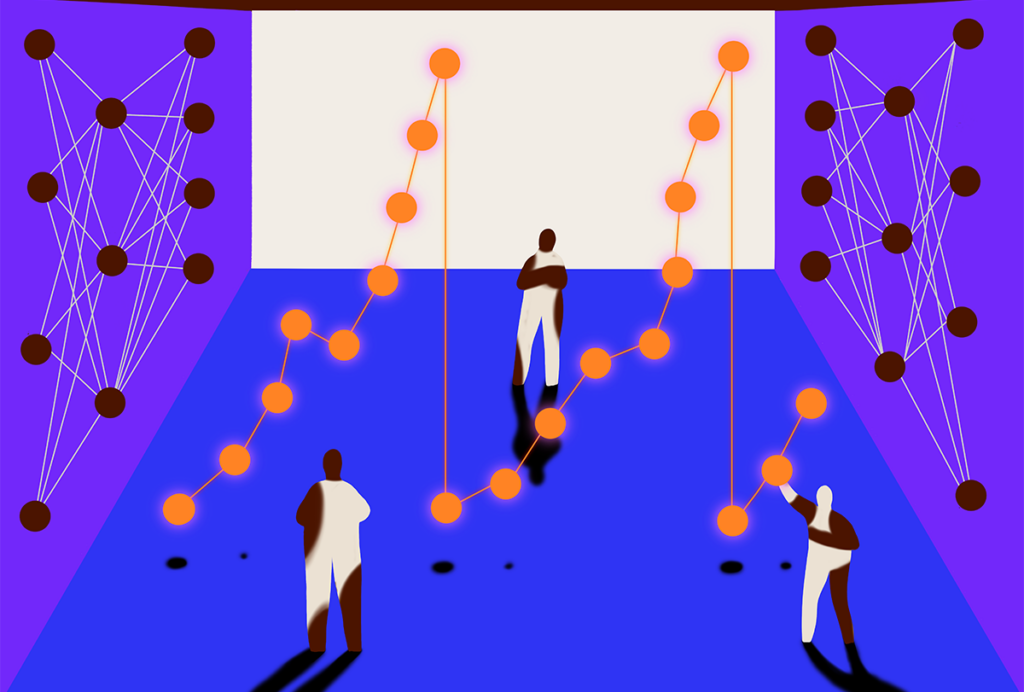
A new study, published in Nature in April, adds more evidence to the growing concern that we have been looking at these cells all wrong. Astrocytes are not a diffuse, undifferentiated support system, the work—led by Melissa Cooper, a postdoctoral researcher working in Shane Liddelow’s lab at the NYU Grossman School of Medicine —reveals. Rather, they form precise, long-range networks, connected by specialized pores called gap junctions, that span the entire brain in patterns as specific and structured as any neuronal circuit. (The Transmitter covered the paper as a preprint in September.)
Cooper’s key advance was engineering a molecular sensor that tags everything passing through a gap junction in an awake mouse. She then cleared the entire brain to make it transparent, imaging the resulting network in three dimensions across the whole organ. The images are striking: Precise chains of astrocytes hold hands across the corpus callosum, forming distinct highways that differ depending on where in the brain they originate.
To understand the astrocytes’ role in plasticity, Cooper trimmed the animals’ whiskers, a standard way to reduce sensory input to the barrel cortex. The astrocyte network shrank by roughly half; most notably, the network rewired, connecting to entirely different places in the cortex. Astrocytes, it turns out, remodel differently than neurons, and in ways that neuronal anatomy cannot necessarily predict.
The implications reach well beyond basic science. The regions that consume the most energy in the brain—areas so metabolically demanding that neighboring astrocytes might not be able to sustain them—may depend on exactly this kind of long-range network to ferry resources from less active regions. And in neurodegeneration, in which the spread of pathological proteins, such as alpha-synuclein and tau, has long puzzled researchers, a better understanding of astrocyte network architecture may reveal how this intricate support system potentially becomes part of the problem.
Here, I speak with Cooper about how she built her molecular sensor, what she saw when she put the first cleared brain under the microscope late one night, and what she thinks it means that glia are only now beginning to be understood at the systems level.
Watch our conversation or read the transcript.