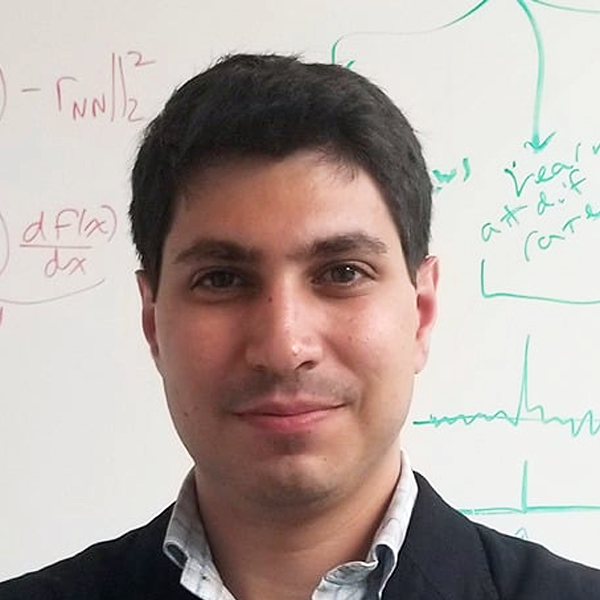
Adam Charles.

Adam Charles

Assistant professor of biomedical engineering
Johns Hopkins University

Adam Charles is assistant professor of biomedical engineering at Johns Hopkins University (with affiliations in the Center for Imaging Science, the Mathematical Institute for Data Science and the Kavli Neuroscience Institute, among others). His lab focuses on developing computational models and methods to understand large-scale brain data collected at micron-level resolution. He works on new microscopy techniques, including computational imaging methods, and compositional dynamical systems that can analyze multi-area neuronal-level recordings in an interpretable way.

Charles earned his B.E and E.C.E. at Cooper Union, followed by a Ph.D. in electrical and computer engineering at the Georgia Institute of Technology in the lab of Christopher Rozell. He then worked as a postdoctoral fellow in Jonathan Pillow’s group at the Princeton Neuroscience Institute.
From this contributor

Explore more from The Transmitter

Gloved hand reaches out to touch a mouse.

This paper changed my life: Ishmail Abdus-Saboor on balancing the study of pain and pleasure

A 2013 Nature paper from David Anderson’s lab revealed a group of sensory neurons involved in pleasurable touch and led Abdus-Saboor down a new research path.

By Ishmail Abdus-Saboor
13 February 2026 | 7 min read
A boy and girl run in a field.

Sex bias in autism drops as age at diagnosis rises

The disparity begins to level out after age 10, raising questions about why so many autistic girls go undiagnosed earlier in childhood.

By Helena Kudiabor
13 February 2026 | 4 min read
Research image of the mouse dentate gyrus.

Microglia implicated in infantile amnesia

The glial cells could explain the link between maternal immune activation and autism-like behaviors in mice.

By Lauren Schneider
12 February 2026 | 5 min read

privacy consent banner

Privacy Preference

We use cookies to provide you with the best online experience. By clicking “Accept All,” you help us understand how our site is used and enhance its performance. You can change your choice at any time. To learn more, please visit our Privacy Policy.