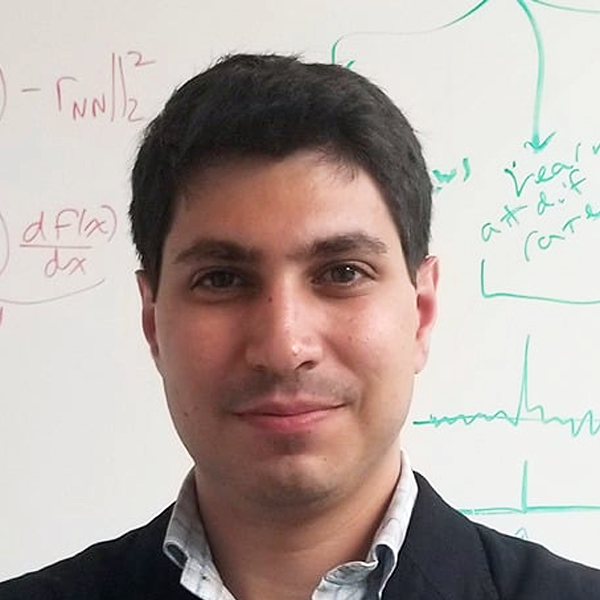
Adam Charles.

Adam Charles

Assistant professor of biomedical engineering
Johns Hopkins University

Adam Charles is assistant professor of biomedical engineering at Johns Hopkins University (with affiliations in the Center for Imaging Science, the Mathematical Institute for Data Science and the Kavli Neuroscience Institute, among others). His lab focuses on developing computational models and methods to understand large-scale brain data collected at micron-level resolution. He works on new microscopy techniques, including computational imaging methods, and compositional dynamical systems that can analyze multi-area neuronal-level recordings in an interpretable way.

Charles earned his B.E and E.C.E. at Cooper Union, followed by a Ph.D. in electrical and computer engineering at the Georgia Institute of Technology in the lab of Christopher Rozell. He then worked as a postdoctoral fellow in Jonathan Pillow’s group at the Princeton Neuroscience Institute.
From this contributor

Explore more from The Transmitter

Piggy bank with blindfold.

Future remains uncertain for U.S. federal funding of behavioral, cognitive science

The National Science Foundation did not include any solicitations for its social, behavioral and economic sciences directorate in its latest round of funding opportunities, nor replace any outgoing program officers—which poses an existential threat for the program, says nonprofit executive Wendy Naus.

By Calli McMurray
26 August 2026 | 5 min read

How energy determines where proteins are produced in neurons

Tatjana Tchumatchenko explains how mathematical modeling elucidates whether ion-channel proteins are produced locally in the soma or in the dendrites.

By Gaute Einevoll
26 August 2026 | 104 min listen
A brown mouse between a red cube and blue cylinder looks curiously at the top of the cylinder, standing on hind legs.

Wouldn’t you like to know? A mouse would

Mice seek information for curiosity’s sake—and their desire for knowledge versus a payout is represented distinctly in the brain, new findings suggest.

By Sarah Thau
26 August 2026 | 5 min read