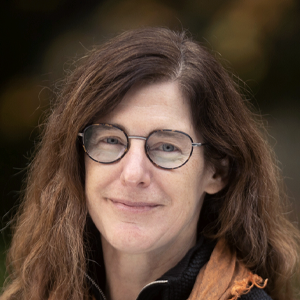
Headshot of Adrienne Fairhall.

Adrienne Fairhall

Professor of physiology and biophysics, University of Washington;
Contributing editor, The Transmitter

Adrienne Fairhall is professor of physiology and biophysics and adjunct professor of physics and applied mathematics at the University of Washington in Seattle. She co-directs the Computational Neuroscience Program at the University of Washington with Eric Shea-Brown. Her work focuses on dynamic neural computation, with a particular interest in the interplay between cellular and circuit dynamics and coding in a wide variety of model systems, including Hydra, Drosophila, birds and primates.

Fairhall obtained her honors degree in theoretical physics from the Australian National University and her Ph.D. in statistical physics from the Weizmann Institute of Science. She received her postdoctoral training at the NEC Research Institute with Bill Bialek and at Princeton University with Michael J. Berry II.
Explore more from The Transmitter

This paper changed my life: John Tuthill reflects on the subjectivity of selfhood

Wittlinger, Wehner and Wolf’s 2006 “stilts and stumps” Science paper revealed how ants pull off extraordinary feats of navigation using a biological odometer, and it inspired Tuthill to consider how other insects sense their own bodies.

By John Tuthill
12 January 2026 | 7 min read
Rhesus macaque monkey makes an intimidating face.

Some facial expressions are less reflexive than previously thought

A countenance such as a grimace activates many of the same cortical pathways as voluntary facial movements.

By Natalia Mesa
8 January 2026 | 5 min read
Mouse on top of drinking water spout in crowded cage.

Cracking the neural code for emotional states

Rather than act as a simple switchboard for innate behaviors, the hypothalamus encodes an animal's internal state, which influences behavior.

By Natalia Mesa
8 January 2026 | 8 min read

privacy consent banner

Privacy Preference

We use cookies to provide you with the best online experience. By clicking “Accept All,” you help us understand how our site is used and enhance its performance. You can change your choice at any time. To learn more, please visit our Privacy Policy.