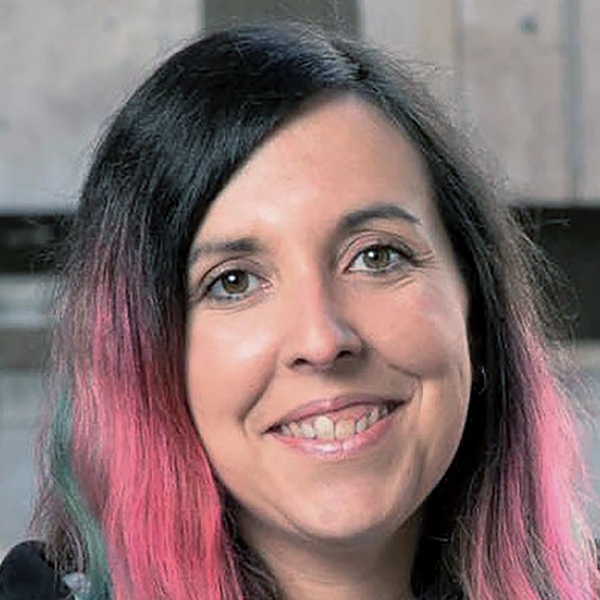
Elena Blanco-Suárez.

Elena Blanco-Suárez

Assistant professor of neurobiology
San Diego State University

Elena Blanco-Suárez is assistant professor of neurobiology at San Diego State University. Her laboratory studies astrocyte-mediated mechanisms of plasticity in health and disease, with a particular focus on recovery after stroke.

Blanco-Suárez is the editor of the book “Astrocyte-Neuron Interactions in Health and Disease.” She is deeply engaged in science communication and outreach, for which she received the Next Generation Award by the Society for Neuroscience and was named a finalist for the AAAS Early Career Award for Public Engagement with Science. She also writes about neuroscience research and career development on her blog.

She earned her B.Sc. in biology at the Universidad de Oviedo and her M.Sc. in biochemistry, molecular biology and biomedicine at the Universidad Complutense de Madrid. She completed her Ph.D. in biochemistry at the University of Bristol, followed by postdoctoral training at the Salk Institute for Biological Studies. She established her independent research program in 2020 at Thomas Jefferson University in Philadelphia and returned to Southern California in 2025 to join the faculty at San Diego State University.


Explore more from The Transmitter

Illustration of a laptop computer superimposed over a scroll.

‘Friction-maxxing’ in school: Students should read primary literature, not AI summaries

Trainees need to learn how to identify a neuroscience paper’s major takeaways and integrate them into their understanding. This skill doesn’t come from outsourcing the work to large language models.

By Nora Bradford
26 March 2026 | 5 min read

Head direction cells stably orient mice to outside world

The cells’ representations show little drift over time—unlike those of other navigation system neurons—and may provide a “rigid backbone” for more flexible sensory and cognitive responses.

By Angie Voyles Askham
25 March 2026 | 0 min watch
Thumbnail of Juan Gallego.

Juan Gallego discusses how manifolds are transforming our understanding of the coordination of neuronal population activity

A wealth of evidence supports the view that neural manifolds are real and useful, Gallego says, even if they may not completely solve the age-old mind-body problem.

By Paul Middlebrooks
25 March 2026 | 121 min listen