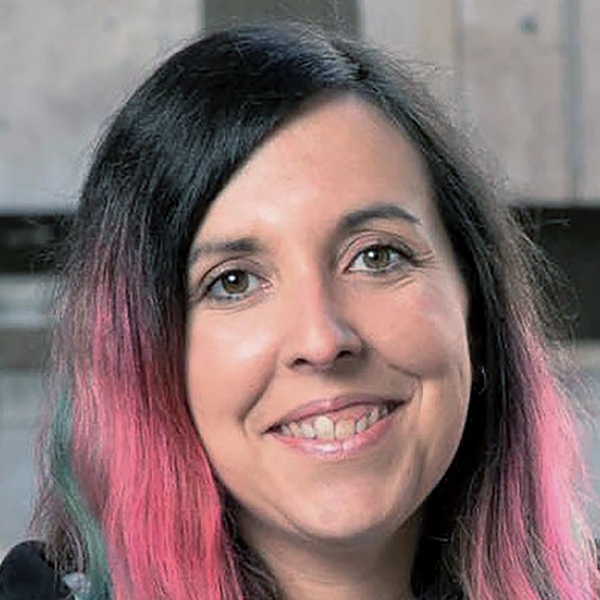
Elena Blanco-Suárez.

Elena Blanco-Suárez

Assistant professor of neurobiology
San Diego State University

Elena Blanco-Suárez is assistant professor of neurobiology at San Diego State University. Her laboratory studies astrocyte-mediated mechanisms of plasticity in health and disease, with a particular focus on recovery after stroke.

Blanco-Suárez is the editor of the book “Astrocyte-Neuron Interactions in Health and Disease.” She is deeply engaged in science communication and outreach, for which she received the Next Generation Award by the Society for Neuroscience and was named a finalist for the AAAS Early Career Award for Public Engagement with Science. She also writes about neuroscience research and career development on her blog.

She earned her B.Sc. in biology at the Universidad de Oviedo and her M.Sc. in biochemistry, molecular biology and biomedicine at the Universidad Complutense de Madrid. She completed her Ph.D. in biochemistry at the University of Bristol, followed by postdoctoral training at the Salk Institute for Biological Studies. She established her independent research program in 2020 at Thomas Jefferson University in Philadelphia and returned to Southern California in 2025 to join the faculty at San Diego State University.
Explore more from The Transmitter

Illustration of an open journal featuring lines of text and small illustrations of eyes and mouths.

Autism-linked genes alter sleep behavior, and more

Here is a roundup of autism-related news and research spotted around the web for the week of 13 April.

By Jill Adams
14 April 2026 | 2 min read
Illustration of a monkey pushing a button.

This paper changed my life: Erin Calipari ponders the nuances of rewarding and aversive stimuli

A 1960s study by Kelleher and Morse found that lever pressing in squirrel monkeys depended not on whether they received a reward or shock, but on the rules of the task. This taught Calipari to think deeply about factors that influence how behavior is generated and maintained.

By Erin Calipari
14 April 2026 | 5 min read
Illustration of a sheet of paper with a topography map-like pattern on it.

Why neural foundation models work, and what they might—and might not—teach us about the brain

These models can partly generalize across species, brain regions and tasks, suggesting that a set of machine-learnable rules govern neural population activity. But will we be able to understand them?

By Juan Gallego
13 April 2026 | 8 min read