FDA website no longer warns against bogus autism therapies, and more

Here is a roundup of autism-related news and research spotted around the web for the week of 26 January.

By Jill Adams
27 January 2026 | 2 min read

Misinformation factory: The U.S. Food and Drug Administration has deleted a web page that cautioned people against using unproven and potentially harmful autism treatments, according to journalists at The BMJ and Disability Scoop. A spokesperson at the FDA confirmed the removal but couched it as routine cleanup of dated material. In an email to The Transmitter, Helen Tager-Flusberg, professor emerita of psychological and brain sciences at Boston University, described her concern that these changes will put autistic children in danger. “Parents have come to expect that their government will provide them with the right guidance on the best treatments for their autistic children … Now, for no reason, the FDA is abdicating their responsibility,” she wrote.

The page warned against such “treatments” as chelation therapies, hyperbaric oxygen therapy, detoxifying clay baths, raw camel milk, chlorine dioxide and essential oils. Some of the cited products and so-called therapies have led to deaths, according to Tager-Flusberg. The FDA site is not the only U.S. government website to assert specious information about autism—in November, the Centers for Disease Control and Prevention claimed that the disproven vaccine-autism link was still an open question, The Transmitter has reported. 

Autism research spotted this week: 

  • “Cortical thickness and curvature in autism and ADHD: A mega-analysis” bioRxiv 
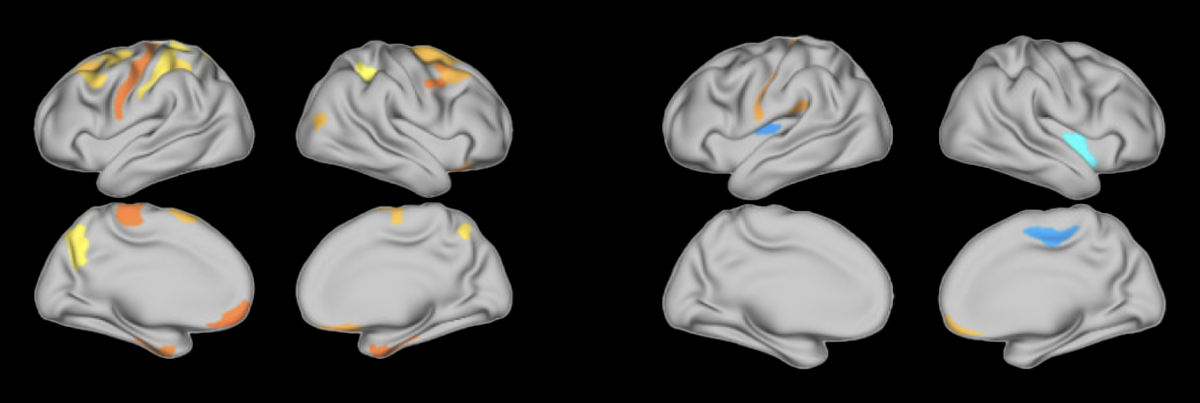
Brain scans showing people with autism have a thinner cortex in many brain regions than do people with ADHD, but greater measures of cortical curvature.
Divergent forms: People with autism have a thinner cortex in many brain regions than do people with ADHD, but greater measures of cortical curvature. (Left images show cortical thickness; right images are cortical curvature. Cool colors represent higher values in brain regions of autistic people; warm colors are higher values in ADHD.)
  • “Hyperactivity is linked to elevated cortisol levels: Comprehensive behavioral analysis in the prenatal valproic acid-induced marmoset model of autism” Translational Psychiatry
  • “Human neocortical glutamatergic neurons revealed through multimodal profiling” bioRxiv
  • “Prenatal paracetamol exposure and child neurodevelopment: A systematic review and meta-analysis” The Lancet Obstetrics, Gynaecology, & Women’s Health
  • “Variant-resolved prediction of context-specific isoform variation with a graph-based attention model” Cell Genomics (The investigators on this paper include staff members of the Simons Foundation, The Transmitter’s parent organization.)
  • “Pannexin-1 channel activity regulates neurogenesis and cell survival in the developing cortex” bioRxiv

Sign up for the weekly Spectrum newsletter.

Stay current with the latest advancements in autism research.

privacy consent banner

Privacy Preference

We use cookies to provide you with the best online experience. By clicking “Accept All,” you help us understand how our site is used and enhance its performance. You can change your choice at any time. To learn more, please visit our Privacy Policy.