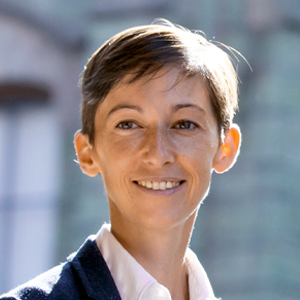
Dani Bassett is J. Peter Skirkanich Professor at the University of Pennsylvania, with appointments in the bioengineering; electrical and systems engineering; physics and astronomy; neurology; and psychiatry departments. They are also an external professor at the Santa Fe Institute. Bassett is most well known for blending neural and systems engineering to identify fundamental mechanisms of cognition and disease in human brain networks.
They received a B.S. in physics from Pennsylvania State University and a Ph.D. in physics from the University of Cambridge as a Churchill Scholar, and as an NIH Health Sciences Scholar. Following a postdoctoral position at the University of California, Santa Barbara, Bassett was a junior research fellow at the SAGE Center for the Study of the Mind.
They have received multiple awards, including the Association for Psychological Science’s “Rising Stars” list (2013), Sloan Research Fellow (2014), MacArthur Fellow Genius Grant (2014), Early Academic Achievement Award from the IEEE Engineering in Medicine and Biology Society (2015), Office of Naval Research Young Investigator (2015), National Science Foundation CAREER Award (2016), Popular Science Brilliant 10 (2016), Lagrange Prize in Complex Systems Science (2017), Erdős-Rényi Prize in Network Science (2018), Organization for Human Brain Mapping Young Investigator Award (2020), American Institute for Medical and Biological Engineering College of Fellows (2020) and American Physical Society Fellow (2021). They have also been named one of Clarivate’s Web of Science’s most highly cited researchers for four years running. Bassett recently co-authored “Curious Minds: The Power of Connection” (MIT Press) with philosopher and twin Perry Zurn.