Rebecca Horne oversees and directs The Transmitter’s multimedia operations and commissions illustrations, photography, videos and other multimedia content. Prior to joining the team, Rebecca was photography director and photography editor for Discover magazine and The Wall Street Journal, where she won several awards for her work. Originally from California, she has also served as an art producer at the advertising agency Addison Design, a photography producer at Airbnb and the multimedia app Storehouse. She has also taught photography at the California College of the Arts and Rutgers University, and has written on art and science for Wired, CNN, The Wall Street Journal, Nautilus and others.

Rebecca Horne
Art director
The Transmitter
From this contributor
How BCIs reveal the speaking brain
By
Claudia López Lloreda, Rebecca Horne
17 July 2026 | 4 min watch
Scientists push back against stricter European Research Council grant application rules
By
Lauren Schenkman
29 April 2026 | 5 min read
What neuroscientists want from a new NINDS director
By
Helena Kudiabor
15 April 2026 | 4 min read
Letter asks Congress for nearly $500 million to sustain BRAIN Initiative
By
Angie Voyles Askham
31 March 2026 | 3 min read
Marcelle Lapicque: A forgotten pioneer in neuroscience
By
Angie Voyles Askham, Rebecca Horne
24 February 2026 | 3 min watch
Education
- M.F.A., Rutgers University
- B.F.A., San Francisco Art Institute
Explore more from The Transmitter
New projectome captures ‘complex beast’ of serotonin system in mice
The whole-brain map—the first of its kind in a vertebrate—identifies five distinct neuron groups.
New projectome captures ‘complex beast’ of serotonin system in mice
The whole-brain map—the first of its kind in a vertebrate—identifies five distinct neuron groups.
By
Madeline Shaw
2 October 2026 | 0 min watch
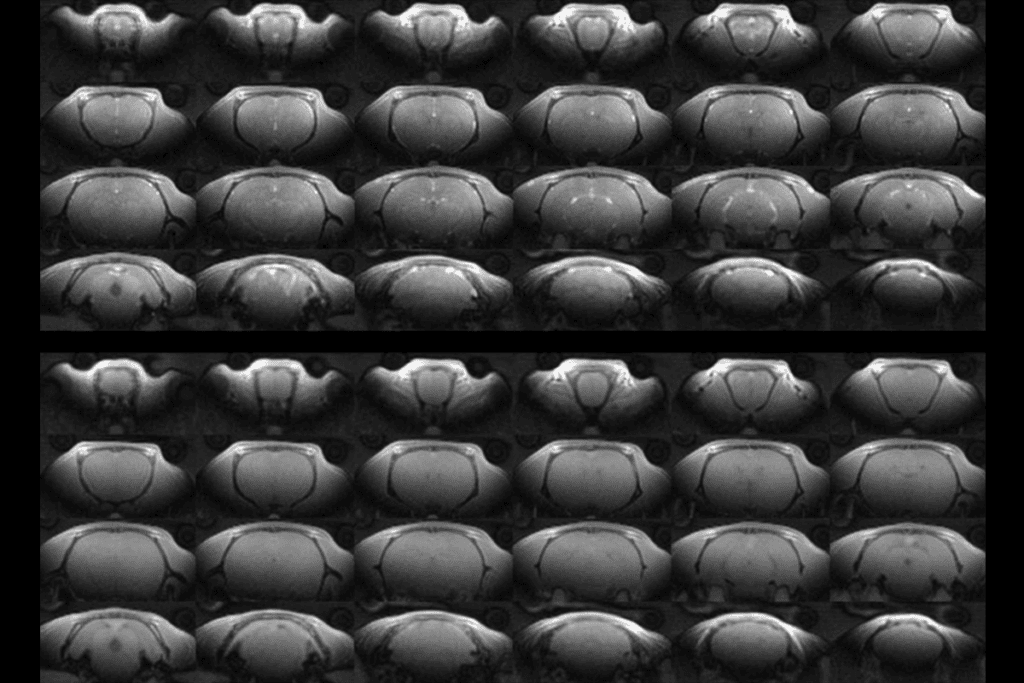
Silent, motion-resistant fMRI expands scans in behaving mice
The method, called SORDINO, captures brain images in animals while they move and interact.
Silent, motion-resistant fMRI expands scans in behaving mice
The method, called SORDINO, captures brain images in animals while they move and interact.
By
Diana Kwon
2 October 2026 | 5 min read

Autism-linked variants converge on two molecular patterns in mouse brains
Gene activity across 17 autism mouse models occurs in either of two opposing transcriptomic states, supporting the idea that diverse genetic changes may converge on a few recurring biological patterns.
Autism-linked variants converge on two molecular patterns in mouse brains
Gene activity across 17 autism mouse models occurs in either of two opposing transcriptomic states, supporting the idea that diverse genetic changes may converge on a few recurring biological patterns.
By
Giorgia Guglielmi
1 October 2026 | 4 min read