Training
Recent articles

How to incorporate open-science practices into neuroscience training
If we want emerging neuroscientists to implement open science throughout their careers, we need to establish its practices as a core principle of training.
How to incorporate open-science practices into neuroscience training
If we want emerging neuroscientists to implement open science throughout their careers, we need to establish its practices as a core principle of training.

‘Friction-maxxing’ in school: Students should read primary literature, not AI summaries
Trainees need to learn how to identify a neuroscience paper’s major takeaways and integrate them into their understanding. This skill doesn’t come from outsourcing the work to large language models.
‘Friction-maxxing’ in school: Students should read primary literature, not AI summaries
Trainees need to learn how to identify a neuroscience paper’s major takeaways and integrate them into their understanding. This skill doesn’t come from outsourcing the work to large language models.
Let’s teach neuroscientists how to be thoughtful and fair reviewers
Blanco-Suárez revamped the traditional journal club by developing a course in which students peer review preprints alongside the published papers that evolved from them.
Let’s teach neuroscientists how to be thoughtful and fair reviewers
Blanco-Suárez revamped the traditional journal club by developing a course in which students peer review preprints alongside the published papers that evolved from them.
How will neuroscience training need to change in the future?
Training in computational neuroscience, data science and statistics will need to expand, say many of the scientists we surveyed. But that must be balanced with a more traditional grounding in the scientific method and critical thinking. Researchers noted that funding concerns will also affect training, especially for people from underrepresented groups.
How will neuroscience training need to change in the future?
Training in computational neuroscience, data science and statistics will need to expand, say many of the scientists we surveyed. But that must be balanced with a more traditional grounding in the scientific method and critical thinking. Researchers noted that funding concerns will also affect training, especially for people from underrepresented groups.

How will the field’s relationship to industry change over the next decade? Will a larger neurotechnology sector emerge?
Interactions between academic neuroscience and industry will grow, and the neurotech sector will expand, most survey respondents predict. The current funding upheaval in the United States may accelerate this trend as the field searches for new funding models.
How will the field’s relationship to industry change over the next decade? Will a larger neurotechnology sector emerge?
Interactions between academic neuroscience and industry will grow, and the neurotech sector will expand, most survey respondents predict. The current funding upheaval in the United States may accelerate this trend as the field searches for new funding models.
The state of neuroscience in 2025: An overview
The Transmitter presents a portrait of the field through four lenses: its focus, its output, its people and its funding.
The state of neuroscience in 2025: An overview
The Transmitter presents a portrait of the field through four lenses: its focus, its output, its people and its funding.
Explore more from The Transmitter

Prevalence of profound autism declines with new definition
The updated, more precise definition used in a CDC study includes adaptive scores.
Prevalence of profound autism declines with new definition
The updated, more precise definition used in a CDC study includes adaptive scores.
Is it time for neuroscience to shift its focus from a computational mind to a navigating mind?
Andrea Hiott explains her navigational approach to the mind, and why now is the time to embrace seemingly paradoxical findings in neuroscience.
Is it time for neuroscience to shift its focus from a computational mind to a navigating mind?
Andrea Hiott explains her navigational approach to the mind, and why now is the time to embrace seemingly paradoxical findings in neuroscience.
Human brain organoids come of age—but still have room to grow
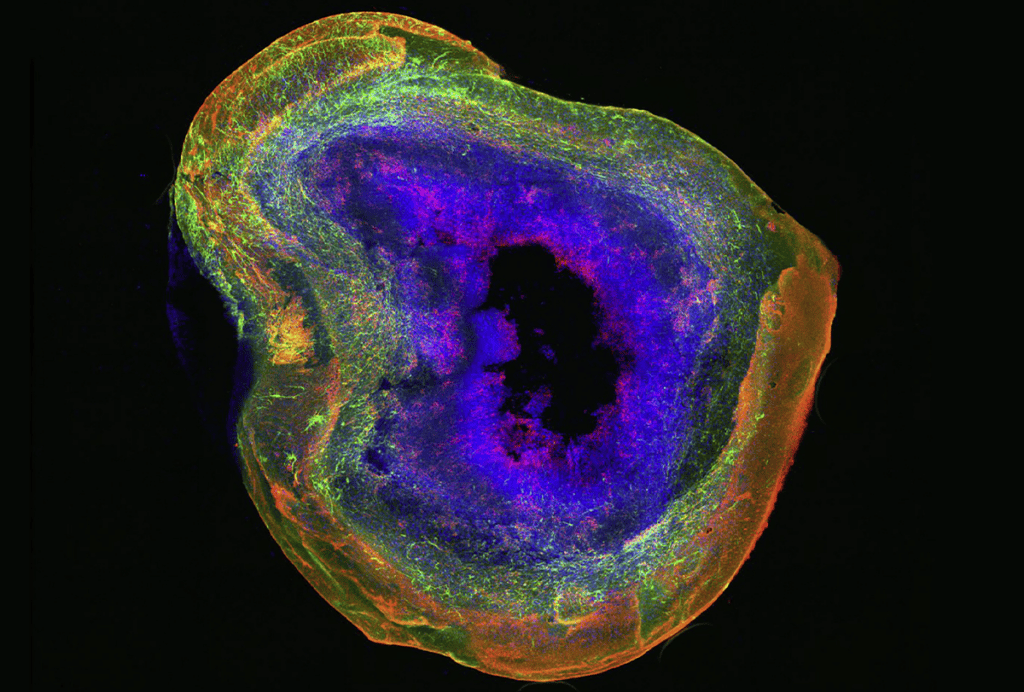
The U.S. government has touted organoids as an alternative to animals for studying the brain. The model has improved since its debut in 2013, but scientists are still working to overcome key limitations: immaturity, consistency and the lack of vascularization.
Human brain organoids come of age—but still have room to grow
The U.S. government has touted organoids as an alternative to animals for studying the brain. The model has improved since its debut in 2013, but scientists are still working to overcome key limitations: immaturity, consistency and the lack of vascularization.