Robert Krencik is a postdoctoral researcher in Erik M. Ullian’s lab, which is in the ophthalmology department at the University of California San Francisco School of Medicine.
Robert Krencik
Post-doctoral researcher
University of California, San Francisco
From this contributor

Targeting brain’s star-shaped cells may yield autism drugs
Astrocytes modulate most — if not all — aspects of neuronal development. We need new techniques to study these star-shaped brain cells and their potential role in autism and other conditions.
Targeting brain’s star-shaped cells may yield autism drugs
By
Robert Krencik, Erik M. Ullian
3 May 2016 | 6 min read
Explore more from The Transmitter
Head direction cells stably orient mice to outside world
The cells’ representations show little drift over time—unlike those of other navigation system neurons—and may provide a “rigid backbone” for more flexible sensory and cognitive responses.
Head direction cells stably orient mice to outside world
The cells’ representations show little drift over time—unlike those of other navigation system neurons—and may provide a “rigid backbone” for more flexible sensory and cognitive responses.
By
Angie Voyles Askham
25 March 2026 | 0 min watch
Juan Gallego discusses how manifolds are transforming our understanding of the coordination of neuronal population activity
A wealth of evidence supports the view that neural manifolds are real and useful, Gallego says, even if they may not completely solve the age-old mind-body problem.
Juan Gallego discusses how manifolds are transforming our understanding of the coordination of neuronal population activity
A wealth of evidence supports the view that neural manifolds are real and useful, Gallego says, even if they may not completely solve the age-old mind-body problem.
By
Paul Middlebrooks
25 March 2026 | 121 min listen
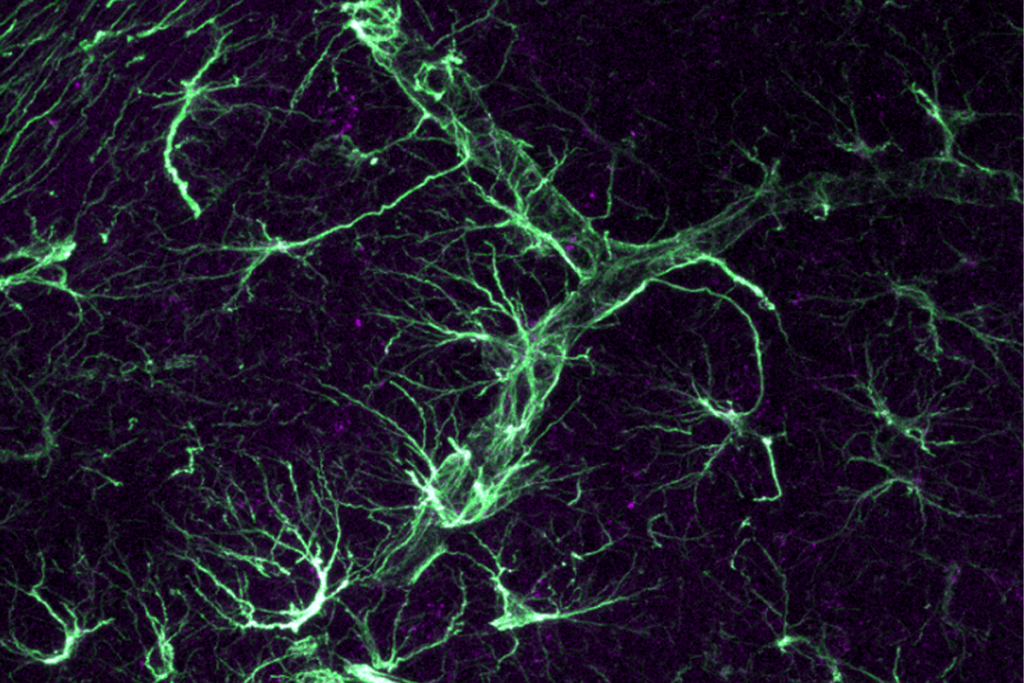
Astrocytes in mouse amygdala encode emotional state
The glial cells’ activity reliably tracks with freezing, hesitancy and other behaviors reminiscent of anxiety.
Astrocytes in mouse amygdala encode emotional state
The glial cells’ activity reliably tracks with freezing, hesitancy and other behaviors reminiscent of anxiety.
By
Holly Barker
24 March 2026 | 4 min read