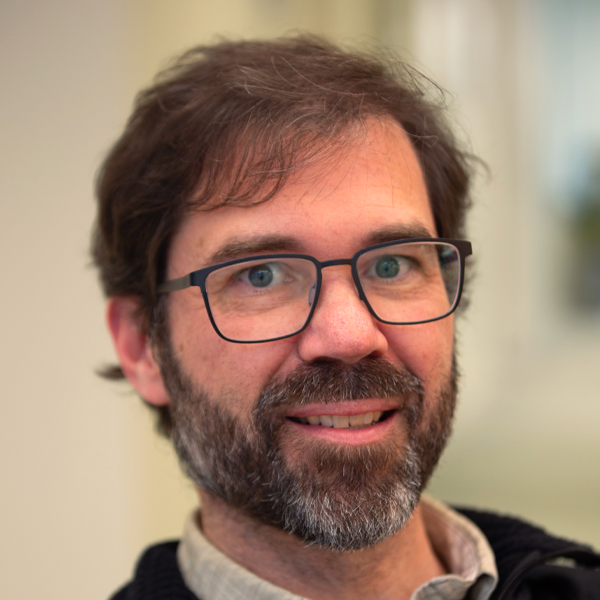
Stephen David.

Stephen David

Contributing editor, The Transmitter;
Professor of otolaryngology, Oregon Hearing Research Center, Oregon Health & Science University

Stephen David is professor of otolaryngology in the Oregon Hearing Research Center at Oregon Health & Science University. His day job focuses on the neural basis of sensory perception, particularly in the auditory system. Current projects use computational approaches to characterize auditory neural representations while manipulating context through associative learning, attention, environmental noise and hearing loss. A long-standing interest in the history of ideas has also led him to co-found and maintain Neurotree, a crowdsourced academic genealogy of neuroscience.

Before coming to Oregon Health & Science University, David completed an A.B. in applied mathematics at Harvard University; a Ph.D. in bioengineering at the University of California, Berkeley, studying visual cortex and attention with Jack Gallant; and a postdoctoral fellowship with Shihab Shamma in the Institute for Systems Research at the University of Maryland, College Park. Learn more.
From this contributor

Explore more from The Transmitter

Illustration of a leaking pipe.

Securing the academic pipeline amid uncertain U.S. funding climate

Finding creative ways to keep early-career researchers in academia—for example, through part-time roles—can help the field weather the storm.

By Lucina Q. Uddin
9 March 2026 | 4 min read
Illustration of a sheet of paper with many holes punched out of it.

Let’s teach neuroscientists how to be thoughtful and fair reviewers

Blanco-Suárez revamped the traditional journal club by developing a course in which students peer review preprints alongside the published papers that evolved from them.

By Elena Blanco-Suárez
6 March 2026 | 6 min read
Megaphone with many different shapes and textures emanating from it.

New autism committee positions itself as science-backed alternative to government group

The Independent Autism Coordinating Committee plans to meet at the same time as the U.S. federal Interagency Autism Coordinating Committee later this month—and offer its own research agenda.

By Angie Voyles Askham
5 March 2026 | 5 min read

privacy consent banner

Privacy Preference

We use cookies to provide you with the best online experience. By clicking “Accept All,” you help us understand how our site is used and enhance its performance. You can change your choice at any time. To learn more, please visit our Privacy Policy.