Brain evolution: Molecular and cellular regulatory components that support neuronal communication across the layers of the cerebral cortex distinguish mammalian brains from non-mammalian ones, a new study details. The investigators focused on the many types of excitatory projection neurons and their genes—and specifically zeroed in on the transcription factor ZBTB18, which is implicated in autism and intellectual disability. Deletion of ZBTB18 in mouse excitatory projection neurons decreased molecular diversity and connectivity within the brain, reminiscent of older evolutionary brain structures. The authors surmise that although the complexity in the mammalian brain has advantages (and is highly conserved), it may also “render them more susceptible to various neurodevelopmental and neuropsychiatric disorders.”
Cortical evolution, ZBTB18, and more
Here is a roundup of autism-related news and research spotted around the web for the week of 30 March.
By
Jill Adams
31 March 2026 | 2 min read
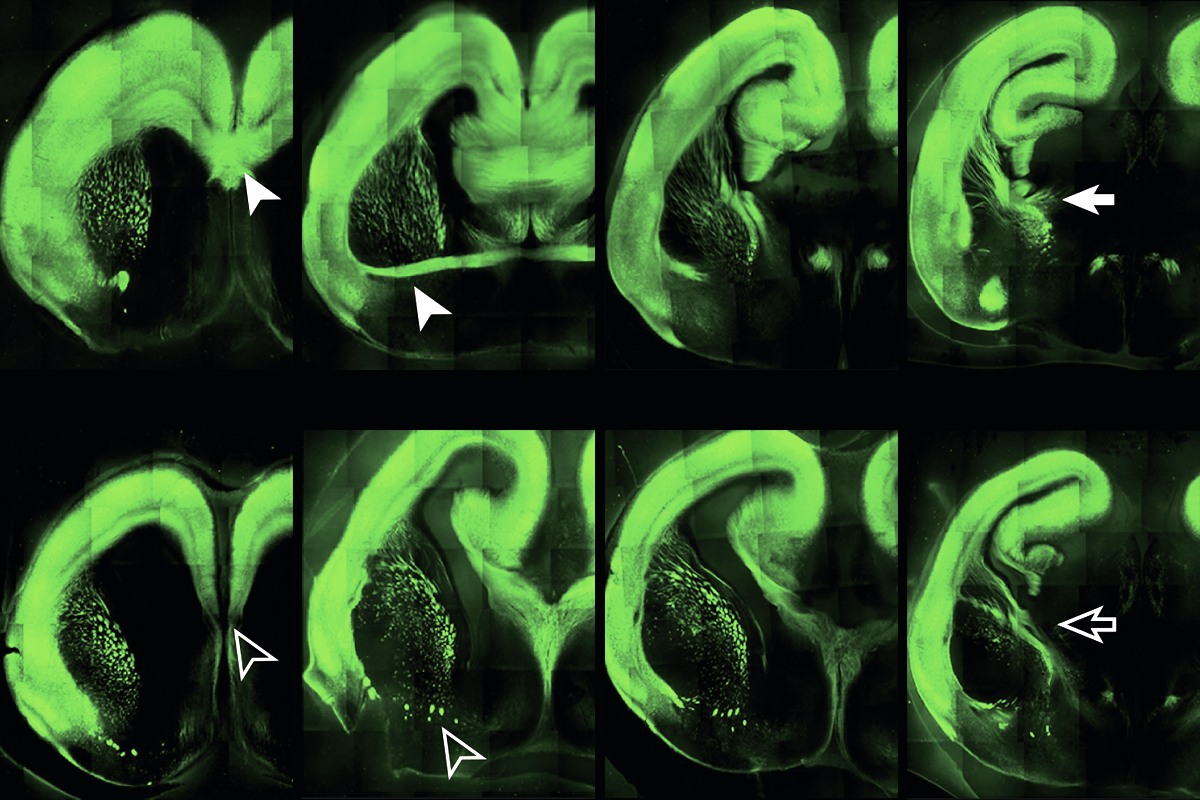
Thinning out: Mice missing the ZBTB18 gene (bottom panels) show altered brain structure and connectivity (coronal images with green-stained axonal projections) when compared with wildtype mice (top panels).
Autism research spotted this week:
- “SHANK3 and beta-synuclein are novel blood-based biomarkers for the Phelan-McDermid syndrome: a pilot study” Translational Psychiatry
- “Co-occurrence of rare variants implicates gene pairs in cytoskeletal pathways and is associated with increased severity in autism spectrum disorder” Genome Biology
- “Prevalence of autism spectrum disorder severity levels from the fifth edition of the Diagnostic and Statistical Manual (DSM-5) in the autism and developmental disabilities monitoring network” Journal of Autism and Developmental Disorders
- “Distinct synaptic mechanisms underlie NRXN1 variant and disorder background-dependent phenotypes in iPSC-derived neurons” Cell Reports
- “Genotype-phenotype correlations and putative modifier genes in SYNGAP1 encephalopathy” Neurobiology of Disease
- “CHD8 haploinsufficiency leads to molecular layer heterotopias and age-dependent cortical expansion” bioRxiv
- “Why the term ‘virtual autism’ warrants caution” Autism
See also: “Study links screen time to autism, but problems abound” and “Studies investigating link between screen time and autism must improve”
tags:
Explore more from The Transmitter
Among brain changes studied in autism, spotlight shifts to subcortex
By
Holly Barker
11 December 2025 | 5 min read
SHANK3 deficiency and behavior in mice; and more
By
Jill Adams
25 November 2025 | 2 min read
Cite this article: