Coding
Recent articles

How to collaborate with AI
To make the best use of LLMs in research, turn your scientific question into a set of concrete, checkable proposals, wire up an automatic scoring loop, and let the AI iterate.
How to collaborate with AI
To make the best use of LLMs in research, turn your scientific question into a set of concrete, checkable proposals, wire up an automatic scoring loop, and let the AI iterate.

AI-assisted coding: 10 simple rules to maintain scientific rigor
These guidelines can help researchers ensure the integrity of their work while accelerating progress on important scientific questions.
AI-assisted coding: 10 simple rules to maintain scientific rigor
These guidelines can help researchers ensure the integrity of their work while accelerating progress on important scientific questions.
Should neuroscientists ‘vibe code’?
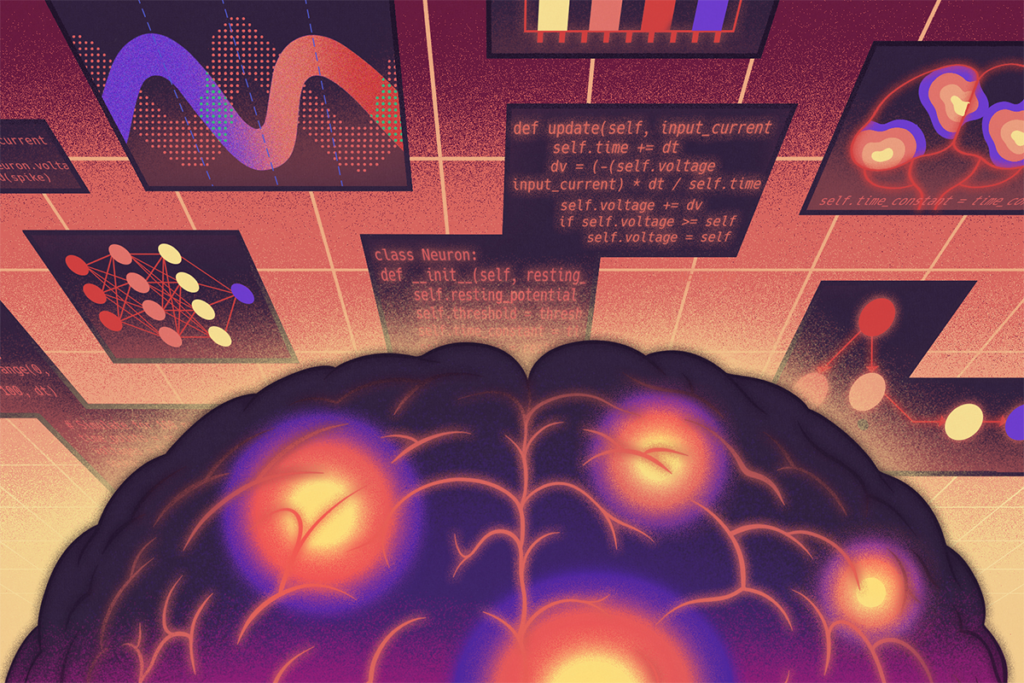
Researchers are developing software entirely through natural language conversations with advanced large language models. The trend is transforming how research gets done—but it also presents new challenges for evaluating the outcomes.
Should neuroscientists ‘vibe code’?
Researchers are developing software entirely through natural language conversations with advanced large language models. The trend is transforming how research gets done—but it also presents new challenges for evaluating the outcomes.
Explore more from The Transmitter

Error equation predicts brain’s ability to generalize
Four statistical measurements of neural network geometry capture how well brains and artificial networks use what they already know to solve new problems, a study suggests.
Error equation predicts brain’s ability to generalize
Four statistical measurements of neural network geometry capture how well brains and artificial networks use what they already know to solve new problems, a study suggests.

Embrace complexity to improve the translatability of basic neuroscience
Researchers must learn to view heterogeneity as an essential feature of the systems they study and a central consideration in experimental design, not a variable to control for or reduce.
Embrace complexity to improve the translatability of basic neuroscience
Researchers must learn to view heterogeneity as an essential feature of the systems they study and a central consideration in experimental design, not a variable to control for or reduce.
Romain Brette reveals fundamental flaws in commonly assumed neuroscience concepts
His new book, “The Brain, In Theory,” offers alternatives to many of the computer science frameworks currently driving theoretical neuroscience.
Romain Brette reveals fundamental flaws in commonly assumed neuroscience concepts
His new book, “The Brain, In Theory,” offers alternatives to many of the computer science frameworks currently driving theoretical neuroscience.