IMFAR 2010
Recent articles

Gene expression pattern could pinpoint autism
Researchers can reliably identify individuals with autism by looking at the expression pattern of a set of genes in cultured blood cells, according to a poster presented Friday at the IMFAR 2010 conference in Philadelphia.
Gene expression pattern could pinpoint autism
Researchers can reliably identify individuals with autism by looking at the expression pattern of a set of genes in cultured blood cells, according to a poster presented Friday at the IMFAR 2010 conference in Philadelphia.
Children with autism and siblings share brain ‘signature’
Children who have autism and their healthy siblings share patterns of brain activity that are different than those seen in children with no family history of the disorder, according to unpublished research presented at the IMFAR 2010 conference in Philadelphia.
Children with autism and siblings share brain ‘signature’
Children who have autism and their healthy siblings share patterns of brain activity that are different than those seen in children with no family history of the disorder, according to unpublished research presented at the IMFAR 2010 conference in Philadelphia.
Language specialization skewed in children with autism
Brain imaging reveals distinct signatures in the language circuits of young toddlers with autism while they sleep, according to unpublished data presented yesterday at the IMFAR 2010 meeting in Philadelphia.
Language specialization skewed in children with autism
Brain imaging reveals distinct signatures in the language circuits of young toddlers with autism while they sleep, according to unpublished data presented yesterday at the IMFAR 2010 meeting in Philadelphia.
People with autism misjudge quality of visual signals
Adolescents with autism can gauge the direction of moving objects just as well as healthy controls can, but their confidence in their visual ability is sometimes misplaced, according to unpublished data presented yesterday at the IMFAR 2010 conference in Philadelphia.
People with autism misjudge quality of visual signals
Adolescents with autism can gauge the direction of moving objects just as well as healthy controls can, but their confidence in their visual ability is sometimes misplaced, according to unpublished data presented yesterday at the IMFAR 2010 conference in Philadelphia.
Blinking could detect autism, group says
How interested a child with autism is in a social scene can be determined in the blink of an eye, according to research presented yesterday at IMFAR 2010.
Blinking could detect autism, group says
How interested a child with autism is in a social scene can be determined in the blink of an eye, according to research presented yesterday at IMFAR 2010.
Geometric gaze
Some children with autism prefer to look at geometric patterns rather than at 'social' images of other children — and this tendency is obvious as early as 14 months of age, according to a poster presented today at IMFAR 2010 in Philadelphia.
Geometric gaze
Some children with autism prefer to look at geometric patterns rather than at 'social' images of other children — and this tendency is obvious as early as 14 months of age, according to a poster presented today at IMFAR 2010 in Philadelphia.
Explore more from The Transmitter
Head direction cells stably orient mice to outside world
The cells’ representations show little drift over time—unlike those of other navigation system neurons—and may provide a “rigid backbone” for more flexible sensory and cognitive responses.
Head direction cells stably orient mice to outside world
The cells’ representations show little drift over time—unlike those of other navigation system neurons—and may provide a “rigid backbone” for more flexible sensory and cognitive responses.
Juan Gallego discusses how manifolds are transforming our understanding of the coordination of neuronal population activity
A wealth of evidence supports the view that neural manifolds are real and useful, Gallego says, even if they may not completely solve the age-old mind-body problem.
Juan Gallego discusses how manifolds are transforming our understanding of the coordination of neuronal population activity
A wealth of evidence supports the view that neural manifolds are real and useful, Gallego says, even if they may not completely solve the age-old mind-body problem.
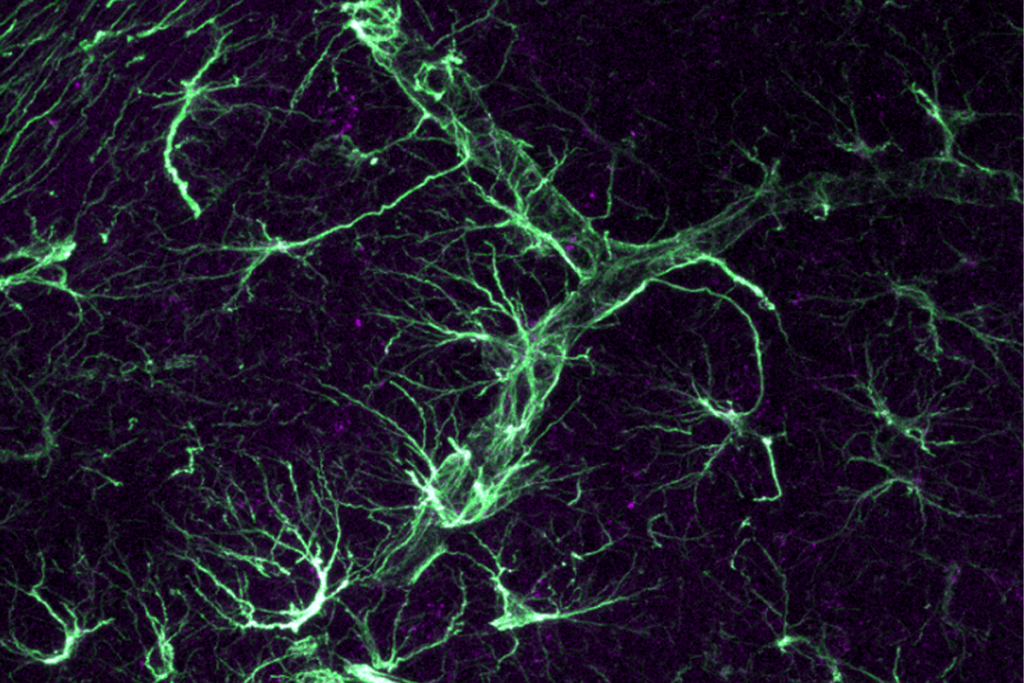
Astrocytes in mouse amygdala encode emotional state
The glial cells’ activity reliably tracks with freezing, hesitancy and other behaviors reminiscent of anxiety.
Astrocytes in mouse amygdala encode emotional state
The glial cells’ activity reliably tracks with freezing, hesitancy and other behaviors reminiscent of anxiety.