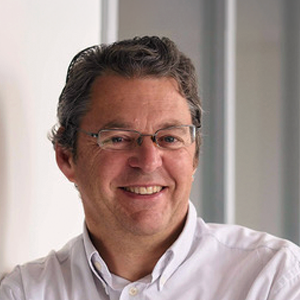
Christophe Bernard.

Christophe Bernard

Director of research
Institute of Systems Neuroscience

Christophe Bernard is director of research at the Institute of Systems Neuroscience, INSERM U1106. His main interest is to understand brain dynamics in health and disease, with a focus on epilepsy.

He acts as a reviewing editor for Science Advances, and formerly for Science and the Journal of Neuroscience. He created and is the editor-in-chief of eNeuro, the online open-access journal of the Society for Neuroscience. eNeuro is designed to serve and educate the neuroscience community, promoting reproducibility, publishing negative results and sensitizing scientists to open science and better data interpretation with a focus on statistics and experimental bias.

Bernard obtained his Ph.D. in neuroscience from Pierre and Marie Curie University, did his postdoctoral research at the University of Southampton and spent a sabbatical at Baylor College of Medicine. He participated in the development of organic technologies to record and control brain activity, which earned him the Felix Innovation Prize, and in the development of the Virtual Mouse Brain.
Explore more from The Transmitter

Neuroscientist Julieta Sztarker holds an open-air teach-in for the general public in Plaza Italia in Buenos Aires.

Funding crisis in Argentina sparks new wave of protests

Two years after the country’s research funding collapsed, scientists are demonstrating against the government’s failure to restore previously cut scholarships and increase salaries as required by a 2025 law.

By Claudia López Lloreda, Natalia Mesa
8 May 2026 | 4 min read
Conceptual image of disjointed communication.

‘Slightly unhinged’ federal autism meeting portends unclear research priorities

The meeting last week sparked concerns about the latest Interagency Autism Coordinating Committee’s ability to perform its core function: developing a strategy to support autism research.

By Daisy Yuhas
7 May 2026 | 5 min read

Ehud Ahissar offers a new kind of dualism for neuroscience

He explains how “perceptual dualism” can account for the way we communicate via digital symbols and perceive the world via analog brain processes.

By Paul Middlebrooks
6 May 2026 | 102 min listen