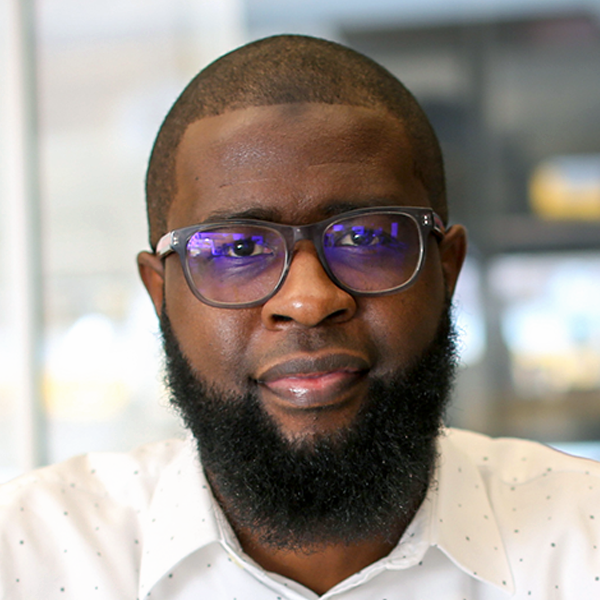
Ishmail Abdus-Saboor.

Ishmail Abdus-Saboor

Associate professor of biological sciences
Columbia University

Ishmail Abdus-Saboor is associate professor of biological sciences at Columbia University and principal investigator at Columbia’s Zuckerman Institute. He is also a Freeman Hrabowski Scholar at the Howard Hughes Medical Institute. 

Since opening his lab in 2018, he and his team have focused on how the nervous system encodes pain and social touch based on sensory stimuli applied to the skin. His lab uses both mice and naked mole-rats, integrating the peripheral and central nervous systems, seeking to uncover genes and neural circuits for somatosensation from the skin to the spinal cord and interconnected networks across the brain. The team is working to elucidate the “skin-brain axis”—taking a wholistic approach that combines high-resolution behavioral mapping, brain imaging and neural circuit manipulations. 

Abdus-Saboor earned his B.S. in animal science at North Carolina Agricultural and Technical State University and his Ph.D. in cell and molecular biology at the University of Pennsylvania.
Explore more from The Transmitter

Sex bias in autism drops as age at diagnosis rises

The disparity begins to level out after age 10, raising questions about why so many autistic girls go undiagnosed earlier in childhood.

By Helena Kudiabor
13 February 2026 | 4 min read
Research image of the mouse dentate gyrus.

Microglia implicated in infantile amnesia

The glial cells could explain the link between maternal immune activation and autism-like behaviors in mice.

By Lauren Schneider
12 February 2026 | 5 min read
Research image of myelinated axons.

Oligodendrocytes need mechanical cues to myelinate axons correctly

Without the mechanosensor TMEM63A, the cells cannot deposit the appropriate amount of insulation, according to a new study.

By Calli McMurray
11 February 2026 | 5 min read

privacy consent banner

Privacy Preference

We use cookies to provide you with the best online experience. By clicking “Accept All,” you help us understand how our site is used and enhance its performance. You can change your choice at any time. To learn more, please visit our Privacy Policy.