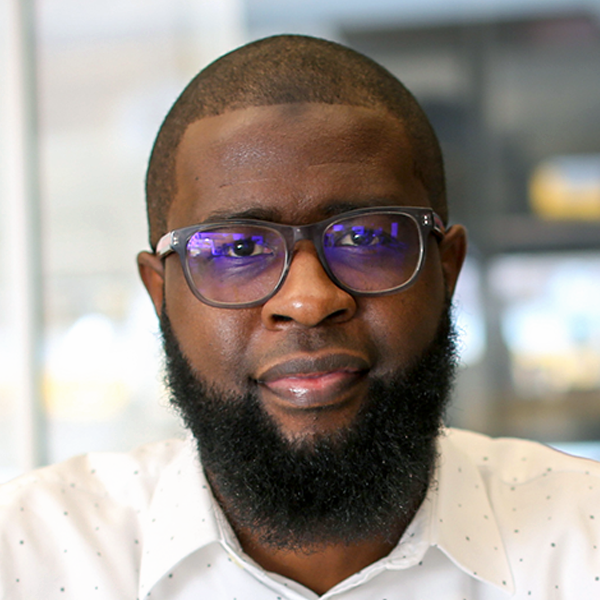
Ishmail Abdus-Saboor.

Ishmail Abdus-Saboor

Associate professor of biological sciences
Columbia University

Ishmail Abdus-Saboor is associate professor of biological sciences at Columbia University and principal investigator at Columbia’s Zuckerman Institute. He is also a Freeman Hrabowski Scholar at the Howard Hughes Medical Institute. 

Since opening his lab in 2018, he and his team have focused on how the nervous system encodes pain and social touch based on sensory stimuli applied to the skin. His lab uses both mice and naked mole-rats, integrating the peripheral and central nervous systems, seeking to uncover genes and neural circuits for somatosensation from the skin to the spinal cord and interconnected networks across the brain. The team is working to elucidate the “skin-brain axis”—taking a wholistic approach that combines high-resolution behavioral mapping, brain imaging and neural circuit manipulations. 

Abdus-Saboor earned his B.S. in animal science at North Carolina Agricultural and Technical State University and his Ph.D. in cell and molecular biology at the University of Pennsylvania.
Explore more from The Transmitter

Illustration of an open journal featuring lines of text and small illustrations of eyes and mouths.

Autism-linked genes alter sleep behavior, and more

Here is a roundup of autism-related news and research spotted around the web for the week of 13 April.

By Jill Adams
14 April 2026 | 2 min read
Illustration of a monkey pushing a button.

This paper changed my life: Erin Calipari ponders the nuances of rewarding and aversive stimuli

A 1960s study by Kelleher and Morse found that lever pressing in squirrel monkeys depended not on whether they received a reward or shock, but on the rules of the task. This taught Calipari to think deeply about factors that influence how behavior is generated and maintained.

By Erin Calipari
14 April 2026 | 5 min read
Illustration of a sheet of paper with a topography map-like pattern on it.

Why neural foundation models work, and what they might—and might not—teach us about the brain

These models can partly generalize across species, brain regions and tasks, suggesting that a set of machine-learnable rules govern neural population activity. But will we be able to understand them?

By Juan Gallego
13 April 2026 | 8 min read