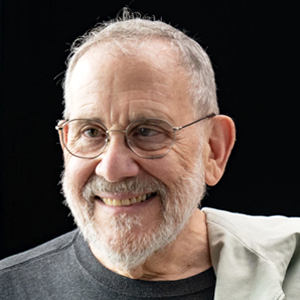
Headshot of Joshua Sanes.

Joshua R. Sanes

Professor emeritus of molecular and cellular biology, Harvard University;
Contributing editor, The Transmitter

Joshua Sanes is professor of molecular and cellular biology and founding director of the Center for Brain Science at Harvard University. He and his colleagues study the formation of synapses. They have also pioneered new ways to mark and manipulate neurons and the synapses they form.

For the past 20 years, Sanes and his team have focused on the retina, in which specific patterns of connections form the complex circuits that underlie the initial steps in visual perception. Most recently, they have extended this work to comprehensive classification of retinal cell types in multiple species, including humans. Sanes received a B.A. from Yale University and a Ph.D. from Harvard University. He served on the faculty of Washington University in St. Louis, Missouri, for more than 20 years before returning to Harvard in 2004.

He is a member of the National Academy of Sciences and the American Academy of Arts and Sciences. His work has been published in more than 400 papers, and he has been honored with the Schuetze Award, the Gruber Neuroscience Prize, the Cowan Award, the Perl-UNC Neuroscience Prize and the Edward M. Scolnick Prize in Neuroscience, as well as an honorary doctoral degree from Hebrew University in Jerusalem, Israel.

Explore more from The Transmitter

Brain organoid.

What is the future of organoid and assembloid regulation?

Four experts weigh in on how to establish ethical guardrails for research on the 3D neuron clusters as these models become ever more complex.

By Claudia López Lloreda
10 December 2025 | 7 min read
Research image of variants of the ATPase subunit PSMC5/RPT6.

Insights on suicidality and autism; and more

Here is a roundup of autism-related news and research spotted around the web for the week of 8 December.

By Jill Adams
9 December 2025 | 2 min read
A stack of papers topped by many paper shreddings against a red background.

Exclusive: Springer Nature retracts, removes nearly 40 publications that trained neural networks on ‘bonkers’ dataset

The dataset contains images of children’s faces downloaded from websites about autism, which sparked concerns at Springer Nature about consent and reliability.

By Calli McMurray
8 December 2025 | 5 min read

privacy consent banner

Privacy Preference

We use cookies to provide you with the best online experience. By clicking “Accept All,” you help us understand how our site is used and enhance its performance. You can change your choice at any time. To learn more, please visit our Privacy Policy.