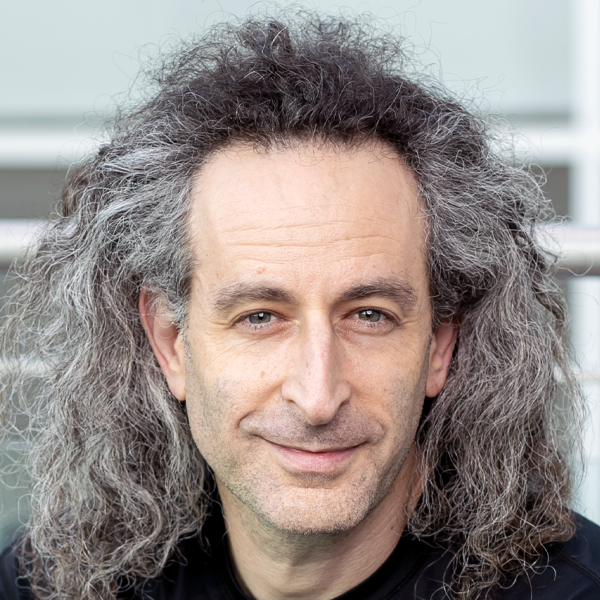
Xaq Pitkow.

Xaq Pitkow

Associate professor of computational neuroscience
Carnegie Mellon University

Xaq Pitkow is associate professor of computational neuroscience at Carnegie Mellon University. He is a computational neuroscientist who develops mathematical theories of the brain and general principles of intelligent systems. He focuses on how distributed nonlinear neural computation uses statistical algorithms to guide actions in naturalistic tasks. He develops novel analysis methods validated on synthetic agents and collaborates closely with experimentalists to test theories on real data.

Pitkow was trained in physics as an undergraduate student at Princeton University  and went on to study biophysics for his Ph.D. at Harvard University. He then took postdoctoral positions in the Center for Theoretical Neuroscience at Columbia University and in the Department of Brain and Cognitive Sciences at the University of Rochester. In 2013, he joined the faculty in the neuroscience department at Baylor College of Medicine, jointly appointed at Rice University in the Department of Electrical and Computer Engineering. After a decade there, he moved to Carnegie Mellon University, appointed in the Neuroscience Institute and the Department of Machine Learning by courtesy. He is currently associate director of the National Science Foundation’s AI Institute for Artificial and Natural Intelligence.
Explore more from The Transmitter

Illustration of an open journal featuring lines of text and small illustrations of eyes and mouths.

Autism-linked genes alter sleep behavior, and more

Here is a roundup of autism-related news and research spotted around the web for the week of 13 April.

By Jill Adams
14 April 2026 | 2 min read
Illustration of a monkey pushing a button.

This paper changed my life: Erin Calipari ponders the nuances of rewarding and aversive stimuli

A 1960s study by Kelleher and Morse found that lever pressing in squirrel monkeys depended not on whether they received a reward or shock, but on the rules of the task. This taught Calipari to think deeply about factors that influence how behavior is generated and maintained.

By Erin Calipari
14 April 2026 | 5 min read
Illustration of a sheet of paper with a topography map-like pattern on it.

Why neural foundation models work, and what they might—and might not—teach us about the brain

These models can partly generalize across species, brain regions and tasks, suggesting that a set of machine-learnable rules govern neural population activity. But will we be able to understand them?

By Juan Gallego
13 April 2026 | 8 min read