Listen to this story:
0:00
/
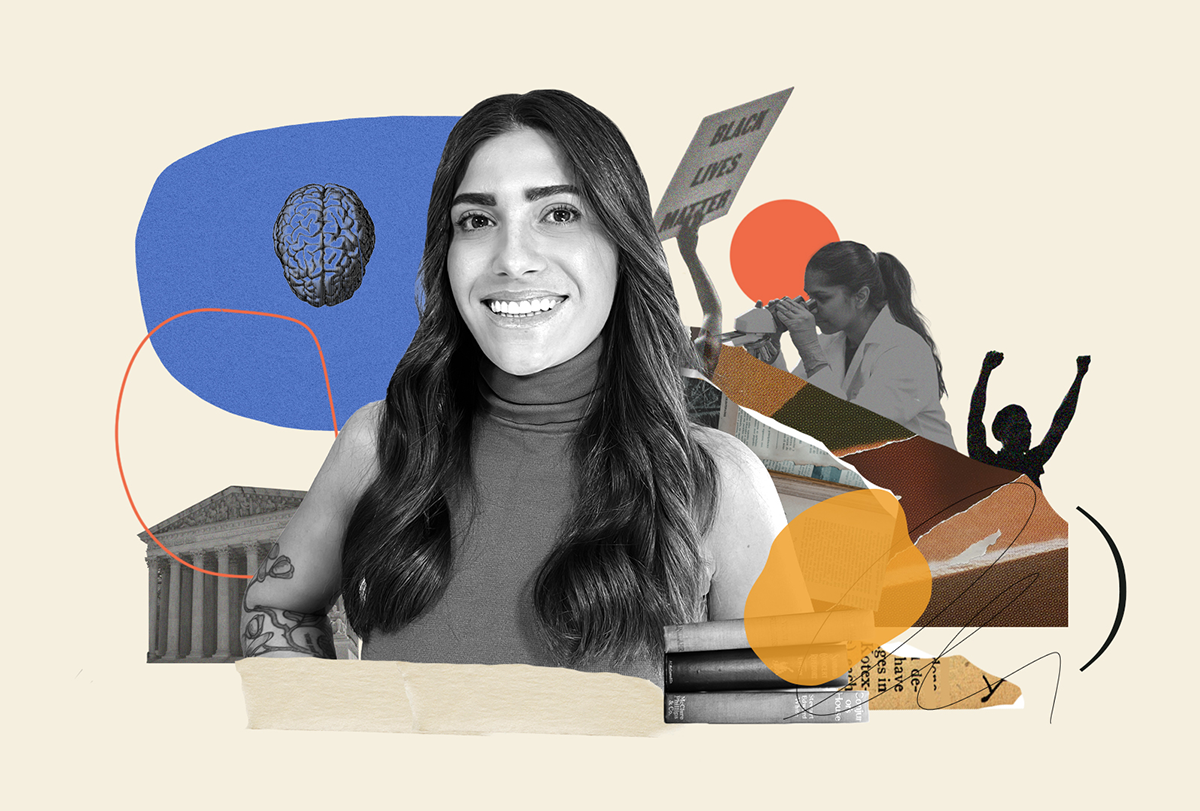
As a fellow at the Dana Foundation, she merged two familiar passions and discovered a new one: science philanthropy.
Mia Thomaidou developed a keen interest in the societal applications of science during her undergraduate studies in cognitive neuroscience. Two years into her Ph.D. in behavioral neuroscience, she decided to simultaneously pursue an M.Sc. in criminal justice, exploring the role of bias in judicial decision-making. “It felt less fulfilling to do the basic work in the lab than to ask, ‘How is this going to be used?’” she says.
Thomaidou sharpened her focus on the legal applications of brain research during a postdoctoral fellowship in criminal justice. Now, as a fellow in the Neuroscience & Society Frontiers Program at the Dana Foundation, she works to advance neuroscience initiatives in collaboration with the communities that stand to benefit. She spoke with The Transmitter about carving out an applied, interdisciplinary niche and her foray into science philanthropy.
This interview has been lightly edited for length and clarity.
The Transmitter: How did you go from neuroscience to criminal justice—and pursue two postgraduate degrees at once?
Mia Thomaidou: In clinical neuroscience, the science leads to new therapies—new approaches to diagnosing and treating conditions. But for behavioral neuroscience, the applications are less obvious. During my Ph.D., I was studying attentional biases in the context of pain. We wanted to know if the way you encode the world could lead you to experience pain differently, because pain is such a subjective thing. But what I really wanted to know was, “Is this going to reach anyone?”
It was 2020, and so much was happening in the world. There was a heightened awareness of how institutions navigate complex human behavior under uncertainty, and how scientific knowledge is interpreted and applied in real-world contexts. It made me curious about the role bias plays in the criminal justice system. I decided to do my master’s in criminal justice to dip my toes into that discipline. I don’t know that I would advise anyone to pursue interdisciplinary work in this way—a master’s at the same time as a Ph.D.—it’s just all I knew to do at the time. After finishing my Ph.D., I did a postdoc with my master’s supervisor. It wasn’t an interdisciplinary lab; it was a criminal justice lab interested in work that comes from neuroscience—how psychological processes can influence sentencing, for instance. I was the only neuroscientist in the lab, and I loved being able to bring that interdisciplinary perspective.
TT: Did you want to stay in academia?
MT: After my postdoc, I had a stack of publications both in neuroscience and criminal justice, but neither stack was big enough to get me a faculty position. And I was never really aiming to become a professor. I did a Ph.D. because I liked research, not necessarily to continue in academia. All my work involved data, so I figured my next job would be somewhere in industry, working with data.
At the time, the Dana Foundation was recruiting a new cohort of fellows. The foundation has an interest in interdisciplinary work, but also in communicating science to different communities—the public, for sure, but also courts and judges. The Dana Foundation had been funding projects such as the American Association for the Advancement of Science Judicial Seminars. I knew about these from my time in the criminal justice lab, so the fellowship felt like a perfect fit for me.
TT: What’s your role as a Dana Foundation fellow?
MT: All fellows come from an interdisciplinary background related to neuroscience. In my case, having come from neuroscience and criminal justice, I had planned on getting involved in that sort of work. But I also became very interested in the world of science philanthropy—how funders can stimulate and support novel research and spark collaborations between industries, organizations and disciplines or directly with communities.
In my first year, there was a focus on reading grant applications and listening to the program directors discuss them. I also helped organize events like panels or receptions. As an academic, I would show up to these events and never consider what kind of work goes into them. Now I get to be on the other side and see the interest a foundation has not only in attracting great projects and ideas, but also in connecting with other funders.
I also spend time analyzing data to inform our programmatic work. We might, for example, track attendance and collect feedback from an event we facilitated, or analyze application and award data to understand who applies, success rates and how funding is distributed across topics.
TT: What skills did you carry over from your Ph.D.?
MT: Program and project management is one skill set that definitely carries over. I was basically running programs through my Ph.D. and postdoc—managing the day-to-day operations and tracking how different projects were developing. I had my little project team—my colleagues and my supervisor. The nature and scope of the projects and programs in philanthropy are different, but the management skills are the same.
The other thing that carries over is the ability to ask the right questions. You need keep asking, “What’s important in this context? What’s important for this project?” Keep sourcing that knowledge.
TT: Will you stay in science philanthropy?
MT: The short answer is, I don’t know. I still have a lot to learn. My fellowship ends in December 2027, which will be three years. I’d like to spend the next year and a half pursuing a more specific direction within science philanthropy. You can go a very operational route or a strategic route. I’m figuring out which path is right for me based on my skills and what I like to do. One thing I loved about my Ph.D. was the hands-on work. When you’re designing a study, it feels like you’re engineering something, and I will say you get that same feeling when you work in philanthropic program evaluation.
TT: What’s your advice for Ph.D.s looking for their own niche outside academia?
MT: Do a fellowship. It’s a great way to explore a different field while keeping a foot in academia.