LISTEN TO THIS STORY:
0:00
/
A systematic review into whether the “rapid prompting method” or “spelling to communicate” can help autistic people express themselves comes up empty yet again.
Several variants of facilitated communication—techniques intended to help people with limited speech express themselves—have been growing in popularity among the parents of autistic people in recent years. But a forthcoming analysis has found no convincing evidence these methods help autistic people communicate their thoughts.
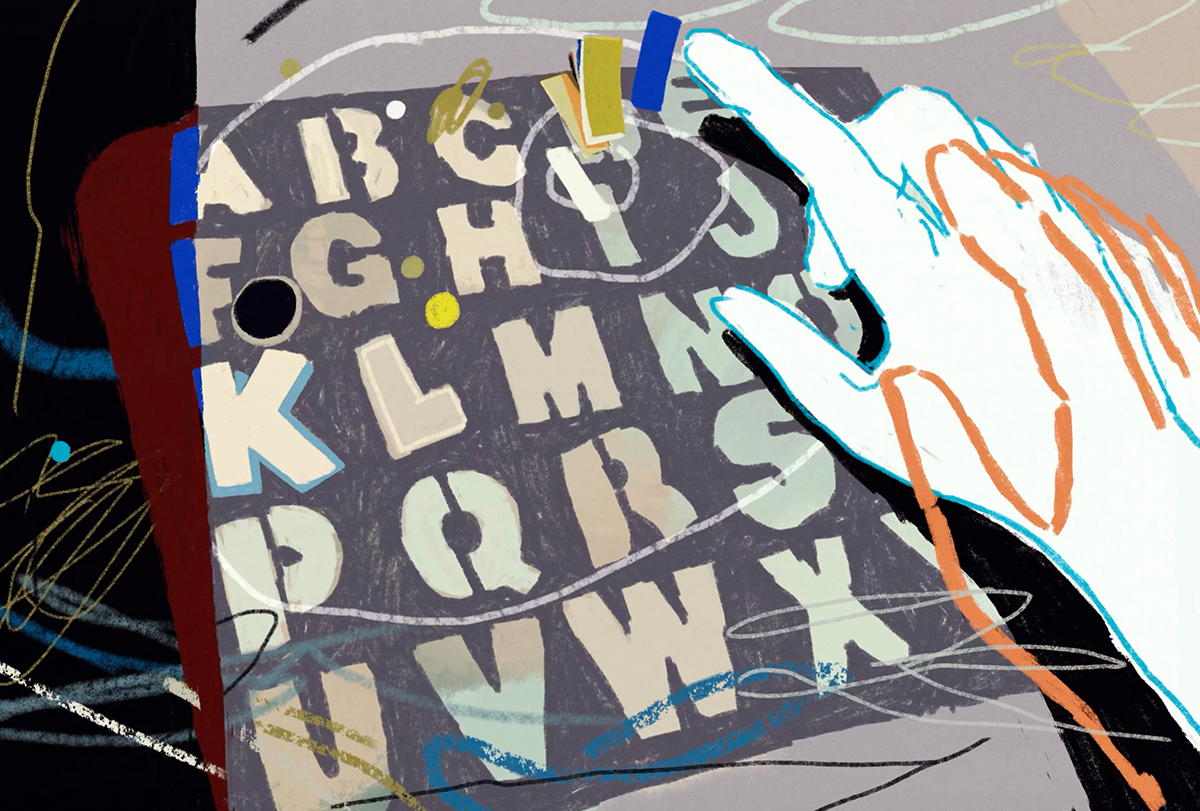
Using these methods, which are marketed as the “rapid prompting method” or “spelling to communicate,” a facilitator—often a parent—holds a letter board or an electronic tablet and uses verbal prompts or gestures to encourage the autistic person to spell out words with their fingers.
Proponents of these methods tout their ability to reveal hidden linguistic and intellectual capabilities in spellers who may only speak a handful of words out loud. In April, “Upward Bound,” a book purportedly written by Woody Brown, an autistic man whose mother helps him communicate via a letter board, became a New York Times bestseller after Brown and his mother appeared on “The Today Show.” One popular podcast even claims that spellers have telepathic abilities.
Ralf Schlosser, an augmentative-communication expert at Northeastern University and one of the investigators on the new study, says that the burden of proof is on the advocates of these methods to demonstrate that messages are authored by the autistic person and not by the facilitator.
“They’re celebrating miracles with these methods,” Schlosser says. “We felt that there was a need to see if there was any direct authorship testing.”
One such test is simple: Give the autistic person an image that the facilitator cannot access, and evaluate whether the facilitator can help the autistic person to spell out what they see. Earlier forms of facilitated communication, which involved the facilitator physically guiding the autistic person’s hand, failed such message-passing tests in the 1990s.
In 2017, Schlosser and his colleagues scoured the literature to determine how and if anyone had used the message-passing test to demonstrate authorship in these newer methods. Of 108 studies that mentioned the rapid prompting method, none tested validity this way. His new review found 5,856 published studies that mention rapid prompting or its variants, but none adequately tested the authorship question under Schlosser’s inclusion criteria.
T
The proponents “are not interested in having people objectively evaluate their methods—specifically, who is responsible for the messaging,” says Helen Tager-Flusberg, director of the Center for Autism Research Excellence at Boston University.
But the real problem with the review, says Vikram Jaswal, professor of psychology at the University of Virginia, is that its inclusion criteria were too narrow and biased.
“This scholarship by self-reference to nonempirical, often non-peer-reviewed material does not strike me as a form of serious academic engagement,” he wrote in an email. “Other methodologies that are standard in contemporary communication science, psycholinguistics, and neuroscience (e.g., eyetracking, movement analyses, stylistic analyses) were excluded.”
Schlosser says he and his colleagues decided to repeat their systematic review because, in the seven years since the previous review was published, facilitated-communication methods have been flourishing, and the body of research around them has been growing.
More than 20 advocacy groups around the world now promote these methods, and more than 100 clinics and schools teach them, according to the website facilitatedcommunication.org. Many of these groups, clinics and schools were established in the past few years.
In January, U.S. Health and Human Services Secretary Robert F. Kennedy Jr. appointed several advocates of facilitated-communication methods, including two nonspeakers, to the Interagency Autism Coordinating Committee.
In public forums and administrative hearings proponents have held up several recent studies as evidence in support of these methods.
Most notably, Jaswal published a contentious eye-tracking study in 2020 that he says demonstrates that participants “were spelling their own thoughts.” He has also argued on the basis of other evidence that letter-board users can develop “foundational literacy skills.”
Jaswal’s recent work has pushed the field forward, says John Damaio, associate professor of occupational therapy at Pace University who is working on his own systematic review related to these methods. “I don’t know why that’s not seen as proving authorship alone.”
B
A message-passing study was slated for publication in the Journal of Autism and Developmental Disorders in 2018 but was withdrawn after a woman, who served as the facilitator for her minimally verbal son, revoked her consent because she claimed her identity had been compromised. The problem was that she had told others in the community that she was participating in the study, which originally aimed to recruit multiple participants, but it was now being published as a case study.
According to an abstract of that study still available on a preprint server, the researchers conducted both blinded and unblinded tests and found no evidence of authentic communication.
Advocates for spellers argue that message-passing tests are unethical, and that the tests generate anxiety, making the spellers more likely to fail.
“More message passing studies are not what we have in mind,” Jaswal and his co-authors wrote in an invited commentary published in January in Autism Research. “Nor do we believe it would be appropriate at this stage to conduct a randomized control trial.”
David Amaral, distinguished professor of psychiatry and behavioral sciences at the University of California, Davis MIND Institute and the journal editor who had solicited Jaswal’s commentary, says that he believes that the debate around facilitated communication has become too polarized and too dogmatic.
A subset of autistic people may benefit from facilitated communication, he says, particularly those who go on to become independent spellers. He would like to see a variety of methods applied to identify this group, he adds.
“Message passing is a very reasonable strategy for trying to validate the independence of communication by a nonverbal person,” he says. “It has to be done with a large enough population of participants that you can begin to see that it works for some people and doesn’t work for others.”