LISTEN TO THIS STORY:
0:00
/
A group of employees has launched a series of campaigns to advocate for their work and argue against the center’s potential transition to an animal sanctuary.
Researchers at a national primate center in Oregon have formed a grassroots nonprofit coalition to argue against the center becoming an animal sanctuary, a transition the facility’s host university has been exploring since February. The group, Oregon Voices for Biomedical Research, launched its first campaign at the end of April.
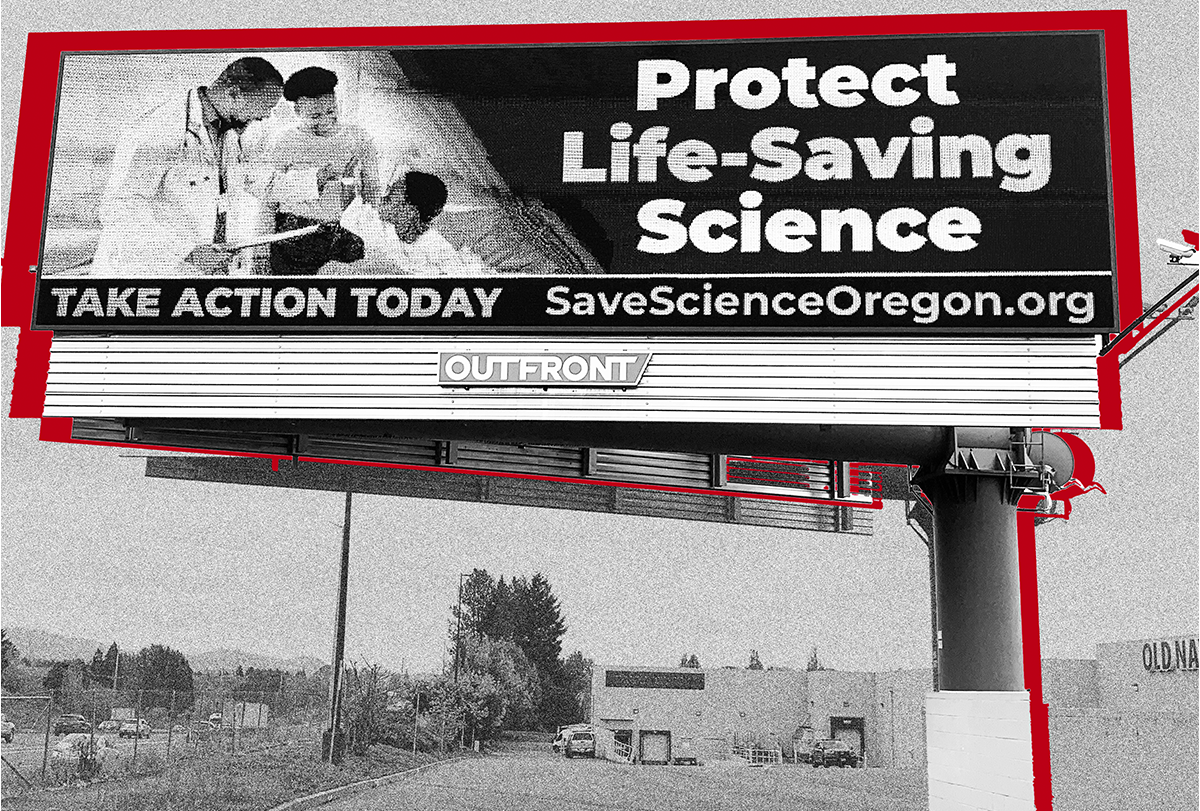
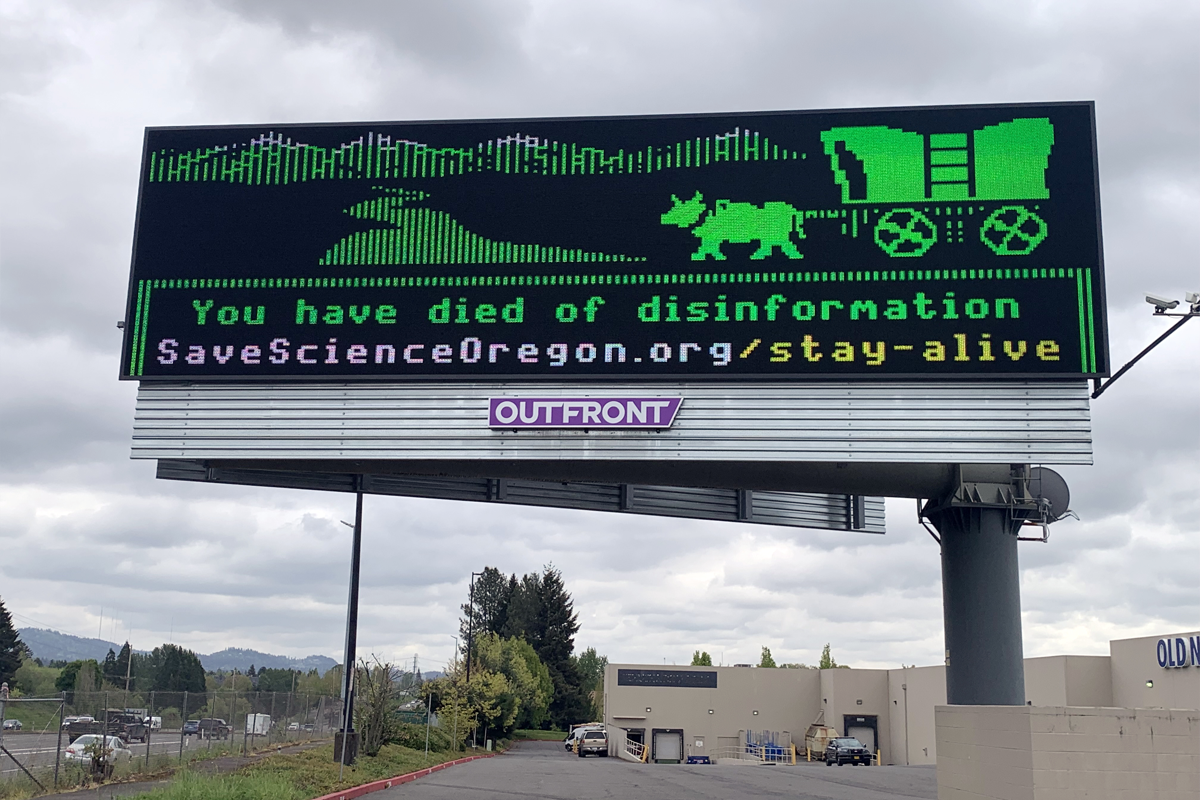
The campaign includes ads on two billboards in Beaverton and 51 buses in Portland—as well as social media posts—that direct viewers to visit a website with information about the Oregon National Primate Research Center (ONPRC) and the research conducted there.
The website outlines the research that could end if the center is shuttered, including projects on fetal brain development, endometriosis, pediatric anesthesia and gene therapy for inherited blindness. The site also includes a form letter visitors can email to state representatives and other leaders to advocate for keeping the center operating as a research facility.
Oregon Voices for Biomedical Research wanted to “create a space where we could educate people, provide materials that were based in facts” and have conversations about the ethically complex issue of nonhuman primate research, says Rachael Wolters, research assistant professor of pathobiology and immunology at the ONPRC and co-organizer of the group. Wolters studies pediatric infectious diseases and how neuroinflammation caused by HIV affects cognitive development. Macaque monkeys are the best model for this work, Wolters says, because their developmental timeline mirrors that of people.
The future of the center is currently being ironed out between Oregon Health & Science University (OHSU), which hosts the center, and the U.S. National Institutes of Health (NIH). The NIH funds seven national primate centers that conduct research, run breeding colonies and serve as a resource for investigators at other institutions; the Oregon center receives the largest base grant of $13.7 million.
The NIH previously approached OHSU about converting the center into an animal sanctuary and winding down research there; in February, the university voted to enter negotiations over this potential change. The approved vote grants the negotiators a six-month period, ending in August, to work out a deal.
The move follows the decision to phase out all monkey research at the U.S. Centers for Disease Control and Prevention, as reported in November 2025 by Science. The agency has since proposed to relocate hundreds of its monkeys to a sanctuary in Texas.
An OHSU representative declined to grant The Transmitter an interview about the sanctuary negotiations and the Oregon Voices group. “Negotiations with NIH are ongoing, deliberative and confidential. No final agreement has yet been reached,” the representative said in an email.
Until then, primate center staff are stuck in limbo.
“We’ve been spending a lot of mental energy planning the plan B’s, because we’re scientists; we’re not gonna just wait and see what happens. We have to know,” says Aqilah McCane, assistant professor of neuroscience at the ONPRC. McCane studies how alcohol exposure during adolescence affects brain development.
T
This uncertainty has made it difficult to stay productive and to set up collaborations, says Christopher D. Kroenke, professor of neuroscience at the ONPRC and Advanced Imaging Research Center. Kroenke studies fetal brain development using MRI.
Hearing from colleagues who feel the need to “plan for the worst” makes you “wonder if your colleague will be around next year,” Kroenke says. “Even if you come up with your own plan, it just sort of cascades.”
Potential graduate students who are drawn to OHSU because of the chance to collaborate with the primate center have also asked about its future, Kroenke says. “It was very challenging to answer those questions.”
Both Wolters and McCane say they turned down other job offers in order to start their labs at the primate center a few years ago. Now they are wondering if they should try to revisit those opportunities.
“Normally, a junior faculty would just need to focus on writing grants and publishing papers, and instead, I’m fighting for the right to still be a scientist,” Wolters says.
T
“It was a gut punch to pretty much everybody there, because we all strongly believe that the work that we do benefits the public health of America,” says Andrew Sylwester, senior staff scientist at OHSU’s Vaccine and Gene Therapy Institute, which collaborates closely with the primate center. Sylwester studies AIDS and began using nonhuman primates in his work in 2002 after observing that in-vitro work did not adequately model the disease.
During the meeting, the people around Sylwester were asking one another what they could do about the vote, he says. “And I, at one point, just blurted out that I would get a billboard.”
Last year, the Physicians Committee for Responsible Medicine, a nonprofit group that advocates for animal-free research, paid for a series of billboards and TV advertisements criticizing the center. The center’s staff had an “emotional need” to respond, Sylwester says. “I figured I can make that happen.”
Sylwester put together a GoFundMe page and soon raised more than $40,000 for the effort. A group of scientists, veterinarians and other primate center staff began meeting to plan how to use the funds and eventually became Oregon Voices for Biomedical Research. “It was quite grassroots and organic,” Wolters says.
The ads the group created are on two of the billboards the Physicians Committee for Responsible Medicine used during their campaign, Sylwester says.
For the first few months, navigating the uncertainty of the sanctuary negotiations was “a low point” and “felt impossible,” Wolters says. But Oregon Voices for Biomedical Research has become “an outlet for all of that frustration, because it felt like there was something that we could do. And I do feel very empowered right now.”
The Oregon Health & Science University employees quoted in this story say the views they express are their own and do not represent the stance of the university.