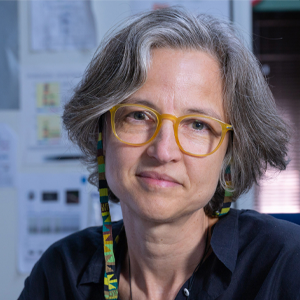
Liset M. de la Prida is professor and leader of the Laboratory of Neural Circuits at Instituto Cajal. The main goal of her lab is to understand how the dynamics of hippocampal microcircuits support memory function in health and disease across species, including the human brain. She is a leading expert in the study of physiological and pathological brain oscillations, with experience in developing groundbreaking neurotechnologies and the application of computational and machine-learning tools to analyze brain activity.
She has held visiting positions in the laboratories of David Brown and Michael Hausser at University College London, Leon Lagnado at the Medical Research Council, and Steven J. Schiff at the Krasnow Institute, which have equipped her with a multidisciplinary background and expertise to study brain function.
After her postdoctoral training with Richard Miles at the ICM Brain & Spine Institute in Paris, de la Prida became group leader at the Instituto Cajal in 2008 and full research professor in 2021.
She has participated in scientific advisory boards and evaluation committees at several institutions, including C-BRAINS in Paris and NERF-IMEC in Leuven. She has served as scientific editor for specialized journals such as the Journal of Neuroscience Methods, Hippocampus, Journal of Neuroscience, eLife and eNeuro. She has commissioning duties in the American Epilepsy Society (workgroups on behavior and networks), the Spanish Societies of Epilepsy (coordinator of the science group from 2014 to 2018), Neuroscience (executive board member from 2011 to 2015), and FENS (program committee member for FENS 2022 and chair of the program committee for FENS 2024).