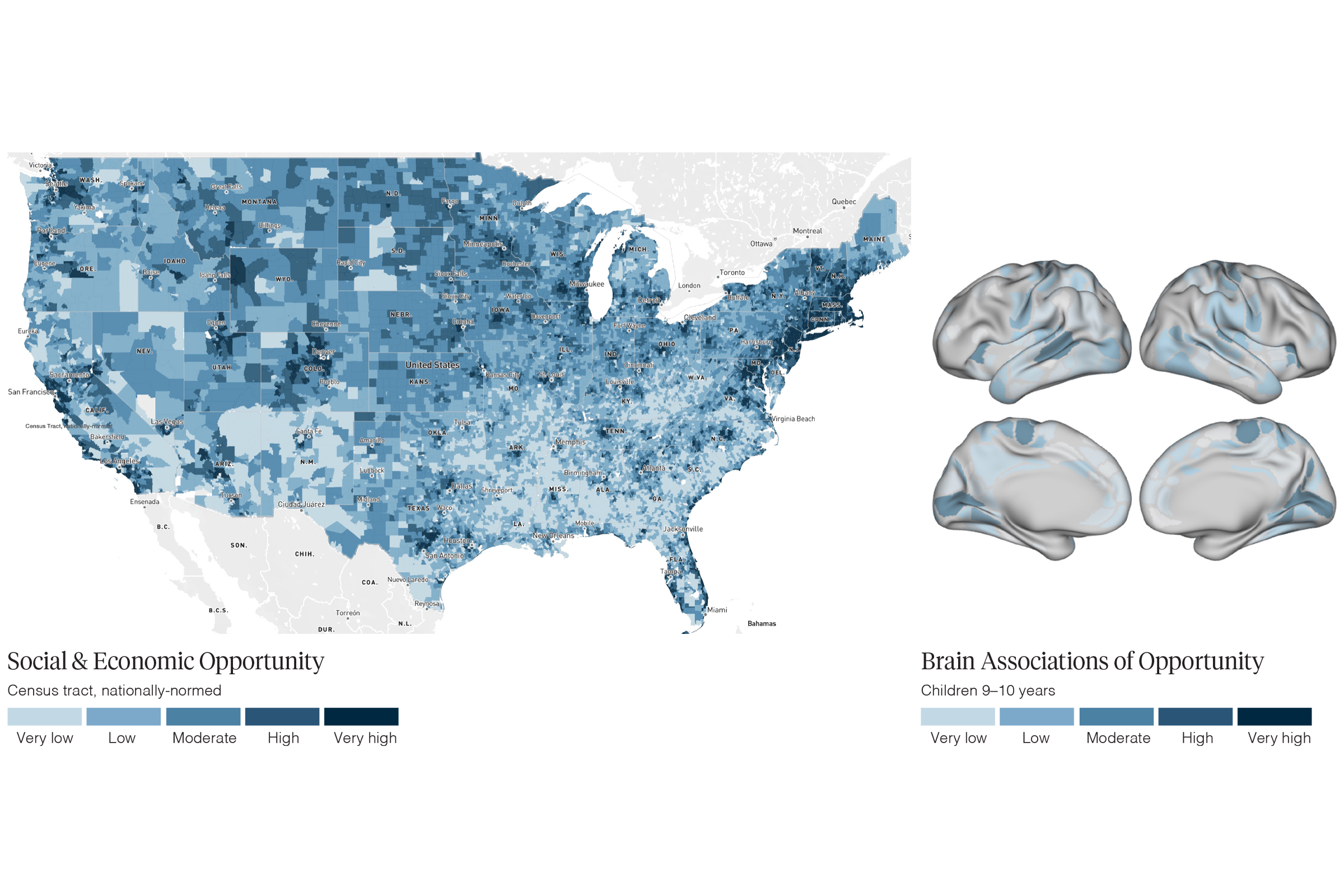
IQ is one of the most-studied traits in brain imaging studies. And yet it has a weaker relationship with brain structure and function in children than socioeconomic status does, according to a study published today in Science.
The apparent link between IQ and brain differences largely disappears once socioeconomic status is controlled for, the findings suggest. The results point to the importance of factoring in socioeconomic status in analyses of brain imaging datasets, the researchers say.
“If you’re not properly taking into account [socioeconomic status]” in brain imaging experiments, “you’re going to fool yourself,” says study investigator Nico Dosenbach, professor of neurology at Washington University in St. Louis.
Dosenbach and his colleagues analyzed MRI scans and behavioral data from roughly 12,000 children aged 9 to 10 in the Adolescent Brain Cognitive Development (ABCD) Study, looking for correlations between measures of brain structure and function and 649 psychological, health, social and environmental factors. Socioeconomic variables—such as household income and where the child lives—were the most strongly associated with functional connectivity and cortical thickness.
Differences in socioeconomics account for 16 percent of the variance in functional connectivity across the participants, the study found, which is among “the largest effects that are seen in these kinds of studies,” says Russ Poldrack, professor of psychology at Stanford University, who was not involved in the study. Socioeconomic status accounted for roughly 13 percent of the variance in cortical thickness. Sleep and screen time are also strongly linked to these brain features, although not as strongly as socioeconomics.
The findings have implications for how researchers approach and interpret future work, Poldrack says. “One has to think really deeply about the confounds that could be present. We can’t just compute correlations and assume they mean what we think they mean.”
M
In the new work, the team trained machine-learning models to predict IQ from brain scans. When trained on the full ABCD dataset, the models accurately predicted IQ, but they failed to do so when trained solely on data from children from high socioeconomic backgrounds. Models trained on children from lower socioeconomic backgrounds predicted IQ just as well as models trained on the full sample, the study shows.
The same models predicted a child’s socioeconomic status better than their IQ even if they were initially trained only to predict IQ from brain scans. This result indicates that the models were detecting the brain signature of socioeconomic status and mistaking it for IQ, Marek says.
“The fact that they were able to build predictive models based on [socioeconomic status (SES)] is mind-boggling,” says Beatriz Luna, professor of psychiatry and pediatrics at the University of Pittsburgh, who was not involved in the study. “We had an intuition that SES is going to have an effect,” but the strength of the effect is surprising, she says.
Socioeconomic status is strongly linked to sensory and motor cortices rather than the frontoparietal regions, which are associated with higher-order cognition, Dosenbach says. Those sensory and motor regions are also responsive to arousal states, including sleep deprivation and stress, previous studies show, suggesting that these changes in the brain may reflect how children adapt to their environments. Poldrack says he observed similar effects when he scanned his own brain hundreds of times over a year. The biggest changes in functional connectivity appeared in sensory and motor regions, and they tracked with whether he was caffeinated.
The new work cannot directly prove that socioeconomic status or other variables cause differences in brain function, the researchers say. But the findings serve as a “sign post” to guide future mechanistic studies, Marek says.
Poldrack says the paper “raises as many questions as it answers.” One open question concerns whether the associations between socioeconomic status and brain shape and function reflect an immediate physiological state or longer-term developmental effects. The fact that socioeconomic status correlates more strongly with functional connectivity, which changes over time, than with cortical thickness, which is more stable throughout life, hints that some of what the study detects may be closer to a transient state, Poldrack says.
Marek says that in future work, he plans to trace when the link between socioeconomics and brain function first emerges during life. Some studies have detected measurable associations between socioeconomic status and brain structure as early as birth to age 2. “Getting to the bottom [of] when [the association] emerges and what that means for outcomes for kids’ brain health as they go on throughout their lives needs to be explored. Especially as a society that does have the level of inequality that ours currently does,” Marek says.