Depression
Recent articles

Psychedelics research in rodents has a behavior problem
Simple behavioral assays—originally validated as drug-screening tools—fall short in studies that aim to unpack the psychedelic mechanism of action, so some behavioral neuroscientists are developing more nuanced tasks.
Psychedelics research in rodents has a behavior problem
Simple behavioral assays—originally validated as drug-screening tools—fall short in studies that aim to unpack the psychedelic mechanism of action, so some behavioral neuroscientists are developing more nuanced tasks.
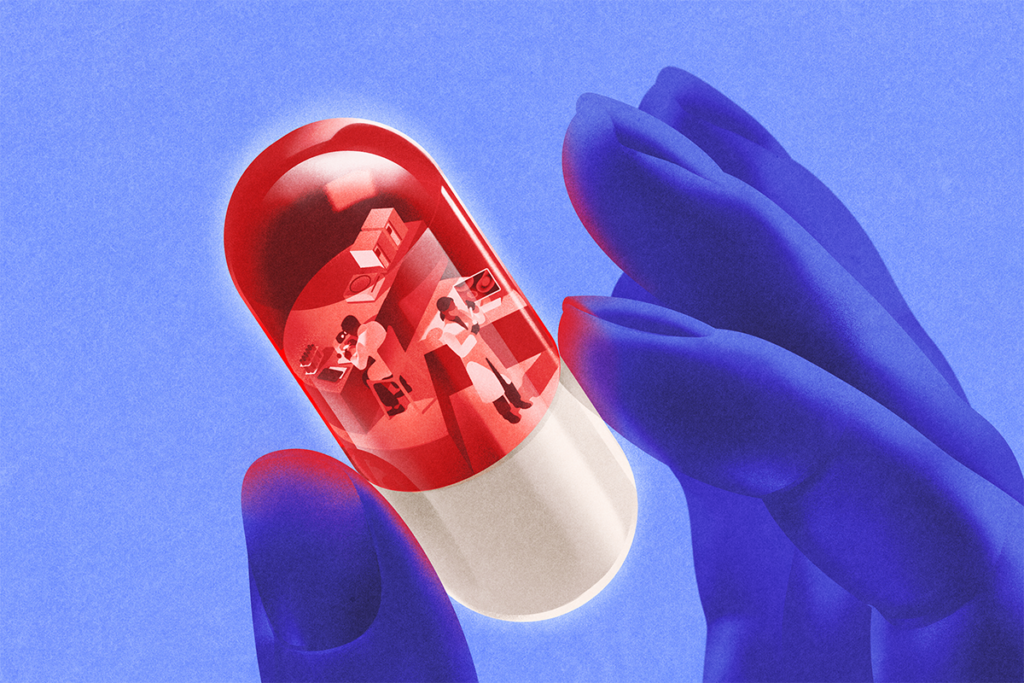
How basic neuroscience has paved the path to new drugs
A growing list of medications—such as zuranolone for postpartum depression, suzetrigine for pain, and the gepants class of migraine medicines—exist because of insights from basic research.
How basic neuroscience has paved the path to new drugs
A growing list of medications—such as zuranolone for postpartum depression, suzetrigine for pain, and the gepants class of migraine medicines—exist because of insights from basic research.

What are the most-cited neuroscience papers from the past 30 years?
Highly cited papers reflect the surge in artificial-intelligence research in the field and other technical advances, plus prizewinning work on analgesics, the fusiform face area and ion channels.
What are the most-cited neuroscience papers from the past 30 years?
Highly cited papers reflect the surge in artificial-intelligence research in the field and other technical advances, plus prizewinning work on analgesics, the fusiform face area and ion channels.
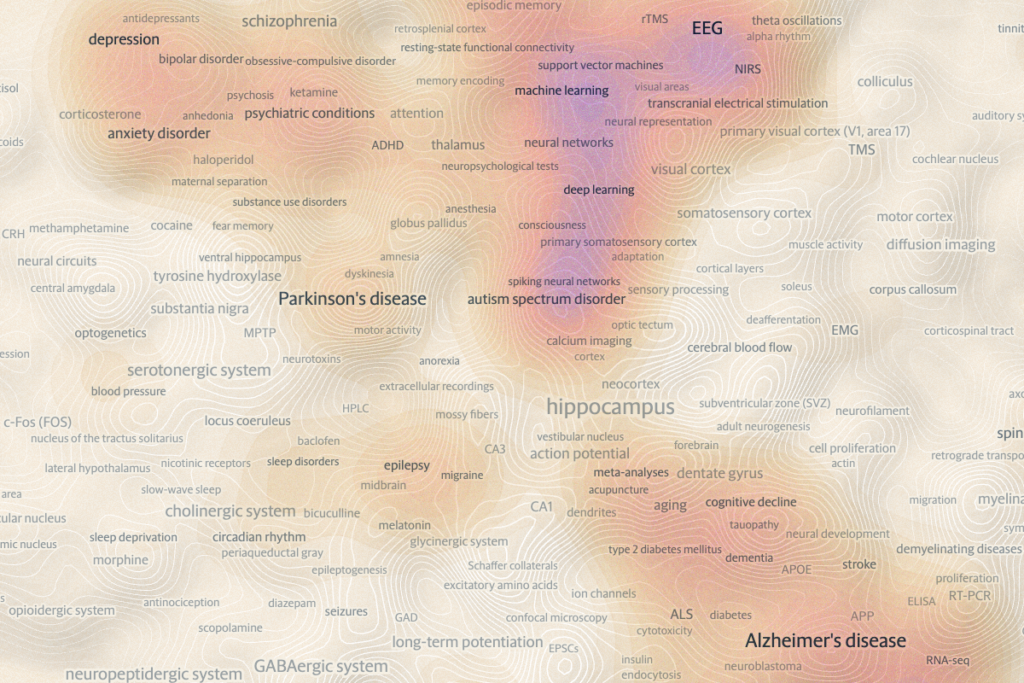
Putting 50 years of neuroscience on the map
Navigate the rise and fall of research topics over five decades using our interactive map, which is based on a semantic analysis of nearly 350,000 abstracts in leading neuroscience journals.
Putting 50 years of neuroscience on the map
Navigate the rise and fall of research topics over five decades using our interactive map, which is based on a semantic analysis of nearly 350,000 abstracts in leading neuroscience journals.
Perimenopause: An important—and understudied—transition for the brain
Many well-known perimenopause symptoms arise in the brain, but we still know little about the specific mechanisms at play. More research—in both animals and humans—is essential.
Perimenopause: An important—and understudied—transition for the brain
Many well-known perimenopause symptoms arise in the brain, but we still know little about the specific mechanisms at play. More research—in both animals and humans—is essential.
Why we need basic science to better understand the neurobiology of psychedelics
Despite the many psychedelics clinical trials underway, there is still much we don’t know about how these drugs work. Preclinical studies represent our best viable avenue to answer these lingering questions.
Why we need basic science to better understand the neurobiology of psychedelics
Despite the many psychedelics clinical trials underway, there is still much we don’t know about how these drugs work. Preclinical studies represent our best viable avenue to answer these lingering questions.
Emotion research has a communication conundrum
In 2025, the words we use to describe emotions matter, but their definitions are controversial. Here, I unpack the different positions in this space and the rationales behind them—and I invite 13 experts to chime in.
Emotion research has a communication conundrum
In 2025, the words we use to describe emotions matter, but their definitions are controversial. Here, I unpack the different positions in this space and the rationales behind them—and I invite 13 experts to chime in.
Chris Rozell explains how brain stimulation and AI are helping to treat mental disorders
Rozell and his colleagues, using deep brain stimulation and explainable artificial intelligence, have developed tools to help people with treatment-resistant depression.
Chris Rozell explains how brain stimulation and AI are helping to treat mental disorders
Rozell and his colleagues, using deep brain stimulation and explainable artificial intelligence, have developed tools to help people with treatment-resistant depression.
‘Elusive Cures: Why Neuroscience Hasn’t Solved Brain Disorders—and How We Can Change That,’ an excerpt
In her new book, published today, neuroscientist Nicole Rust takes us on her personal quest to spell out the brain research community’s “Grand Plan.”
‘Elusive Cures: Why Neuroscience Hasn’t Solved Brain Disorders—and How We Can Change That,’ an excerpt
In her new book, published today, neuroscientist Nicole Rust takes us on her personal quest to spell out the brain research community’s “Grand Plan.”
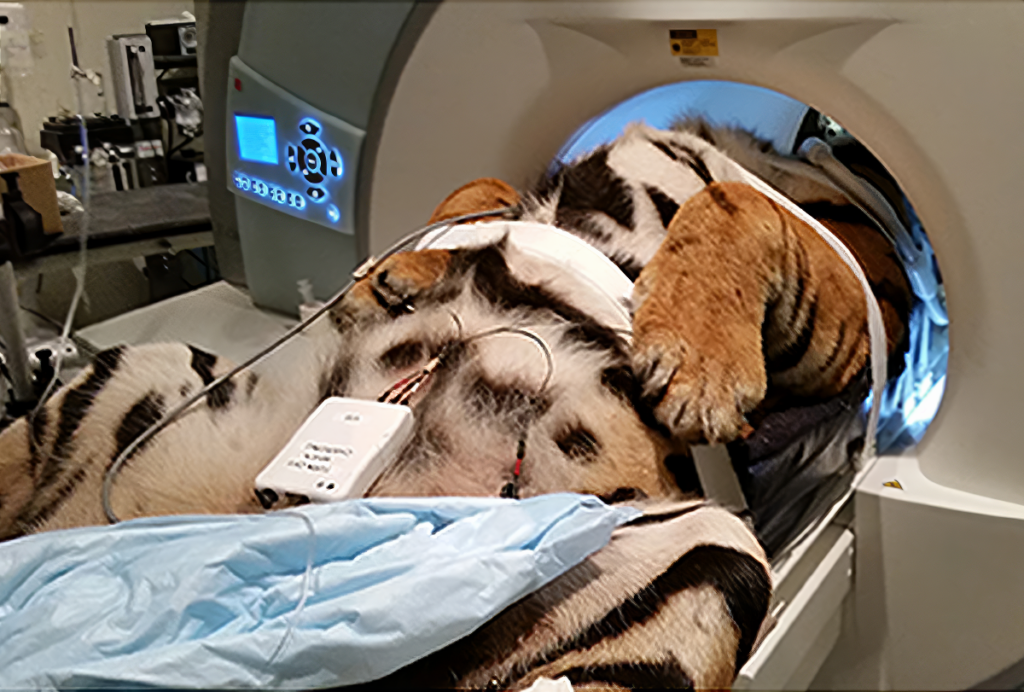
Lions and tigers and bears: Long-lived zoo animals offer a promising venue to study mental health and neurodegenerative disorders
These animals’ lifestyles often mirror those of people, making them a more relevant milieu than lab mice for determining how environmental factors influence mental health and cognitive decline. Studying them could improve animal welfare in the process.
Lions and tigers and bears: Long-lived zoo animals offer a promising venue to study mental health and neurodegenerative disorders
These animals’ lifestyles often mirror those of people, making them a more relevant milieu than lab mice for determining how environmental factors influence mental health and cognitive decline. Studying them could improve animal welfare in the process.
Explore more from The Transmitter
Error equation predicts brain’s ability to generalize
Four statistical measurements of neural network geometry capture how well brains and artificial networks use what they already know to solve new problems, a study suggests.
Error equation predicts brain’s ability to generalize
Four statistical measurements of neural network geometry capture how well brains and artificial networks use what they already know to solve new problems, a study suggests.

Embrace complexity to improve the translatability of basic neuroscience
Researchers must learn to view heterogeneity as an essential feature of the systems they study and a central consideration in experimental design, not a variable to control for or reduce.
Embrace complexity to improve the translatability of basic neuroscience
Researchers must learn to view heterogeneity as an essential feature of the systems they study and a central consideration in experimental design, not a variable to control for or reduce.
Romain Brette reveals fundamental flaws in commonly assumed neuroscience concepts
His new book, “The Brain, In Theory,” offers alternatives to many of the computer science frameworks currently driving theoretical neuroscience.
Romain Brette reveals fundamental flaws in commonly assumed neuroscience concepts
His new book, “The Brain, In Theory,” offers alternatives to many of the computer science frameworks currently driving theoretical neuroscience.