Two-photon
Recent articles

What are the most transformative neuroscience tools and technologies developed in the past five years?
Artificial intelligence and deep-learning methods featured prominently in the survey responses, followed by genetic tools to control circuits, advanced neuroimaging, transcriptomics and various approaches to record brain activity and behavior.
What are the most transformative neuroscience tools and technologies developed in the past five years?
Artificial intelligence and deep-learning methods featured prominently in the survey responses, followed by genetic tools to control circuits, advanced neuroimaging, transcriptomics and various approaches to record brain activity and behavior.

Sounding the alarm on pseudoreplication: Q&A with Constantinos Eleftheriou and Peter Kind
Most studies of neurological disorders in mice erroneously treat multiple samples from a single animal as independent replicates, according to a new analysis. But scientists and journals can take steps to curb this practice.
Sounding the alarm on pseudoreplication: Q&A with Constantinos Eleftheriou and Peter Kind
Most studies of neurological disorders in mice erroneously treat multiple samples from a single animal as independent replicates, according to a new analysis. But scientists and journals can take steps to curb this practice.
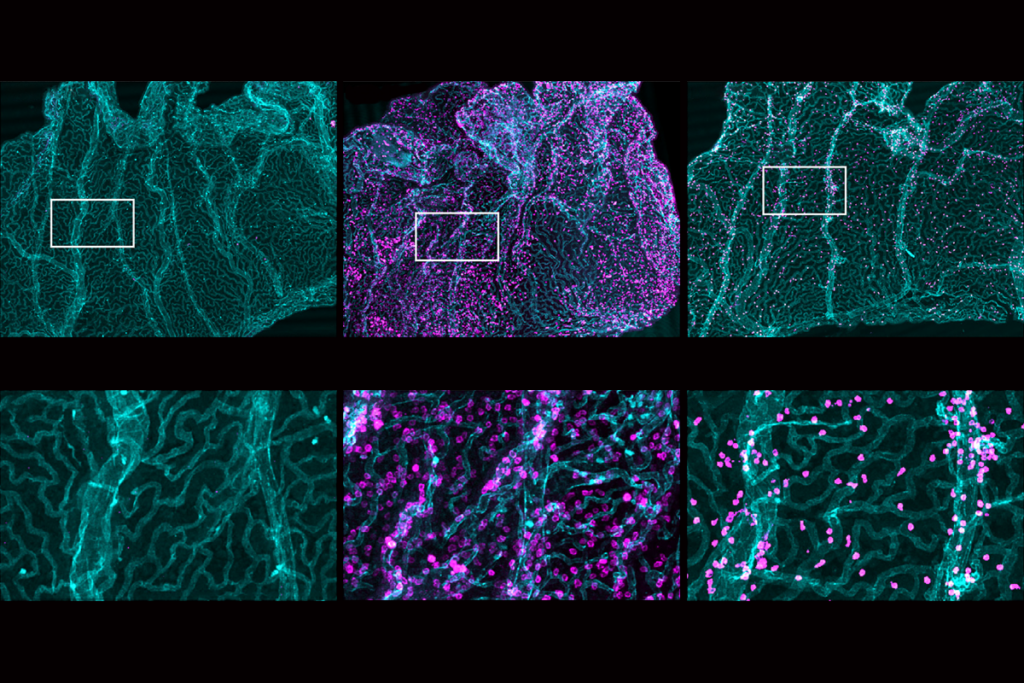
Immune cell interlopers breach—and repair—brain barrier in mice
The choroid plexus, the protective network of blood vessels and epithelial cells that line the brain’s ventricles, recruits neutrophils and macrophages during inflammation, a new study shows.
Immune cell interlopers breach—and repair—brain barrier in mice
The choroid plexus, the protective network of blood vessels and epithelial cells that line the brain’s ventricles, recruits neutrophils and macrophages during inflammation, a new study shows.
New tissue-clearing techniques let microscopes peer deeper into living brains
Washing mouse brain tissue with a blood protein or complex sugar can illuminate cells 550 micrometers into the cortex without compromising its normal physiology.
New tissue-clearing techniques let microscopes peer deeper into living brains
Washing mouse brain tissue with a blood protein or complex sugar can illuminate cells 550 micrometers into the cortex without compromising its normal physiology.
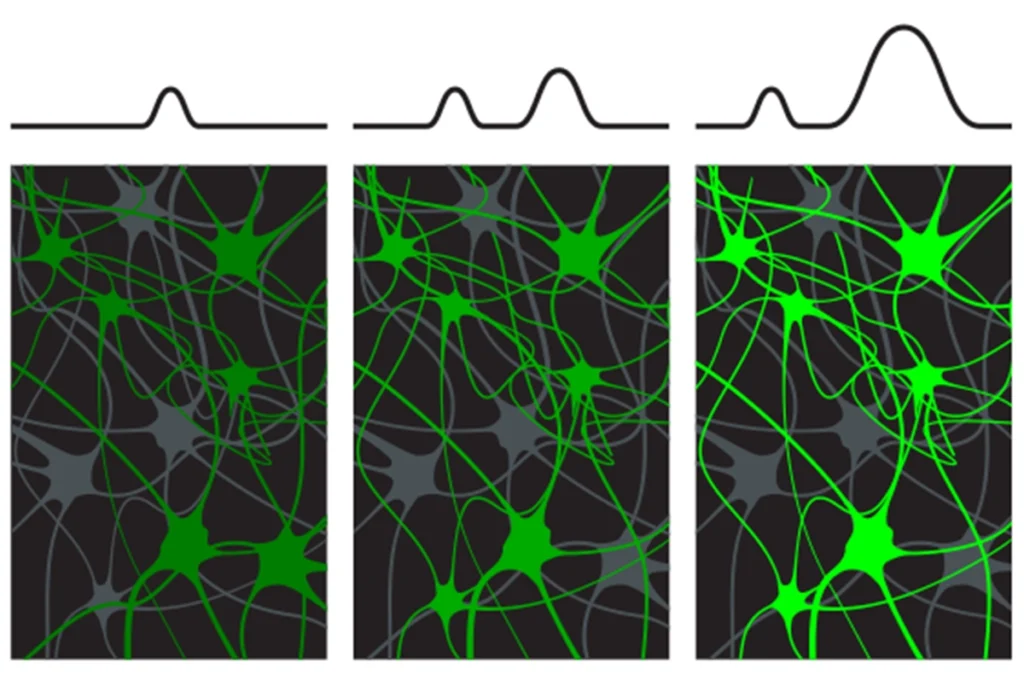
Cocaine, morphine commandeer neurons normally activated by food, water in mice
Confirming a long-held hypothesis, repeated exposure to the drugs alters neurons in the nucleus accumbens, the brain’s reward center, and curbs an animal’s urge for sustenance.
Cocaine, morphine commandeer neurons normally activated by food, water in mice
Confirming a long-held hypothesis, repeated exposure to the drugs alters neurons in the nucleus accumbens, the brain’s reward center, and curbs an animal’s urge for sustenance.
Explore more from The Transmitter

How to teach programming in the age of AI
Scientists and educators are concerned about students using artificial intelligence to shortcut their learning. But there are also opportunities, especially when it comes to teaching neuroscience students how to code.
How to teach programming in the age of AI
Scientists and educators are concerned about students using artificial intelligence to shortcut their learning. But there are also opportunities, especially when it comes to teaching neuroscience students how to code.
Neuroscience conference policy draws confusion, apology
NeurIPS organizers apologized and altered course after issuing a policy that barred submissions from researchers at U.S.-government-sanctioned institutions.
Neuroscience conference policy draws confusion, apology
NeurIPS organizers apologized and altered course after issuing a policy that barred submissions from researchers at U.S.-government-sanctioned institutions.
Funding for animal research alternatives reaches ‘inflection point’
The United States and Europe are dedicating hundreds of millions of dollars in funding to advance novel alternative methods, but not all neuroscientists see this as a positive step.
Funding for animal research alternatives reaches ‘inflection point’
The United States and Europe are dedicating hundreds of millions of dollars in funding to advance novel alternative methods, but not all neuroscientists see this as a positive step.