Listen to this story:
0:00
/
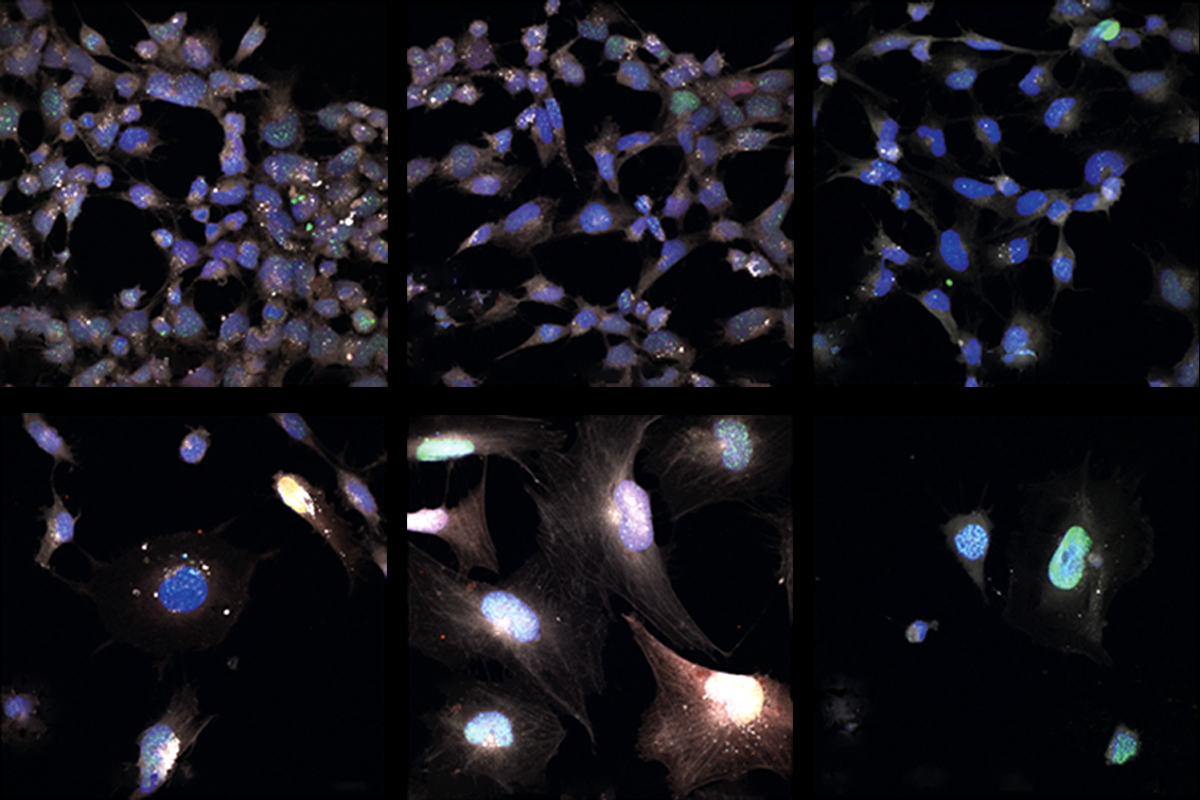
Senescence presents differently depending on the cell type, toxic trigger and neighboring cells, two new studies find.
As cells age and acquire damage, they stop dividing and enter a comatose-like state. This natural process, called senescence, has several classic hallmarks, including the expression of cell cycle arrest genes and enlarged nuclei, and can spread among neighboring cells. But senescence arises and expands differently across human brain cell types and in response to various stressors, two new studies suggest.
“We’re living in the new world of the senescence field,” says Joseph Herdy, investigator at the Salk Institute for Biological Studies, who was not involved with the work. Any cell type, it seems, can senesce under the right conditions, he adds, but each responds in its own way, complicating the picture.
Human brain cell lines—neurons, astrocytes, microglia, oligodendrocytes and endothelial cells—present cell-type-specific responses to stressors that trigger senescence, according to one of the new studies, published in Nature Communications in December. And like senescent cells elsewhere in the body, some—though not all—brain cells can release molecules that spread the senescent phenotype to other cells, according to the other study, a preprint posted on bioRxiv last month.
These cell-type-specific differences may reflect the various ways cells acquire and enter a state of senescence, says Jalees Rehman, professor of biochemistry and molecular genetics at the University of Illinois, who was not involved with either work. “They might all have some shared universal features, such as no more cell cycle, some degree of inflammation, but maybe the path of how you get there might be different between cell types.”
S
All brain cells treated in vitro with BrdU, a nucleotide analog that incorporates itself into DNA to arrest the cell cycle, showed an increase in the enzyme beta-galactosidase, a prominent marker of senescence, the Nature Communications study found. And all cells except microglia showed an increase in p21 expression, mitochondrial mass and nuclei size.
Astrocytes exposed to the herbicide paraquat also showed an increase in beta-galactosidase and p21 gene expression, but those treated with hydrogen peroxide did not, showing that the type of stressor also matters.
“[N]o one cell type perfectly recapitulated all established canonical senescence hallmarks,” the researchers wrote in the study. The results raise questions about the universality of the typical markers used to identify senescence, Herdy says. “We’re still in the Wild West of genetic markers for senescence.”
Cells also responded differently to various senolytics, compounds used to eliminate senescent cells. For example, navitoclax wiped out astrocytes, microglia and oligodendrocytes while leaving neurons and endothelial cells intact.
“It’s really interesting to think about the mechanisms that [make them] so different,” Riessland says. “Maybe we want to target senescent astrocytes very differently than we would target a senescent neuron or senescent microglia.”
And how researchers identify senescence might need more nuance than previously thought, Rehman notes. “Senescence is not a monolith.”
Similarly, not all cells are equal in their ability to activate senescence in neighboring cells, the preprint found. For example, molecules secreted by senescent endothelial cells in culture failed to induce this “secondary senescence” in other brain cell types. Meanwhile, media collected from cultured astrocytes and microglia activated a mix of senescence hallmarks in endothelial cells and other astrocytes and microglia, suggesting that these cells are the main drivers of spread. And neither conditioned media pushed oligodendrocytes or neurons into senescence, the preprint also found.
At least three cell surface receptors mediate secondary senescence, Riessland and his team found by analyzing ligand-receptor interactions. Blocking these ligands and receptors—for example, the receptor CXCR7 and the ligand CCL2—blocked the spread of senescence in healthy astrocytes and microglia exposed to media from senescent astrocytes.
All of these variables create a complex picture of senescence, Rehman says. “I think we’re all thinking about, right now, how do we categorize senescence?” he says. “We don’t want to create 25 different definitions—it has to make scientific sense, and it has to be meaningful and tractable.”