The “Neuro’s Ark” series highlights neuroscience research in nontraditional organisms and the questions those animals are well suited to help researchers answer.
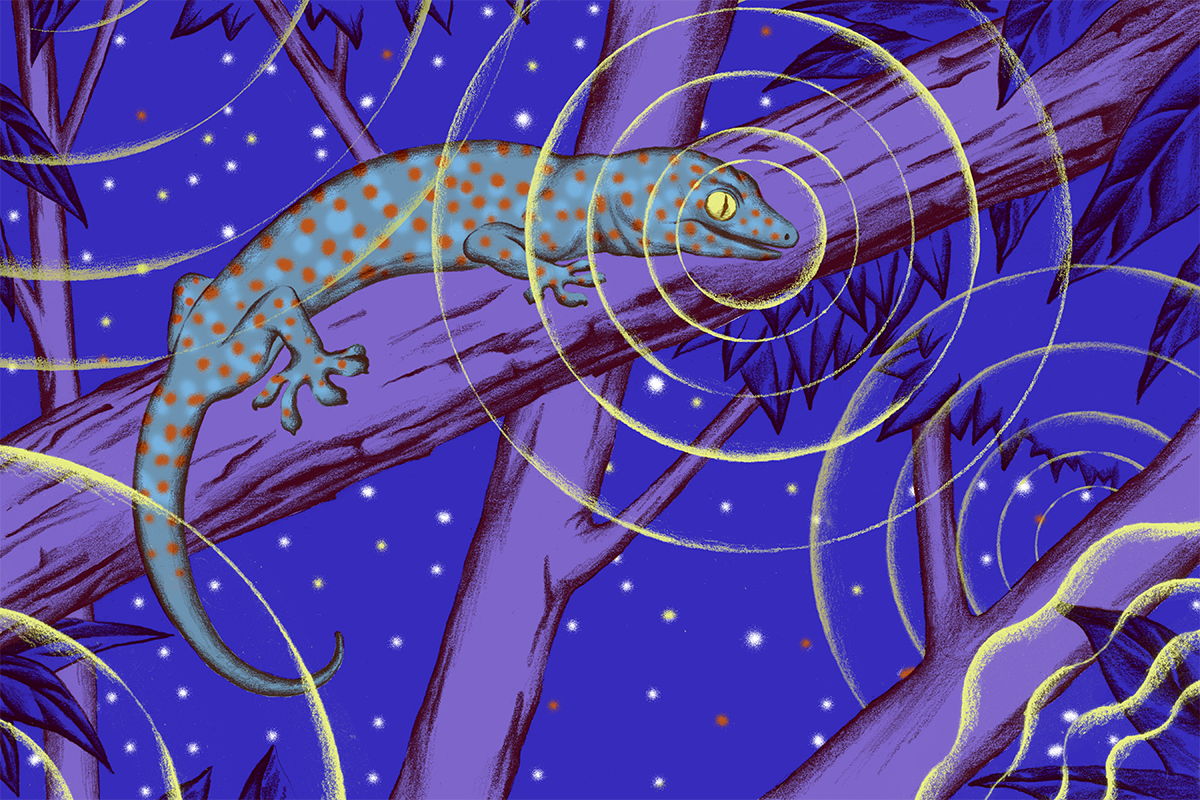
Secret sense: Geckos use an ancestral sound pathway to detect low-frequency vibrations.
Illustration by
Kai Gietzen
Neuro’s ark: Sounding out the evolution of hearing with geckos
Catherine Carr explains her discovery that geckos retain a vibration-sensing pathway previously thought to be lost when animals moved onto land.
By
Helena Kudiabor
1 April 2026 | 5 min read
Most lizards are mute, but not geckos: They chirp, croak, cackle and hiss to attract mates or ward off predators and intruders, among other reasons. And this loquaciousness signals that they process sound differently.
Curious to learn more, Catherine Carr, professor of biology at the University of Maryland, who had studied sound localization in barn owls for decades, exposed tokay geckos (Gekko gecko) to low-frequency vibrations of 50 to 200 hertz. This range falls below what reptiles are thought to be able to hear, but fish and amphibians detect such vibrations via the saccule—a small fluid-filled pouch in the inner ear.
Geckos, too, “hear” these vibrations via the saccule, Carr and her colleagues discovered. The saccule converts the vibrations into electrical signals and transmits them to a specialized brainstem nucleus called the vestibularis ovalis. The vestibularis ovalis then projects these signals to higher-order auditory regions of the brain, just like sounds transmitted more traditionally by the cochlea.
“It’s as if [geckos] have two parallel pathways for sending vibration and auditory responses up the neuraxis,” Carr says.
Other lizards also appear to have vestibularis-ovalis-like brain regions, Carr and her colleagues have found, hinting that this vibration-sensing pathway may be widespread across reptiles.
Carr spoke with The Transmitter about her findings, what they say about the evolution of hearing, and why she is headed to the Kalahari Desert next.
This interview has been edited for length and clarity.
The Transmitter: Why did you decide to pursue this research?
Catherine Carr: Dawei Han is a herpetologist by training, and he came into my lab with an interest in trying to find out if snakes could hear, because it’s one of those things we don’t really understand. Lizards have very nice, clear eardrums: They have an ear canal and a thin eardrum that vibrates in this sound field. But snakes don’t have eardrums.
So Dawei worked for a long time on what snakes could perceive by way of sound and came to the conclusion that a sound vibrates the snake’s body, and that vibration is what they’re actually picking up. So he became interested in how vibration is processed in the brain, and we decided to look at this in geckos.
TT: Why geckos?
CC: We already knew a lot about their auditory processing. There are many lizards, but most of them don’t use sound for communication. But geckos do. They’re nocturnal. They call at night to attract mates. They almost certainly use sound for localizing prey. The fact that they use sound for communication means they are a very nice animal to study if you’re interested in the evolution of hearing.
The most interesting thing about geckos and all lizards is that they have extremely good sound localization. That’s because their middle ears are connected across the mouth by big cavities. So a sound that goes in one eardrum will actually transmit through that middle ear cavity to the other side and interact with the sound that’s coming around the head. And that creates coupled, highly directional sound localization ability. When you see a lizard in the countryside sitting on a wall, it knows where you are.
TT: What does your research tell us about the evolution of hearing?
CC: In terms of evolution, the animals that live in water hear sound through the structures in the brain that we use for detecting vibration. When animals moved onto land 500 million years ago, they separately developed the inner ears to hear airborne sound. But from what we’ve found out in these geckos, it looks like they have retained this sort of ancestral sound-transducing pathway and turned it into a vibration pathway.
This pathway that we thought was lost when animals moved onto land actually is retained in lizards and snakes. So it gives us some idea of the gradual changes in the evolution of the auditory system.
TT: What might geckos use this vibration pathway for?
CC: They can use vibration as part of their auditory scene, like if you had a river that was creating a lot of noise and vibration. You would also get detection of whether there are other animals moving nearby. Also, you could use it for the detection of sounds that are so low frequency that your auditory system doesn’t pick them up, like early warnings of thunderstorms.
TT: What are you studying next?
CC: We’re going to do fieldwork in the Kalahari Desert. I’m finishing up a study on sound localization behavior in much smaller geckos called common barking geckos (Ptenopus garrulus). They live in burrows, and they call at night and in the very early morning. We have a system where we surround them with a semicircle of Bluetooth speakers. Then we play calls and record them on video, and look at their head orientation toward us. That should let us get an accurate behavioral measurement of sound localization.
tags:
Explore more from The Transmitter
Snoozing dragons stir up ancient evidence of sleep’s dual nature
By
Lauren Schenkman
29 December 2025 | 0 min watch
Home makeover helps rats better express themselves: Q&A with Raven Hickson and Peter Kind
By
Holly Barker
4 December 2025 | 0 min watch
Dispute erupts over universal cortical brain-wave claim
By
Claudia López Lloreda
12 December 2025 | 5 min read
Cite this article: