Listen to this story:
0:00
/
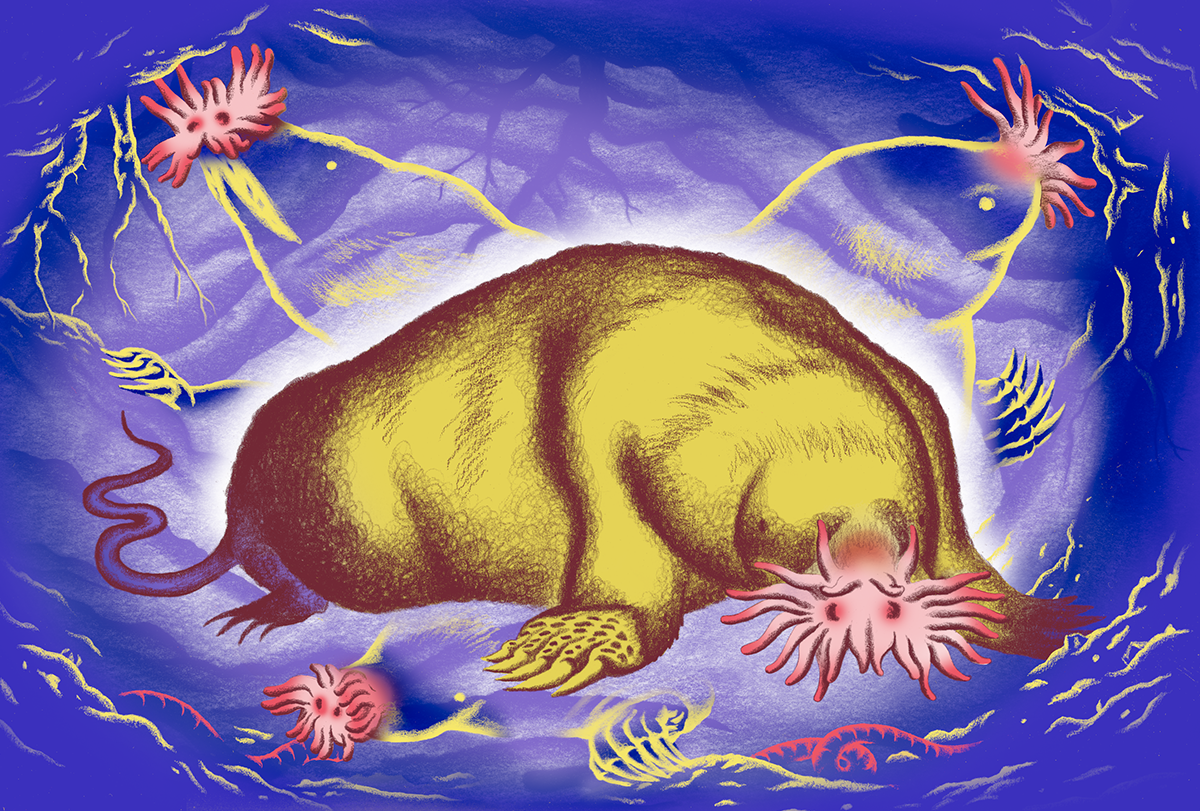
“MacArthur genius” Kenneth Catania outlined the physiology behind the moles’ stellar foraging skills two decades ago. Next, he wants to better characterize their food-seeking behavior.
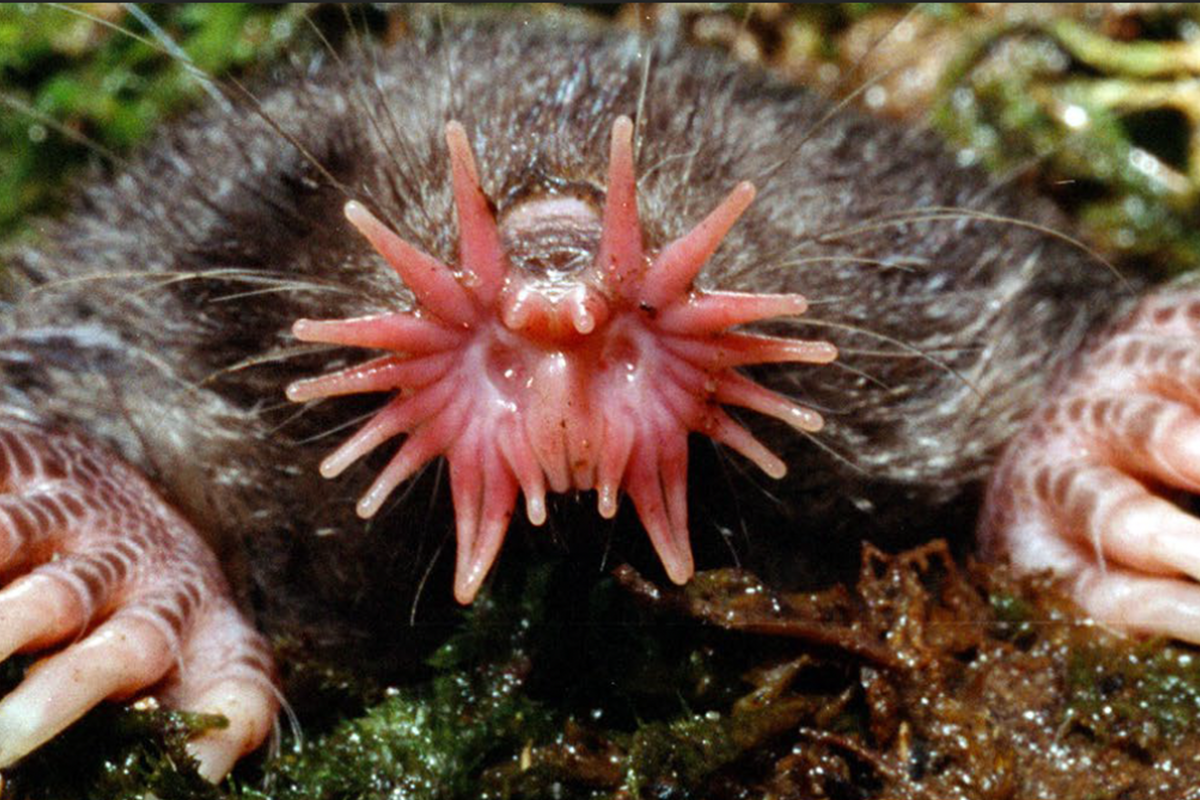
Despite Condylura cristata’s starlike nose, the mole has played mostly a cameo role in neuroscience research. For the virtually blind moles themselves, however, this stellar organ steals every action-packed foraging scene: It probes between 10 and 13 spots a second as the animals search for food in muddy underground tunnels.
“It’s just a flurry of activity where they’re searching out any tidbit large or small that they can eat,” says Kenneth Catania, professor of biological sciences at Vanderbilt University, who received a MacArthur “genius grant” in 2006 for his work mapping how the star-nosed mole’s cortex represents touch input from the nose.
The mole can also forage underwater by expelling and re-inhaling air bubbles to scan the surrounding area, Catania reported that same year, offering the first evidence of underwater olfaction in a mammal; it has since also been found in water shrews and the Russian desman. “This very weird creature opened the door to an ability that is probably much more widespread,” he says.
Catania spoke with The Transmitter about his latest naturalistic foraging studies in the star-nosed mole and his view of how anatomical and behavioral studies should inform each other.
This interview has been edited for length and clarity.
The Transmitter: How did you first encounter the star-nosed mole?
Kenneth Catania: I was one of those kids who grew up investigating the woods and streams and lakes around Columbia, Maryland, where I grew up. When I was about 10 years old, I found a dead star-nosed mole in a sandy area in a stream. I didn’t know what it was. I went to my mother, and we looked it up in the field guide, and we found out that it was this amazing animal that is really rare. I then went looking for where it might have come from, and I discovered this wetland full of lots of interesting animals.
My childhood set me up to volunteer for the Smithsonian National Zoo as an undergraduate to go collect star-nosed moles. It was kind of this impossible mission, but it was the perfect mission for me. I had an intuition about where an animal lived, from years of experience.
The head curator of mammals at the time was really curious about what the star of the star-nosed mole was for, so I was hired to design experiments to explore the possibility that the star could detect electric fields. That turned out not to be the case, but it gave me a lot of experience with failure in science and with designing experiments to learn about star-nosed moles.
It was a very natural thing for me to continue with star-nosed moles in graduate school, because they are legendarily hard to catch, and I was one of the only people in the world who could collect them. They were this outstanding mystery. That is a wonderful thing to have, a big question that’s all your own.
TT: What have you learned about the actual function of the star?
KC: The star is probably the most sensitive, high-resolution touch organ on the planet. It maps into the mole’s neocortex in really interesting ways, where you can actually see the touch maps in the anatomy when you properly prepare the tissue. That allows for all kinds of detailed measurements to be made, in addition to recordings of the nerves in that area.
One of the very interesting findings is that the star functions like an eye, with a central area of high resolution and a peripheral area of low resolution. And when moles touch something with this peripheral part, they make a sudden movement—just like we make with our eyes—to focus the “touch fovea” on the thing that they’re interested in. There are multiple parallels in the way that the nervous system of this nearly blind mole and the primate visual systems are organized. So star-nosed moles have been very useful for questions about how a behaviorally important sensory surface is represented in the cortex.
TT: What inspired your latest work with the star-nosed mole?
KC: When I was studying star-nosed moles in the early 1990s, I was using high-speed cameras to document their foraging behavior, and I’d been showing those old black-and-white videos for years in my seminars. I finally got an updated high-speed camera about four years ago, so I got some star-nosed moles and filmed the behavior again, just to update my videos.
One of the moles that I was filming was a really slow eater. The star-nosed mole is in the Guinness World Records book as the world’s fastest-eating mammal, so when I saw a slow one, I wanted to know what had gone wrong. I discovered that it had worn-down teeth, which is something that happens to old animals. This led me to think more about how they forage. It turns out that star-nosed moles are sort of a poster child for trying to understand the relevance of our paradigms and ideas for understanding foraging.
TT: How so?
KC: There’s been a lot of theoretical work done on the mathematics of choice and the most efficient ways that a predator should act. If you were looking at a mathematical equation, you would want to know how this function behaves at the extremes. And the star-nosed mole has probably been pushed to the extreme limit of the mammalian brain’s ability to process sensory information quickly.
When you think about predator foraging, you generally rank prey items by their profitability—the amount of energy gained when you eat it—divided by how long it takes to capture and consume that prey item. What happens if the bottom part of that equation approaches zero? The food that the star-nosed mole is eating, the small bits of prey, are surprisingly more profitable than you might guess, because the moles are so fast.
TT: Does this have implications for other species?
KC: Yes, because why have a bizarre star when everything that I just described to you is about eating fast? There’s probably a very interesting correlation between unusual kinds of anatomy and unusual behavior. If you just think about extreme physiology or anatomy but you don’t study the behavior, then you could be missing something amazing. I think that’s a general theme that can inform us about other animals.
TT: What research questions is your lab trying to answer going forward?
KC: I’m pursuing a more realistic, naturalistic feeding challenge. I’ve already shown that they can eat little tiny morsels incredibly quickly. I thought when you give them something slightly bigger, like a real moving prey item, that’s certainly going to slow them down. It turns out the opposite is true. They seem to have all these interesting specializations when you give them an even more realistic task, and they can do it underwater.
It has been easy to get distracted by the star when it comes to the physiology and ability of the star-nosed mole, but there are other aspects of their anatomy, such as their teeth and digestive system, that probably go hand in hand with their behavior that are going to be exciting to be exciting to look at.