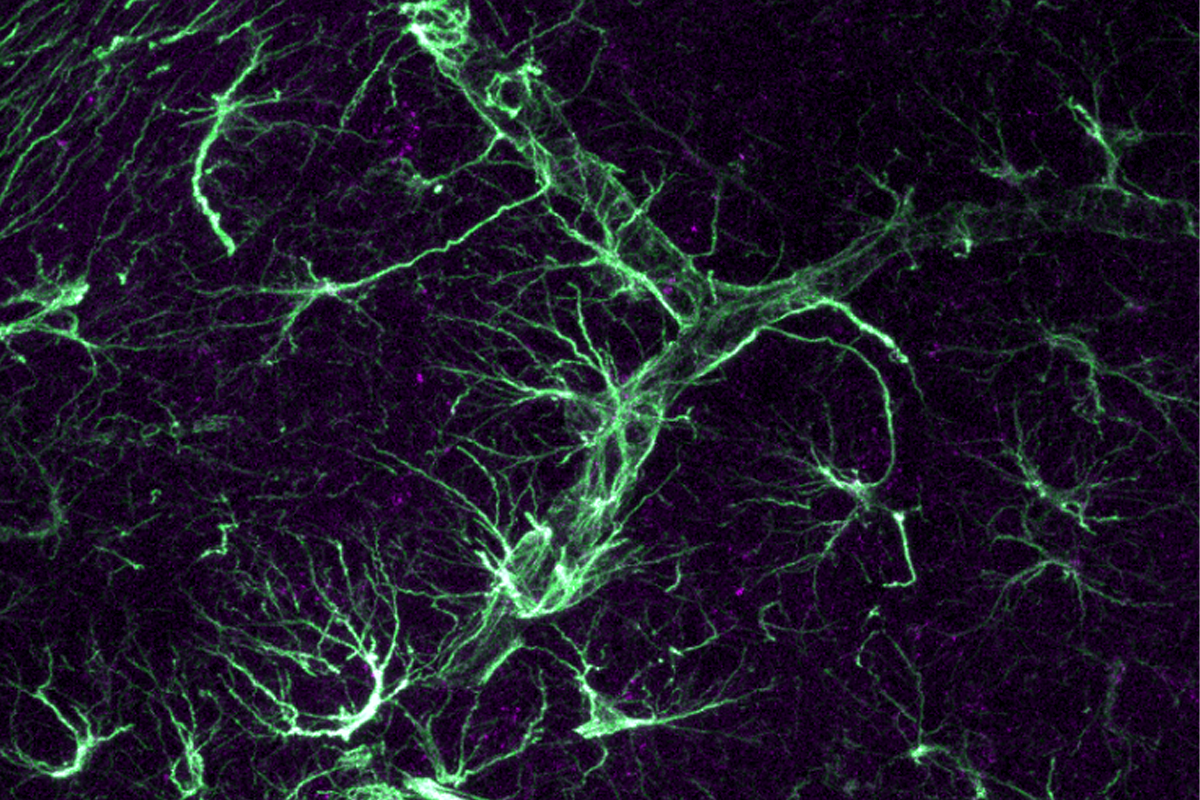
Astrocytes—but not neurons—in the amygdala encode anxiety-like states in mice, according to a paper published today in Neuron. The findings suggest that the cells—which are altered in people with some neuropsychiatric conditions, including autism—contribute to mental health difficulties documented in such groups.
“In a very sophisticated way, the [study] shows that astrocytes are these core computational cells for highly complicated behaviors,” says Michael Wheeler, assistant professor of neurology at Harvard University, who did not contribute to the new work. “Astrocytes are understanding and signaling computations in these circuits.”
Violent movies and other stressful stimuli activate the amygdala, human imaging studies have shown. And in mice, neurons in the basolateral amygdala are active when the animals are placed in exposed environments, which they find aversive, previous research has found. But that neuronal activity appears to mark shifts between defensive and exploratory behaviors rather than tracking anxiety-related ones, according to a later study.
The new findings suggest that astrocytes not only help neurons to regulate anxiety—as previous studies have shown—but “instruct local neurons from the top down,” says study investigator Ciaran Murphy-Royal, associate professor of neuroscience at the University of Montreal. The cells’ activity appears to function as a “safety signal,” that relays danger to other brain regions, he says.
M
And mice that readily explored exposed environments showed overall lower astrocyte activity than did mice that spent more time in concealed areas, the study found.
By contrast, neuronal activity tracks poorly with an anxiety-like state, calcium imaging of those cells revealed. And when the team trained a machine-learning model on either the astrocyte or neuronal calcium data, the astrocyte decoder could predict with 82 percent accuracy whether a mouse was in the open or closed arm of the plus maze.