Novel assembloid illuminates serotonin changes linked to 22q11.2 deletion
The combination of a serotonin-producing organoid with an organoid based on the developing cerebral cortex offers a new way to investigate neuromodulation.
A first-of-its-kind assembloid incorporates neurotransmitter-based neuromodulation, the process by which neurons use chemical signals—in this case, serotonin—to regulate other nerve cells, according to a new preprint.
Assembloids, structures composed of multiple organoids, have emerged in recent years as powerful tools for investigating neuronal migration and the formation of long-range connections between brain cells. But they have not modeled endogenous neuromodulation until now, the study investigators say.
The neuromodulatory assembloid combines a serotonin-producing organoid with an organoid composed of cells modeling the developing cerebral cortex. The resulting structure offers a model for exploring how serotonin subtly shapes the behavior of neurons in the cortical organoid and for observing changes that may occur in conditions such as autism and schizophrenia.
It “expands the toolbox for the field to study neuromodulation under normal and diseased conditions,” saysGuo-li Ming, professor of neuroscience at the University of Pennsylvania, who was not involved in the work. The findings were posted last month on bioRxiv.
Most of the serotonin-producing cells in the central nervous system reside in the raphe nuclei. The nuclei are clumps of cells arranged along the central axis of the brainstem (“raphe” comes from the Greek word for “seam”). But these small, nondescript structures are deceptively difficult to model as organoids, study investigatorSergiu Paşca discovered.
“We thought it should be relatively straightforward” to make an organoid composed of serotonin-producing neurons, says Paşca, professor of psychiatry and behavioral sciences at Stanford University. After all, scientistsnow have recipes for producing the majority of the cell types found in the developing brain, using reprogrammed skin cells.
Famous last words. “This project has actually been about eight years in the making, probably more,” Paşca says.
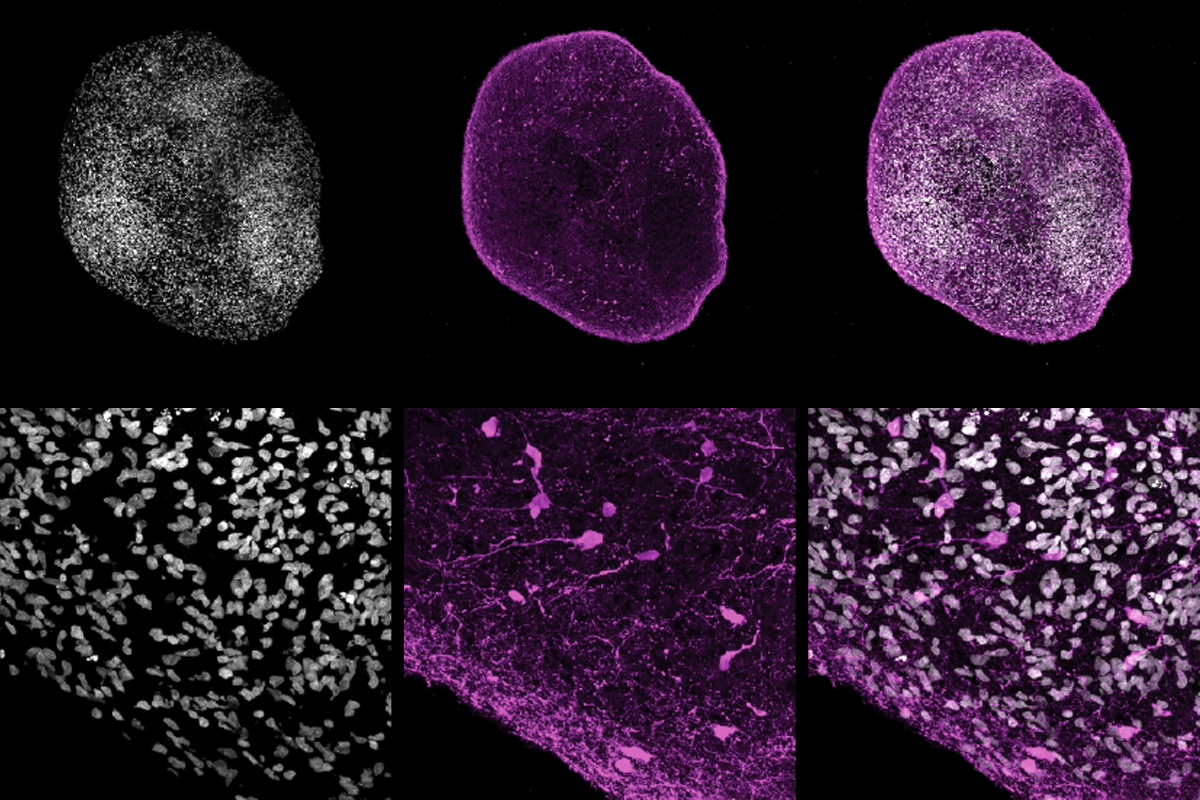
Working model: Staining reveals cell nuclei (left panel) and serotonin (middle panel) together (right panel) in an organoid model of the brainstem.
T
he challenge wasn’t making an organoid with serotonin-producing cells. It was making only serotonin-producing cells in an organoid model of a brain region that is rife with diverse cell types, all packed in close proximity. “It’s just absolutely overwhelming what happens in the brainstem,” Paşca says.
Just as the team was coming to terms with the infeasibility of their quest—and that a purely serotonergic organoid might not be true to life anyway—a technological work-around emerged, deus ex machina-like:a serotonin sensor that would enable the researchers to isolate and visualize the effects of serotonin signaling in their experimental system.
The researchers inserted the genetic sequence for the serotonin sensor into their cortical organoids. Then they fused these structures with the new serotonin-producing organoids, which they had dubbed midbrain-hindbrain organoids (MHOs).
Serotonin-producing cells in the MHOs send out long projections that meet up with neurons in the cortical organoid, the researchers showed in viral tracing experiments. They release serotonin into the minute spaces around the terminals of the cortical neurons, the serotonin sensor revealed.
Over time, cells in cortical organoids that are fused with MHOs develop more synchronized activity compared with cells in standalone cortical organoids.
This synchronization is a known effect of serotonin signaling and represents a maturation of cortical networks, Paşca says. Researchers had long suspected that input from cells outside the cortex was crucial for this maturation. But similar effects have not been seen in previous assembloid models, so the finding “certainly surprised us,” Paşca says.
It is not clear that serotonin signaling alone is responsible for the effect, however, because the MHOs also contain cells that produce other neuromodulators, such as dopamine.
T
he researchers also made neuromodulatory assembloids from reprogrammed skin cells of five people with 22q11.2 microdeletion syndrome. This genetic syndrome is associated with both autism and schizophrenia, and people who carry it often have problems with serotonin regulation in the brain.
In line with those observations, the 22q11.2 assembloids’ cortical component has reduced levels of serotonin compared with control assembloids, the researchers found. But there are no differences in serotonin signaling in either component of the assembloid when tested separately.
“Because the phenotype only appears in the fused system, the paper makes a strong case that assembloids can reveal emergent disease biology that simpler organoid models miss,” saysTommaso Patriarchi, assistant professor of chemical neuropharmacology at the University of Zurich, who was not involved in the work.
Nor are there any differences in how cells from the MHO project into the cortical organoid in the 22q11.2 assembloids. But fluoxetine, a selective serotonin reuptake inhibitor, restores serotonin signaling in the assembloids, suggesting that “the mechanism of reuptake is somehow impaired” in 22q11.2 microdeletion syndrome, Paşca says.
The researchers next aim to identify which serotonin reuptake protein is affected, and which gene in the 22q11.2 region is responsible for the effect, Paşca says. “Mosaic” assembloids, in which the MHO bears the microdeletion while the cortical organoid does not, or vice versa, could help scientists suss out the mechanism, the researchers say.
The cortical organoids contain few neurons that release the inhibitory neurotransmitter GABA—yet such neurons are important targets of neuromodulation by serotonin. “An important part of real cortical serotonergic biology is absent here,” Patriarchi says.
The inhibitory neurons could be modeled by adding a third organoid containing these cells to the system, Paşca says.
Because the MHOs contain multiple cell types and could be tweaked to include others, the assembloid model could also be used to investigate neuromodulation by other neurotransmitters for which similar sensors are available (one such norepinephrine sensor has been developed in Patriarchi’s lab).
In other words, what first seemed to be a limitation of the new MHOs could wind up being their superpower. “There could be an entire arsenal of neuromodulatory assembloids for various neuromodulators,” Paşca says.