Listen to this story:
0:00
/
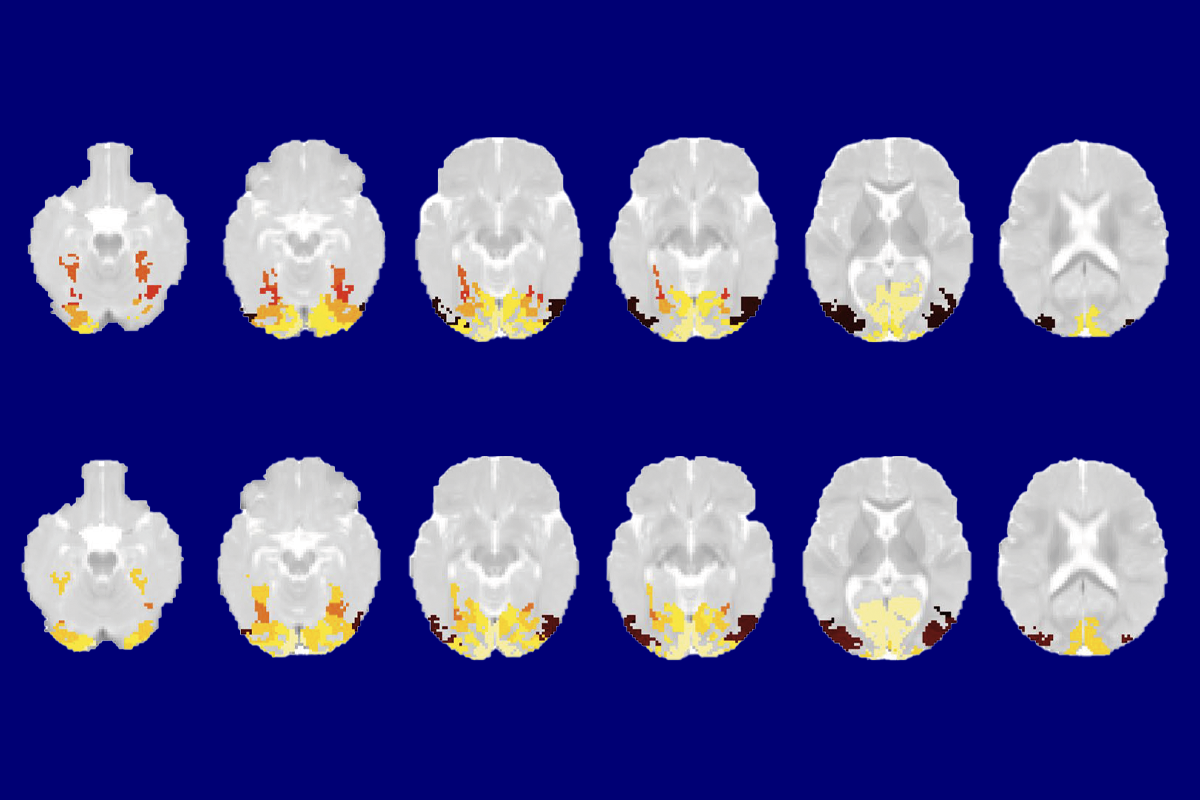
Brain activity patterns in the ventral visual cortex appear to distinguish images across 12 categories, including birds and trees, longitudinal functional MRI scans suggest.
At 2 months old, babies’ visual systems appear ready to distinguish among a variety of common objects, according to a new functional MRI study. Viewing images of different items sets off brain activity patterns in the ventral visual cortex that correlate with those found in adults, and that link strengthens by the time the babies are 9 months old, the study shows.
The findings, published earlier this month in Nature Neuroscience, suggest that adult visual representations are more similar to those of infants than previously thought, says Heather Kosakowski, assistant professor of psychology at the University of Southern California, who was not involved in the study. “There were hints that this [adult similarity] might be true for 5- and 7-year-olds, but to see that it’s true for infants is really exciting.”
The study involved brain scans from 101 2-month-old infants and 17 adults. The scans were collected as the participants viewed three different images of everyday objects from 12 different visual categories that babies typically would have previously encountered, such as a cat, bird, food item and shopping cart. The researchers had 44 infants repeat the task at 9 months of age.
“Having been in and around labs that collect infant neuroimaging data, I know how hard and painstaking the process is,” says Apurva Ratan Murty, assistant professor of cognition and brain science at the Georgia Institute of Technology, who was not involved in the study. “To be able to do so at the scale reported in the paper is quite incredible.”
Images from any given category evoked a more similar pattern of neural activity in the ventral visual cortex than images from different categories did, the study shows. The adult patterns correlate with those seen in the 9-month-olds, and to a slightly lesser extent with those in the 2-month-olds.
What’s more, the infants’ activity patterns resembled those of two deep neural networks trained to classify objects in internet images, the study also shows.
“A lot of the complex category structure used by the neural network models to classify objects was already there in the 2-month-olds,” says study investigator Clíona O’Doherty, a postdoctoral scholar at Stanford University, who completed the work as a Ph.D. student in Rhodri Cusack’s lab at Trinity College Dublin. For instance, the infants appear to recognize that three different images of cats belong to the same category. Similarly, their brains distinguish between animate and inanimate objects. This complex structure was refined further when the infants were rescanned at 9 months.
“Prior research using fMRI in infants has only looked at specific categories of objects, like faces or bodies.” Murty says. “This study is therefore able to analyze visual responses in a more fine-grained manner.”
T
Development of the lateral occipitotemporal cortex could require refined motor skills that improve as babies learn to reach for and grab objects around them, says Cusack, professor of cognitive neuroscience at Trinity College Dublin. “Perhaps the lateral regions are just slower to develop because they need this motor connection,” he says.
Another possibility is that “we’re not getting any signal in that LO [lateral occipitotemporal cortex] because there is no reliable signal across the infants,” O’Doherty says. “What we didn’t dive into is whether within individual infants, that structure is there.”
The findings should prompt researchers to reconsider how infants learn to process the world, Murty says. Cognitive development is often regarded as a bottom-up process, in which “the early visual regions that encode simpler features develop first, and higher-level regions that encode more complex features emerge later.” Instead, brain maturation is “non-hierarchical,” he says, with the more complex visual ventral cortex developing before the lateral occipitotemporal cortex.
The development of these complex structures marks “a really critical period of learning when [infants] develop the foundations for how to think about the world,” Cusack says.
In future research, O’Doherty says she would like to investigate how long infants remember the objects they see and whether they are able to recognize relationships between items from different categories—for example, a dog versus a cat or a bone.
“We show that they can distinguish a cat, but do they know what that is, what it means?” O’Doherty says.