In Frameshift, neuroscientists with careers outside academic labs discuss their work and how they made the transition.
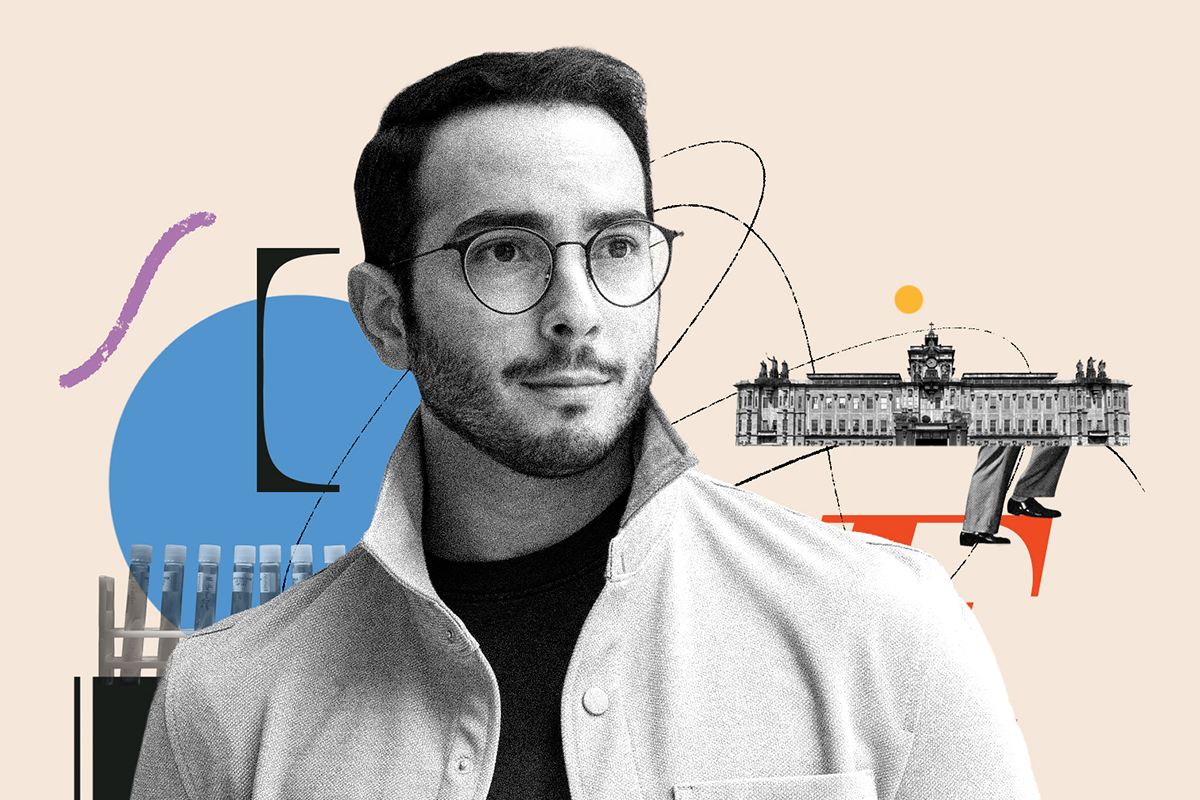
Rejecting rigidity: During his postdoc, Sabbagh reached out to people who work in consulting firms, biotech companies and nonprofit labs to learn how people think about scientific problems outside of academia.
Illustration by
Michela Buttignol
Frameshift: At a biotech firm, Ubadah Sabbagh embraces the expansive world outside academia
As chief of staff at Arcadia, Ubadah Sabbagh gets to do science while also pushing the boundaries of how science gets done.
By
Katie Moisse
20 January 2026 | 7 min read
Ubadah Sabbagh wanted to make a difference through science but felt constrained by academia. At the biotech company Arcadia, he found a work ethos that aligns with his values and outside-the-box style of solving problems. He spoke with The Transmitter about finding creative fulfillment by mixing science and business.
This interview has been lightly edited for length and clarity.
The Transmitter: What is Arcadia?
Ubadah Sabbagh: We’re a biotech company identifying novel therapeutic targets and designing novel biologics. We also build new technology to support this work. For instance, we have a free tool that helps you empirically choose the best model organism for your research question. We often think a mouse is more complex than a worm and closer to a human; a monkey is closer to a human than a mouse; and so on. But maybe it’s easier to answer your research question in algae than in a mouse, and maybe algae is a faithful representation of a particular process in humans. We’re into de-risking ideas early in the process, and we release these tools to the world so people can use them. It’s all open science.
TT: What do you love about working in biotech?
US: There’s so much cool science, and it’s so wide-ranging. It’s like being in a candy store. There’s the intellectual satisfaction of the science itself—I’m learning a lot. And then there’s the satisfying angle of imagining better ways to do science at every step of the scientific process. There are so many brilliant people who work here, and they’re all excited to think about problems in new ways. We’re able to experiment and iterate and figure out what works because we can be bold and take on that kind of risk.
It’s also nice to be in a place where people’s egos are not associated with their work. In academia, so much of your worth is associated with the outcome of your work, and there’s a sort of territorialism around success.
TT: You now work with scientists from many different fields, as well as non-scientists. What is that like?
US: I’ve always been a generalist. When I applied to Ph.D. programs, I applied to lots of different things: neuroscience, synthetic biology, microbiology, virology. I think there are lessons to learn from different scientific subcultures. Neuroscience has its own subculture, for sure. Even systems neuroscience has its own subculture compared with molecular neuroscience. Everybody has their thing that they bring to the table, and it’s nice to cross-pollinate and get a sense of the different ways people approach scientific questions and design their studies.
There are also the non-science things that come with company-building, like thinking about personnel, management, compliance, relationships with investors and so on. I’ve always been interested in building things and understanding how systems work, so it’s a good vantage point for me.
TT: What does a day in your work life look like?
US: It really varies. I typically have some housekeeping stuff to do in the morning, like responding to emails and Slack messages. Sometimes I help with recruiting and try to make sure that we’re hiring people who make sense for our organization, which is a very specific phenotype of scientist. If there’s a block or bottleneck—technical, logistical or intellectual—I try to help. And then I might have a meeting with our chief scientific officer or another team lead to touch base on science strategy and think about where we’re going and what we need to get there. So there are small things, big things, near-term things and long-term things. Some weeks have a theme, but what a day contains can be literally anything.
TT: What made you want to leave academia?
US: When I started my postdoctoral research, I was laser-focused on being a principal investigator. But in my second year, I started to ask myself why I really wanted that. That same year, I became an American citizen, and the world opened up. I hadn’t seen my family in Syria or the United Arab Emirates for 14 years. When I got my U.S. passport, I booked a flight and went to visit my mom in Dubai.
When you’ve lived apart from your family for so long while your country endures a civil war, you want to make your privilege of being in the United States mean something. I always thought a PI position was a way for me to do things in the world that I care about. But I realized there are other ways to do these things beyond being a faculty member. Having access to my family again, and stability in the U.S., made me feel I had some room to breathe, reflect, be inspired and set new goals. I gave myself permission to explore alternatives.
TT: How did you know what the alternatives were?
US: I started talking to people and reading essays on Substack or other blogs, people’s takes on Twitter [now X], and some books. I learned what careers are out there and also explored building my own company. There’s a program at the Massachusetts Institute of Technology, where I did my postdoc, called Venture Mentoring Service, where you learn how to develop a strategy, how to make a pitch deck, how to talk to investors. And I had meetings with investors and got the experience of talking to them about my ideas. All of these experiences were useful, and I did them while I was a postdoc.
TT: What advice do you have for researchers who want to stay in science but leave academia?
US: I think a lot of people have a constrained definition of science. My advice is to go out and talk to people and get a sense of how vast the space really is. I talked to people who work in consulting firms, biotech companies, nonprofit labs, philanthropy and government. There’s a lot to learn from these people.
There’s also a lot to learn about how to market yourself for different things. Reflect on the experience and expertise you developed in academia and think about how you can frame it for different opportunities. Honestly, with large language models, this should be an easier exercise than before. Just brain-dump everything you’ve done and start iterating on which skill sets are transferable to a particular role.
You might need to think about problems differently outside of academia. So when you’re doing informational interviews, try to get a sense of how people think about problems in their jobs. Academia has a very stereotyped approach to things—we all know it because we all speak the same language. But when you move into new spaces, there might be new norms. The more rigid you are, the harder it’ll be. If you’re more expansive and flexible, I think it becomes easier.
Correction
This story has been updated to clarify that Sabbagh visited his family in the United Arab Emirates, not Syria
Explore more from The Transmitter
Frameshift: Shari Wiseman reflects on her pivot from science to publishing
By
Katie Moisse
15 December 2025 | 7 min read
Which sources fund your neuroscience research?
By
Claudia López Lloreda
15 November 2025 | 5 min read
Neuroscience needs engineers—for more reasons than you think
By
Timothy O’Leary
3 November 2025 | 8 min read
Cite this article: