Listen to this story:
0:00
/
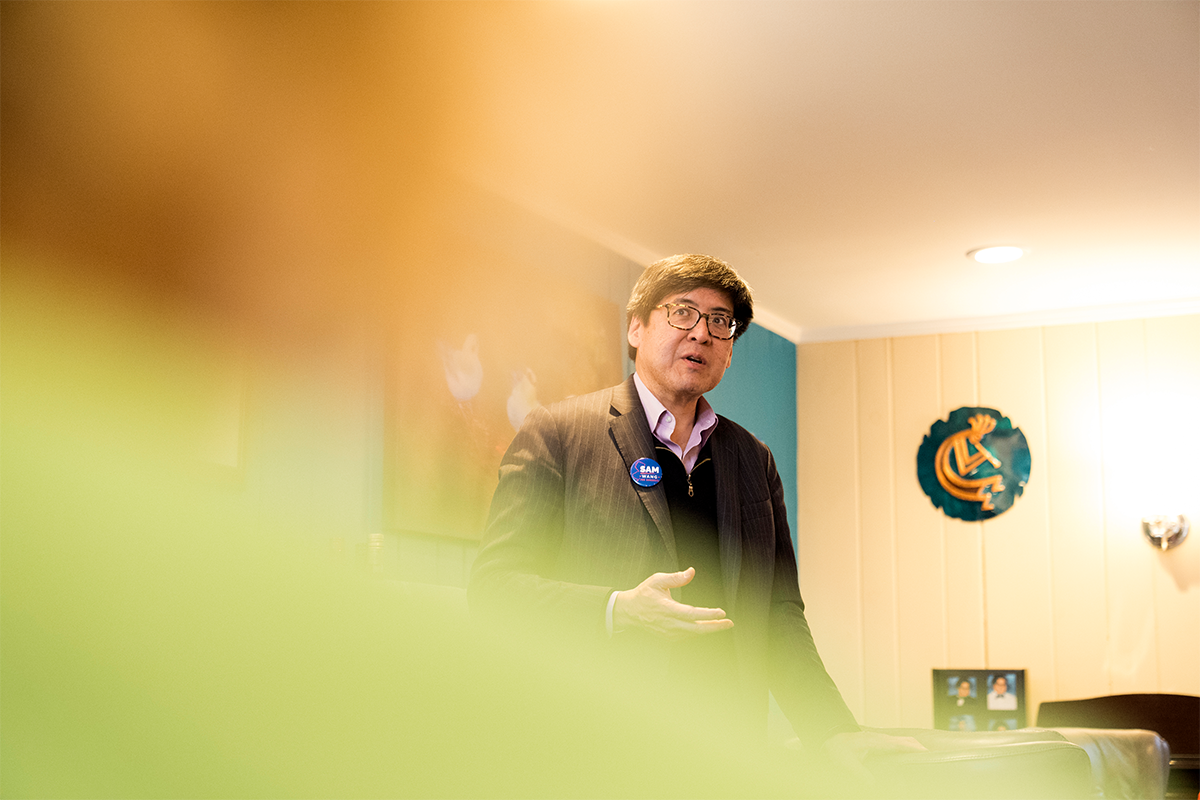
Sam Wang, a neuroscientist running for the U.S. House of Representatives, has been considering American democracy for decades.
Sam Wang, professor of neuroscience at Princeton University, has spent years analyzing the way American democracy works. But after 2025 brought cuts to neuroscience funding and drastic changes to other federal policies, he decided it was time to act. Earlier this month, he announced his candidacy for the Democratic nomination in New Jersey’s 12th Congressional District.
Wang’s platform includes abolishing the U.S. Immigration and Customs Enforcement agency, protecting research funding at academic institutions and shoring up vaccine policy, according to his campaign website. He also wants to introduce legislation to fight gerrymandering—a cause he has supported for years—and eliminate the Electoral College.
During the past year of funding cuts and sweeping changes to public health policy around autism, Wang has been “a leader at Princeton,” says Jesse Gomez, assistant professor of neuroscience at Princeton, who collaborates with Wang. Wang has started email lists, gathered teams and spread the word about protests, Gomez says. “As things started taking a turn for the worse and science funding started getting affected, he really was a key player in rallying people.”
Wang says his leap to potential politician was directly spurred by the events of the past year. “What I want to do is bring what I know about reform to stopping the damage and to making sure it doesn’t happen again,” he says. “I think I can do that as a candidate.”
It’s “very rare” for neuroscientists to get this heavily involved in politics, says George Augustine, a distinguished investigator at Temasek Life Sciences Laboratory, who mentored Wang when he was a postdoctoral researcher at Duke University. “Sam is an outlier, but in a good way,” he says.
W

Wang’s interest in politics began at an early age. For instance, California’s Proposition 13, passed in 1978 and designed to limit property taxes, “really hurt schools in California,” he says, and as a kid he “couldn’t understand why anybody would vote for a thing that would hurt schools.” Yet he went into the sciences, graduating from the California Institute of Technology with a B.S. in physics at age 19, and then nearly fulfilled his father’s wish by earning a Ph.D. in neuroscience from Stanford University at age 26, in 1993.
Wang then went to Augustine’s lab at Duke and worked on synaptic plasticity in the cerebellum. As a postdoctoral researcher, Wang was “a broad thinker” and “very good at saying what’s on his mind, often in an eloquent way, sometimes a humorous way, always a way that got the message across very clearly,” Augustine says.
While in his postdoc, Wang’s focus expanded to politics. He remembers seeing a 1994 newspaper headline announcing that Republicans had regained control of Congress after midterm elections. Wang had been used to a Democratic-controlled Congress, and he didn’t know that a flip “was even possible,” he says. “It just became apparent that a lot of things were going to change.”
Wang took a year off from his postdoc to do a congressional fellowship administered by the American Association for the Advancement of Science, working with Senator Edward M. (Ted) Kennedy on policies related to National Science Foundation policy, technology in schools and higher education.
Wang’s younger sister, Karen, is autistic but wasn’t diagnosed until late childhood. After starting his own lab at Princeton in 2000, he implicated the cerebellum, thought to be mostly involved in movement, in autism. This was “pretty shocking at the time,” Augustine says. Wang later co-founded a publicly traded company, BlinkLab, that is developing artificial intelligence to detect early signs of autism via sensory tests done through a smartphone app. The software would compete with products cleared by the U.S. Food and Drug Administration, such as software from EarliPoint Health.
Not long after arriving at Princeton, he also got interested in the Electoral College. He realized he “could go 20 miles to the west,” into Pennsylvania, and “have more power over who becomes president,” he says. That realization led him to examine gerrymandering, a redrawing of voter district lines to benefit a political party. This, he says, is a “major bug in our democracy that needs fixing.”
In 2014, Wang founded the Princeton Gerrymandering Project, which grades U.S. states according to the fairness of their district lines, and in 2020 the Electoral Innovation Lab, which aims to improve voter representation.
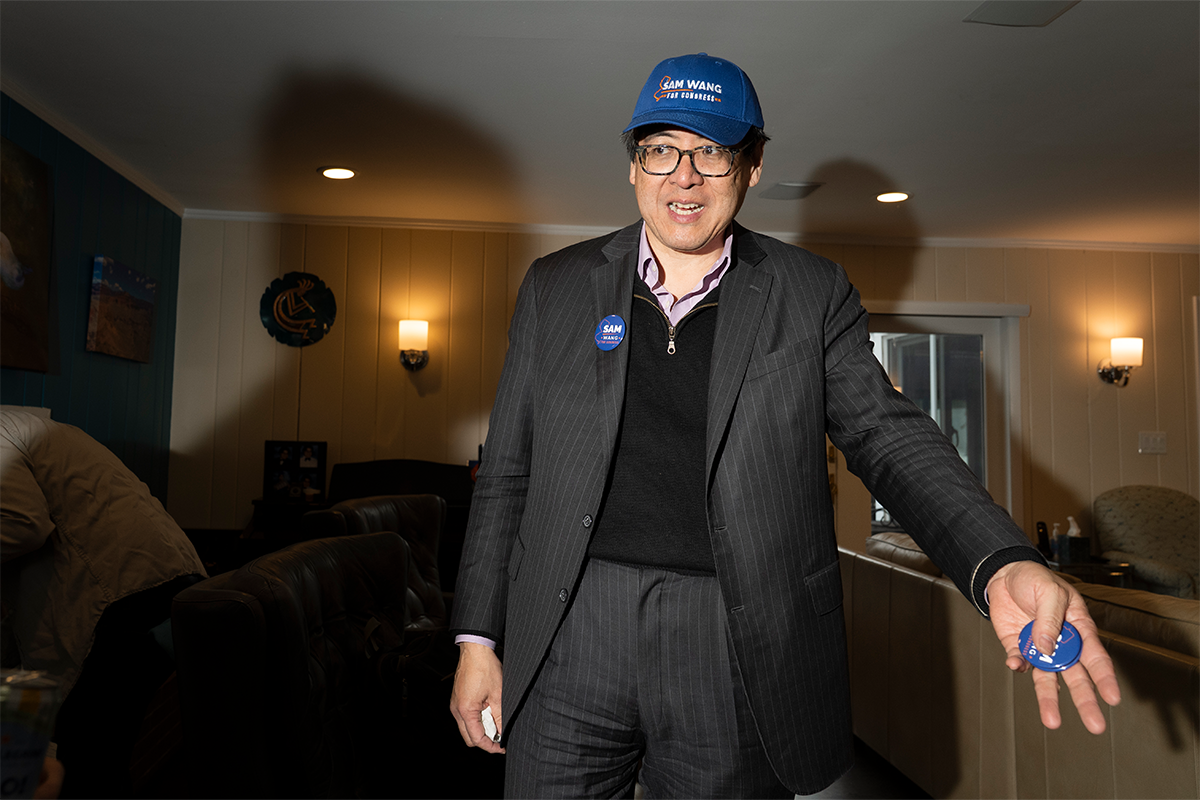
Wang also helped do away with what was known as the “county line” on New Jersey ballots, in which candidates endorsed by the two main parties are lined up in the far left column—third party and independent candidates are displayed in further columns. “The eye is drawn to a column of names,” he says, and the county line gives endorsed candidates “an average of 38 points of advantage. It’s this visual neuroscience trick.”
W
Wang also has been criticized by former Republican state chairman Doug Steinhardt, the Republican redistricting chairman, for not releasing the algorithms used to advise the redistricting process. The New Jersey Republican redistricting delegation then accused Democrats and Wang of data manipulation, among other things, and the State of New Jersey launched an investigation; claims were eventually dismissed. Similarly, in 2022, Princeton investigated Wang for research misconduct and accusations of a toxic workplace; the allegations were also found to be without merit.
Wang says that “being targeted by false accusations was shocking.” He has heard less about them since the allegations were dismissed, but the experience taught him that “behaving with integrity is not enough,” and that it is important to “respond quickly to falsehoods.”
Wang’s scientific training alone makes him an uncommon candidate. Zachary Williams, a resident in psychiatry at the University of California, Los Angeles, who served on a National Academy of Sciences expert committee advising the Department of Defense’s handling of autism services, says he would not consider that a bad thing. A Congress member who studies autism “could help steer the ship toward real, evidence-based autism policy,” he says, as well as provide a “check to executive control” over federal policy, such as the recent overhaul of the Interagency Autism Coordinating Committee undertaken by U.S. Department of Health and Human Services.
Walter Koroshetz, who served as director of the National Institute of Neurological Disorders and Stroke for more than 10 years, says that the big advocates for science during his career were not actually scientists. A scientist in Congress could help promote science, but “I don’t think that’s what we should be relying on,” he says. “I think we need to be relying on getting good stories to people on both sides of the aisle about the value of what science brings to the country.”
Wang says his campaign is more about doing his part in difficult times. “As our scientific system comes under attack, and higher education and even the rule of law, like immigration enforcement—as all these things come under attack, I’ve realized that we all have to pitch in,” Wang says. “And that me working, you know, state by state, it’s not enough.”