What a bird’s-eye view of half a million papers reveals about neuroscience

New research uses artificial-intellligence-driven bibliometrics to map the structural organization of neuroscience across 25 years. The field it reveals is at once thriving and theoretically adrift.

By Mac Shine
6 April 2026 | 36 min watch

The brain is arguably the most complex object in the known universe, and neuroscience—the discipline charged with understanding it—has grown to match that complexity. Today, the field spans everything from the molecular choreography of a single synapse to the large-scale network dynamics that give rise to conscious experience. It is simultaneously one of the most exciting and most disorienting fields to work in. The conceptual map that connects our different subfields hasn’t been written yet.

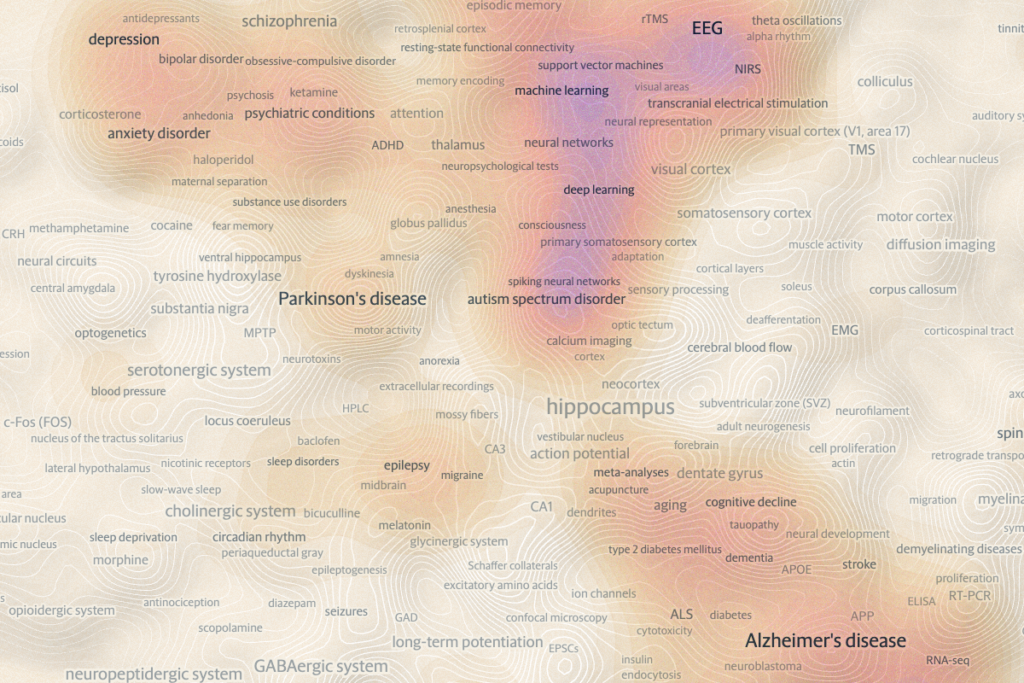
But a new study published in Aperture Neuro in February takes a remarkable step toward drawing that map. Led by Mario Senden, a computational neuroscientist at Maastricht University, the work applies state-of-the-art text embedding and community detection algorithms to nearly half a million neuroscience abstracts published between 1999 and 2023. It carves the literature into 175 distinct research clusters, characterizing each one along dimensions ranging from spatial scale to theoretical orientation.

What emerges is a portrait of a discipline that is, in many ways, healthier than it might appear from the inside. Despite its staggering diversity—clusters range from AMPA receptor trafficking to the neural underpinnings of consciousness—the field is remarkably well integrated; the vast majority of research communities actively draw on and feed into one another. The cluster of resting-state functional MRI dynamics and the molecular mechanisms of hippocampal plasticity emerge as some of the field’s great intellectual hubs, providing conceptual and methodological scaffolding for dozens of downstream communities.
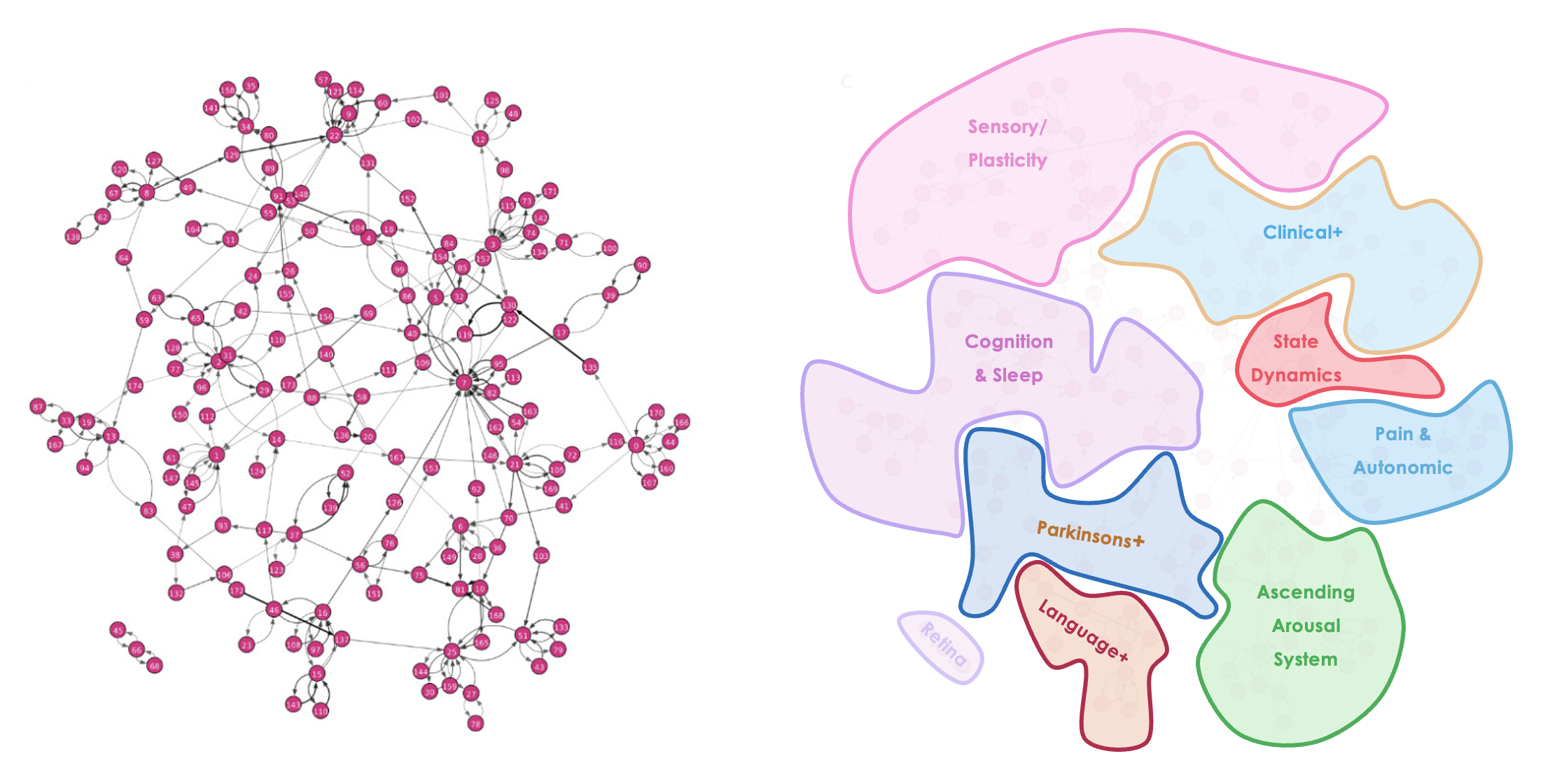
Connected clusters: Data from 500,000 neuroscience papers were categorized into 175 distinct clusters (left), which are connected based on how often articles in each cluster cite one another. Darker edges indicate higher citation density among articles within the connected clusters. A coarser grouping (right) of nine hand-annotated communities captures most of the connectivity structure amongst the 175 semantically defined clusters.
Left: Senden et al., Aperture Neuro 2026; Right: Mac Shine

But the map also has its fault lines. Microscale and macroscale research communities operate in two largely separate epistemic worlds, divided by spatial scale and by the training trajectories that produce different kinds of neuroscientists. Temporal scales are integrated only pairwise, never holistically. And perhaps most provocatively: Not a single cluster in the entire 175-cluster solution is organized around a theoretical framework. The Bayesian brain, the free energy principle and predictive coding are common targets of empirical science, yet none of them anchor their own research community. Theory, it seems, is something neuroscience does around the edges of the phenomena it is really interested in.

In this video, I discuss the results with Senden. Our discussion left me with both a feeling of optimism and the sense that we still have a lot to learn. The field is thriving, collaborative and increasingly powered by tools that would have been unimaginable a decade ago. But the absence of any theory-dedicated cluster is not a minor methodological footnote. It is a structural feature of the field, and one worth sitting with. The question Senden’s work quietly raises is not whether neuroscience is doing well but whether it is, collectively, doing enough of the right kind of thinking to understand what it is actually building toward.

Watch our conversation or read the transcript.

Sign up for our weekly newsletter.

Catch up on what you missed from our recent coverage, and get breaking news alerts.