Sidarta Ribeiro.

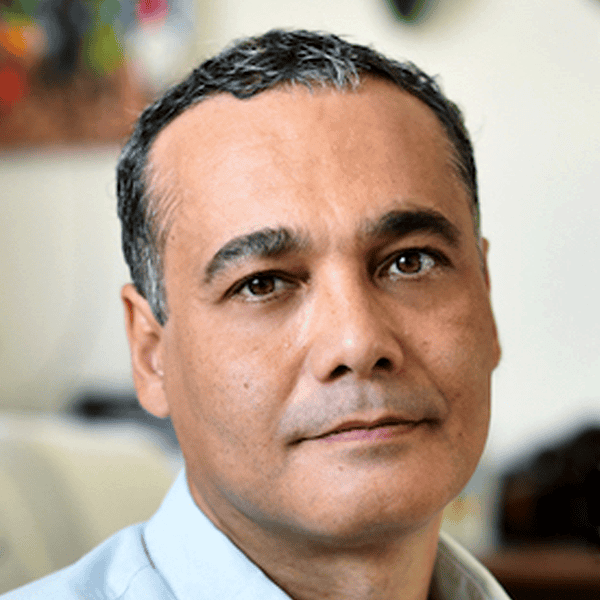
Sidarta Ribeiro

Professor of neuroscience and director
Brain Institute, Universidade Federal do Rio Grande do Norte

Sidarta Ribeiro is professor of neuroscience and director of the Brain Institute at the Universidade Federal do Rio Grande do Norte. He has researched and published on memory, sleep and dreams; neuronal plasticity; vocal communication; symbolic competence in nonhuman animals; computational psychiatry; neuroeducation; and psychedelics and drug policy.

Ribero earned his bachelor’s degree in biology at the Universidade de Brasília in 1993, his M.Sc. in biophysics at the Universidade Federal do Rio de Janeiro in 1994 and his Ph.D. in animal behavior at Rockefeller University in 2000, followed by postdoctoral studies in neurophysiology at Duke University. He has written six books, including “The Oracle of Night: The History and Science of Dreams” and “The Flowers of Good: The Science and the History of Marijuana Liberation.”
Explore more from The Transmitter

Illustration of scientist in lab coat looking at shelves of computer network models.

Mass-produced science is coming. What happens to scientists?

Artificial intelligence may soon enable researchers to generate high-quality science at a previously unimaginable speed. For science consumers—the public, medical patients, technology users—the likely effects will be positive. For scientists, the effects will be as disruptive as industrial mass production was for artisan manufacturers.

By Kenneth Harris
9 July 2026 | 9 min read
Adriano Aguzzi.

Neuropathologist not guilty of research misconduct, says university probe

The investigation determined that seven papers by corresponding author Adriano Aguzzi have “scientifically significant” errors, which Aguzzi attributes to his former students.

By Dalmeet Singh Chawla
8 July 2026 | 5 min read
Research image of proliferating neural cells.

Diverse autism genes derail common developmental pathways

Multiple genetic mouse models initially show delayed cortical development, but the animals’ molecular trajectories diverge within weeks after birth, a new study finds.

By Holly Barker
8 July 2026 | 5 min read