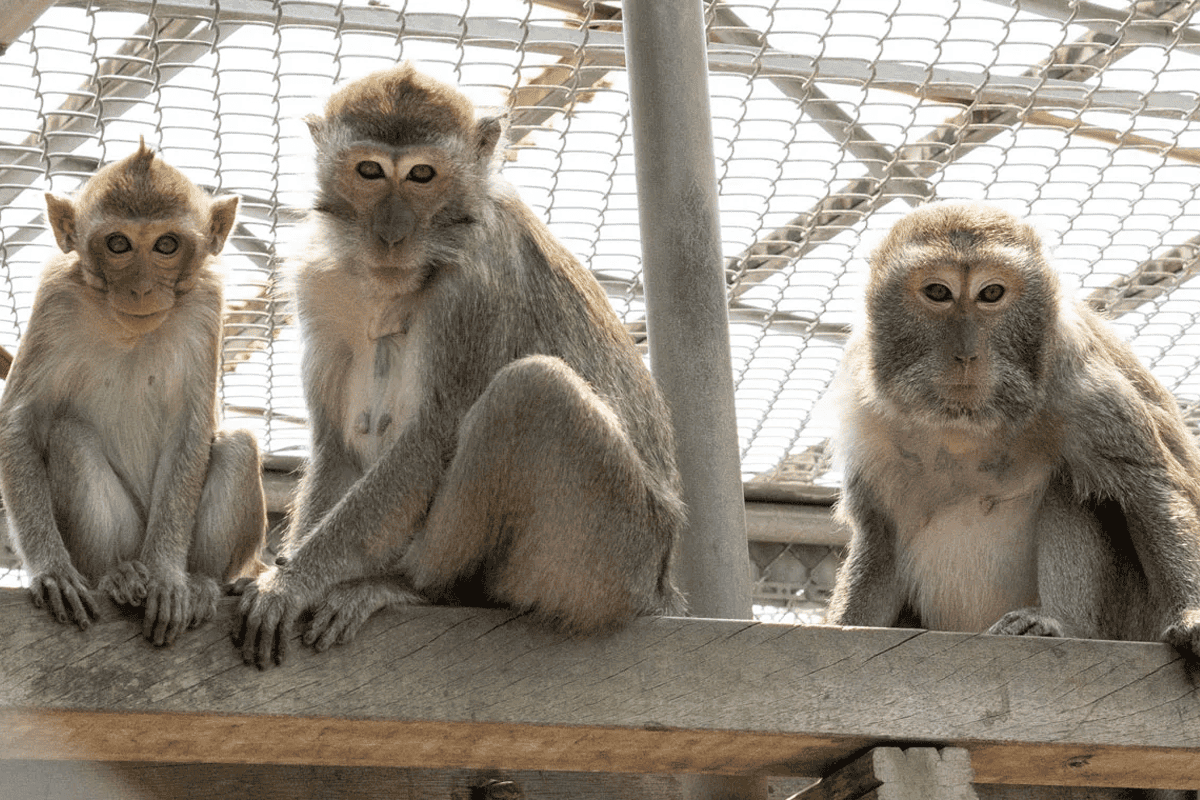
One of Europe’s biggest primate research centers has escaped a budget mandate passed last October that would have phased out federal funding for animal experiments at the center by 2030. But the fate of the Biomedical Primate Research Centre (BPRC), based in Rijswijk, the Netherlands, remains vulnerable, according to center director Merel Langelaar, a veterinarian.
The Dutch Parliament is set to debate animal research next month, and members are allowed to propose changes to the science budget at that time. “As long as this government is there, I think we’re pretty safe,” Langelaar says. But a future parliament could easily move to phase out animal research again.
“At this moment, we’re completely dependent on the politics and elections,” she says.
On 28 October 2025, the Dutch Parliament passed a budget requiring the BPRC, which houses about 1,000 macaques and sometimes provides animals to outside researchers, to gradually reallocate its primate research funding—roughly 10 million euros annually—to non-animal research by 2030.
But a new set of officials was elected the next day, following the Dutch government’s collapse in June 2025. The center engaged in “an enormous amount of lobbying,” Langelaar says. In March 2026, the new House of Representatives, one of the parliament’s two chambers, voted to reverse the phase-out, and the Senate confirmed the decision on 30 June.
“I state that the animal-free research methods currently available cannot yet provide an adequate alternative to the research currently being conducted with monkeys,” wrote Minister of Education, Culture and Science Rianne Letschert in a 3 July letter to Parliament. She called the BPRC “essential infrastructure.”
That means that the BPRC, which mostly focuses on infectious diseases but also studies Parkinson’s disease, Alzheimer’s disease and the neurological effects of COVID-19, can continue carrying out 120 to 150 nonhuman primate studies per year. It also must increase the proportion of its government funding devoted to the development of new non-animal models from its current 17 percent to 30 percent by 2030; it already conducts in-vitro, comparative genetics and data-science studies.
“We want to pursue that anyway,” says Jinte Middeldorp, who heads the center’s Department of Neurobiology and Aging. After the October 2025 decision to phase out primate research, she says she questioned whether to begin new projects or write new grants. Ultimately, BPRC scientists, in the hopes of finding other funding sources, “decided to just keep going,” she says, with her department launching a study of alpha-synuclein aggregation in Parkinson’s disease, beginning with two animals. But with efforts partially diverted to ensuring the center’s survival, the science “did suffer,” she says.
T
he debate about animal research to be held in October is part of a larger discussion about animal welfare that happens twice a year, according to Joris Schouten, a spokesperson for Letschert. Members can propose changes to the budget then, but it’s unlikely that another funding phaseout will be put forward, says Debby Weijers, director of the Dutch Society for the Replacement of Animal Testing, a nongovernmental organization.The society, called “Proefdervrij” in Dutch, intends to participate in a 30 September roundtable before the debate, she says. The group lobbied in support of last year’s amendment and, after the reversal was proposed, sent a letter to members of Parliament. That letter, which was reviewed by The Transmitter, argues that there is “insufficient scientific evidence” that nonhuman primate research is still necessary.
“I think we had the chance to become or stay the forerunner in animal-free innovations while the whole world is watching us,” Weijers says. “But we didn’t take it.” She adds that she is not hopeful that other countries in Europe will take up the charge. “I don’t see the political will in Europe specifically for [ending research with] nonhuman primates.”
Stefan Treue, director of the German Primate Center and professor of biological psychology and cognitive neuroscience at the University of Göttingen, agrees. “We have firm support from a political side for responsible research,” he says, and the situation is similar in France. The strongest opposition to animal research comes from the far-right Alternative for Germany party, he notes.
But “Europe as a whole, as a continent, is going to get on board much more quickly now” with phasing out animal research, given the push in the United States, says Jarrod Bailey, a trained geneticist and director of medical research at the Physicians Committee for Responsible Medicine, a U.S.-based nonprofit group that campaigned to turn an Oregon primate center into a sanctuary and supported Proefdervrij’s lobbying against the BPRC. “This is not wishful thinking.”
He notes that the Animals in Science Committee, which advises the U.K. government, is working to set up a government committee dedicated to alternatives to animal experiments.
In May, Treue, Langelaar and others organized PrimeMeet Europe, a conference for researchers from primate centers around Europe, along with representatives of patient advocacy groups. One of the goals was “to think proactively—how can we make sure that politicians are well informed, that they don’t fall prey to simplistic arguments,” Treue says. During the conference, a small group of protesters gathered outside the hotel, Langelaar and Middeldorp say.
Even though the BPRC has had visits from members of the government, including from Minister Letschert last week, Langelaar says the center should not rely on the government’s good will. “We have to think of a strategy to be able to sustainably go on with the work that we have to do,” she says.