LISTEN TO THIS STORY:
0:00
/
Placing too much emphasis on a specific interpretation of dimensionality, or treating it as an end-all quantification of some aspect of neural computation, may hinder progress in understanding the brain.
The following statement should be uncontroversial for any neuroscientists reading this: Brains are astoundingly complex. The human brain comprises a recurrent, ever-changing network of billions of neurons, making more synapses than there are stars in our galaxy. Even small nervous systems and sub-nuclei, such as those of Caenorhabditis elegans or the crustacean stomatogastric ganglion, seem to have a near-infinite number of internal variations to produce the same behavior.
These observations made it all the more surprising when, starting largely in the early 2000s, systems neuroscientists began to notice that neural population activity in a number of neural circuits—from the locust olfactory system to the primate premotor cortex and prefrontal cortex—were surprisingly “low dimensional.” Specifically, when scientists analyzed recordings of dozens to hundreds of neurons using dimensionality-reduction techniques, a remarkably low number of components or factors could explain the majority of neural activity.
Like many scientific insights, these observations are potentially obvious in hindsight, almost intuitive. Thanks to many years of exploration and follow-ups, including some theoretical work, it’s clear that low dimensionality is probably expected given the relatively constrained space of typical laboratory tasks and stimuli. Further, the recurrence and time-dependent dynamics of population activity create more constraints, making it difficult to truly explore the full space of possible population activity. Yet, recent studies from mice have used recordings of large numbers of neurons to challenge the ubiquity of the “low-dimensional representation,” showing instead that, even when viewed at the population level, all (or nearly all) neurons are needed to fully capture relevant neural responses to stimuli. Even motor cortical activity is apparently more highly dimensional when sampled during a broad set of motor behaviors than during the point-to-point reaching common in the mid-2000s. Was all of the hullabaloo about low dimensionality a wrong turn?
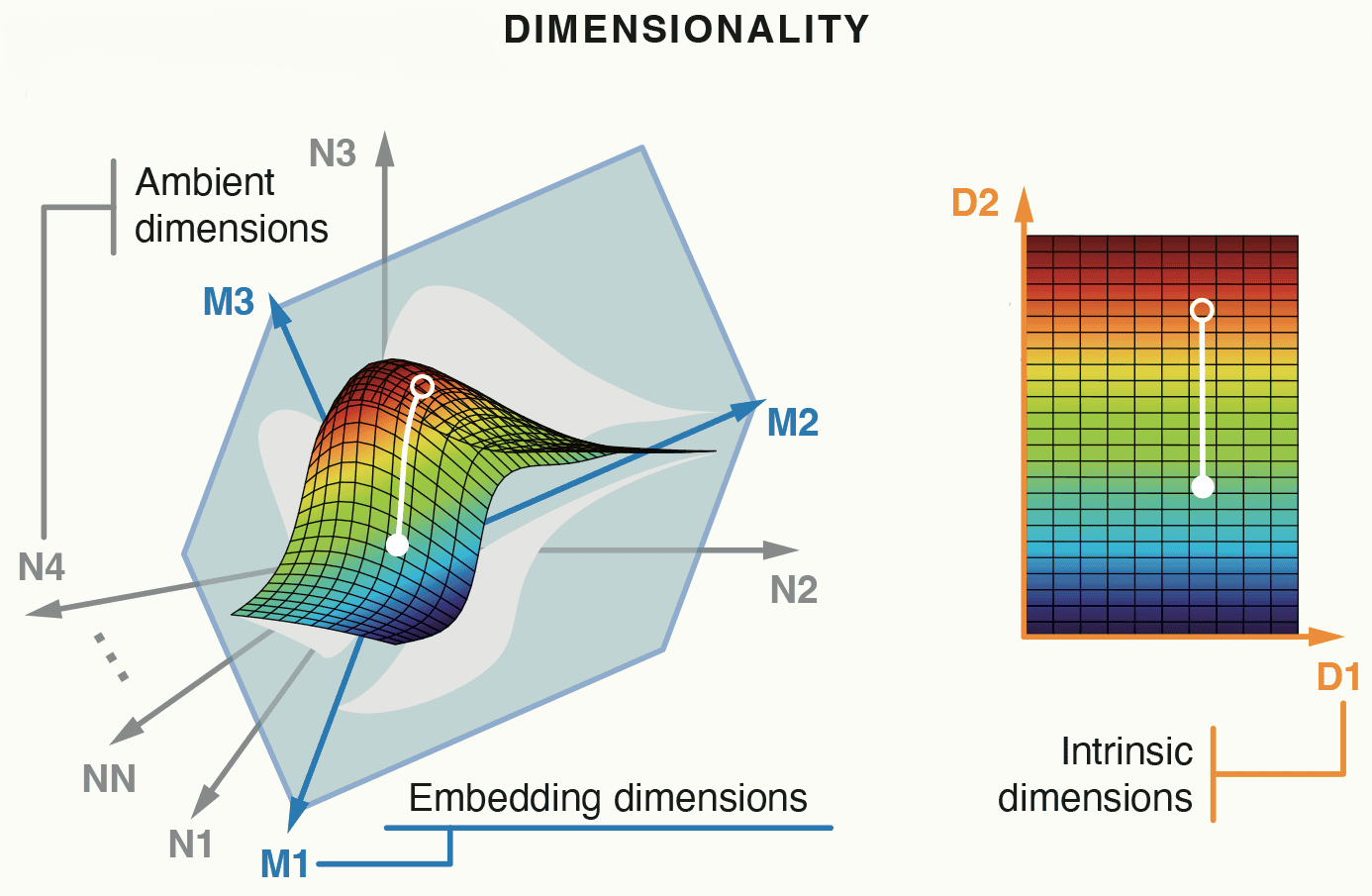
In short: No! I want to argue that there is likely no disagreement at play. Indeed, activity can be simultaneously “high dimensional” and “low dimensional,” non-paradoxically. At its core, the confusion arises because there is not one universal definition of dimensionality. In neuroscience, we often sample the brain by recording neural activity. For cellular-resolution recordings, our “full” dimensionality is the number of recorded neurons, or the ambient dimensionality. However, as stated earlier, neural activity doesn’t typically explore the full set of possible states and instead seems to occupy a subspace of activity: The number of dimensions needed to capture the real activity has been called the embedding dimensionality. Yet there can be even further constraints—for example, if activity lives on a specific surface, with curvature or more complex structure, its intrinsic dimensionality could be even lower. When the system is fully linear, these should agree, but nonlinearities are likely ubiquitous in the brain. Recent work, for example, has shown nonlinearity even in relatively low-dimensional motor cortical activity. This distinction between embedding and intrinsic dimensionality is at the core of my argument.
T
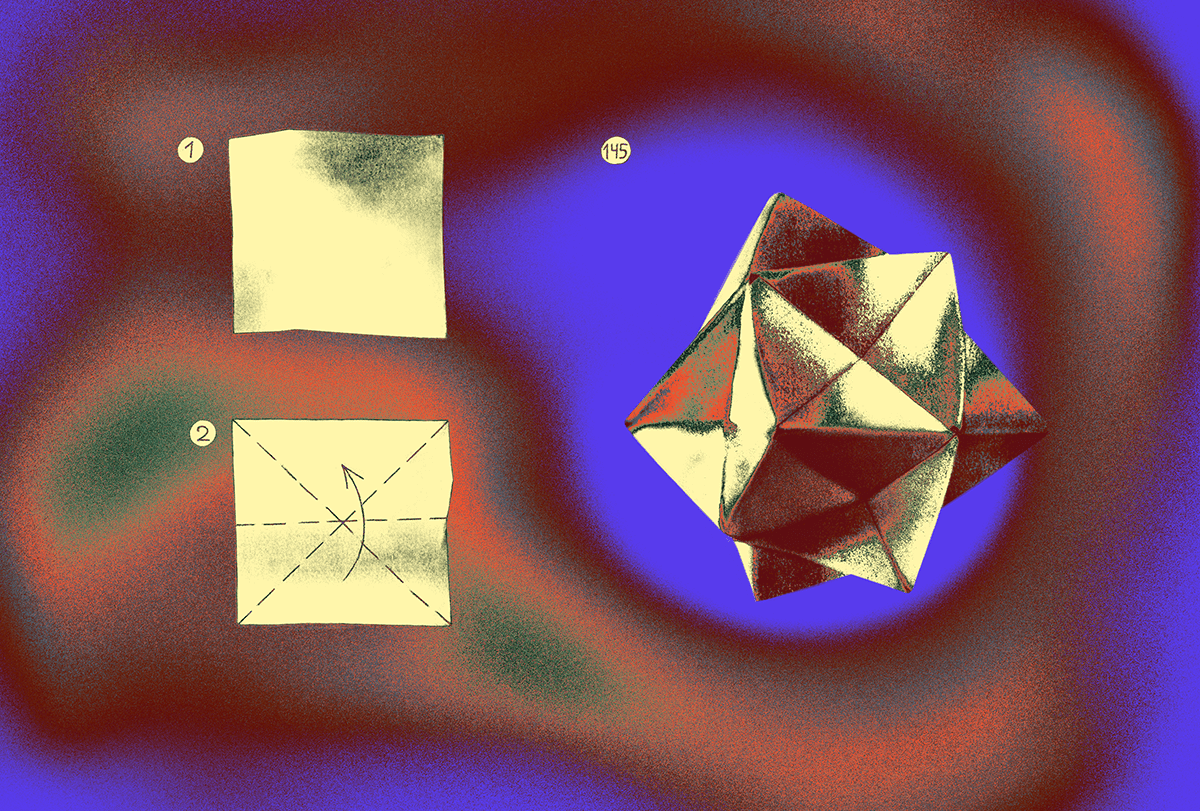
The sheet of paper that contains the readable information about the article is intrinsically 2D. When folded into the origami crane, that same 2D surface is embedded in a 3D space with a specific shape. Both the 2D intrinsic and 3D embedded representations are useful. If you wanted to point out that the crane has two wings on opposite sides of its body, you must know the 3D configuration of the object. However, it would be completely impossible to read the article in crane form: We would need to unfold the sheet. In practice, linear dimensionality reduction techniques such as principal components analysis (PCA) would readily reveal the 3D shape of the crane but would not help us read the printed text. We would need nonlinear dimensionality reduction (or manifold estimation) techniques to unfold the sheet, which would reveal a simpler 2D representation that lets us read the article’s text.
The same intuition can help us navigate the waters of dimensionality in neuroscience. Let’s say I record 1,000 neurons from a brain region as an animal performs a task. I run a PCA, which finds new axes in this 1,000-dimensional neural state space that maximally explain the variance in the neural activity. Surprisingly, I find I need at least 900, maybe more, principal components to fully reconstruct the behaviorally relevant neural activity. Is that “high dimensional”? Probably—and this is a valuable insight with implications for models of neural representations or the neural interfaces that we develop. However, the picture is still incomplete. This PCA gives us a new embedding space for the data, but a relatively high-dimensional embedding space does not preclude that simpler, more parsimonious structure or explanations (with lower dimensionality) could exist within that space.
A recent example of this idea in neuroscience is the toroidal manifold structure found in the rat entorhinal cortex. Linear dimensionality reduction (PCA) applied to the activity of hundreds of grid cells showed that the activity mostly lived in an embedding space with approximately six dimensions—perhaps quite low dimensional, but also intriguingly more than the 2D environments the rats were exploring. Yet, nonlinear dimensionality reduction (UMAP) uncovered even lower-dimensional structure in the form of a torus (which, by the way, was beautifully predicted from theoretical work). This torus is effectively a 2D surface (like our sheet of paper) arranged in a 3D shape (the donut-like torus, analogous to our origami crane) embedded in a six-dimensional subspace of a 100-plus-dimensional neural space.
Therein lies the crux of the issue: There are at least three valid answers to the question: “What is the dimensionality of rat entorhinal cortex grid cells in this task?” Further, there is not one “best” answer. The parsimonious 2D representation along the surface of the torus allowed for highly accurate decoding of the mouse’s navigation, much like unfolding the paper crane is the easiest way to read the text. Yet, the specific toroidal shape is an essential piece of information for our understanding of the processes involved and how “downstream” regions that read out the grid cell activity might interpret it. Ultimately, the most useful definition of dimensionality will depend on the goals of the experimenter; I suspect that considering all views as important evidence will often be appropriate.
I want to be clear: All of the papers linked within this essay (regardless of claim on dimensionality) are important and interesting contributions to the field. I am intentionally not taking any stance here on whether activity in a given region of the brain is intrinsically low or high dimensional, nor whether activity is embedded in low- or high-dimensional spaces. However, given what we have learned in recent years, it does seem that both intrinsic and embedded dimensionalities will be higher than those found during the initial forays into quantifying the complexity of neural activity. (These experiments, in the 2000s through the present, focused largely on constrained lab tasks.) And because little is simple in neuroscience, I suspect a precise definition of dimensionality (if it exists) will vary greatly depending on recorded brain region and other factors.
My caution is that the mere notion of “dimensionality” is not a complete way to describe and quantify the complexity of neural computations, and in fact can be misleading. I fear that placing too much emphasis on a specific interpretation of dimensionality, or treating one notion of dimensionality as an end-all quantification of some aspect of neural computation, may turn out to be a “red herring” for neuroscience, distracting us with discussions about neural activity, such as whether it is high or low dimensional, that never quite get to the heart of the neural processes we hope to understand. Fortunately, this path is easy to avoid, as long as we are precise in our definitions and interpretations of neural dimensionality and do our best to consider how the multiple definitions could provide complementary views into the brain.