For the last 20 years, a bump in high gamma activity in brain recordings has signaled one thing: that neurons near the electrode are firing. But it may reflect widespread, synchronized population activity instead, a new study in the journal Nature suggests.
High gamma activity is “not purely local,” says study investigator Marc Slutzky, professor of neurology at Northwestern University.
This finding could influence how researchers interpret and make use of high gamma activity experimentally. “It’s become kind of a shorthand to think of [high gamma activity] as a marker of aggregate [local] spiking,” says Erin Rich, associate professor of neural science at New York University. “The nuance of whether that’s all it is, or precisely what it is, is being lost.”
High gamma activity is a broadband signal seen between 70 and 300 Hz in electrophysiologic recordings of humans and monkeys. It is used to study many behaviors, from memory to movement, and correlates with the activity of neurons spiking near a recording electrode. Researchers thought this localized spiking “leaks” into the broadband signal, creating the characteristic high gamma feature, Slutzky says.
But the correlation between spiking activity and high gamma is only moderate—and emerges only in averages across trials and electrodes. This led Slutzky, more than a decade ago, to suspect that the broadband signal is a poor proxy for local neural activity, he says. Adding to those suspicions, blocking NMDA receptors, which sit mainly in the signal-receiving ends of neurons, dampens high gamma activity but not local spiking in monkeys, suggesting that the former is generated postsynaptically, according to a 2020 study.
“Based on the actual data, I was fairly sure that that was not the entire story,” Slutzky says.
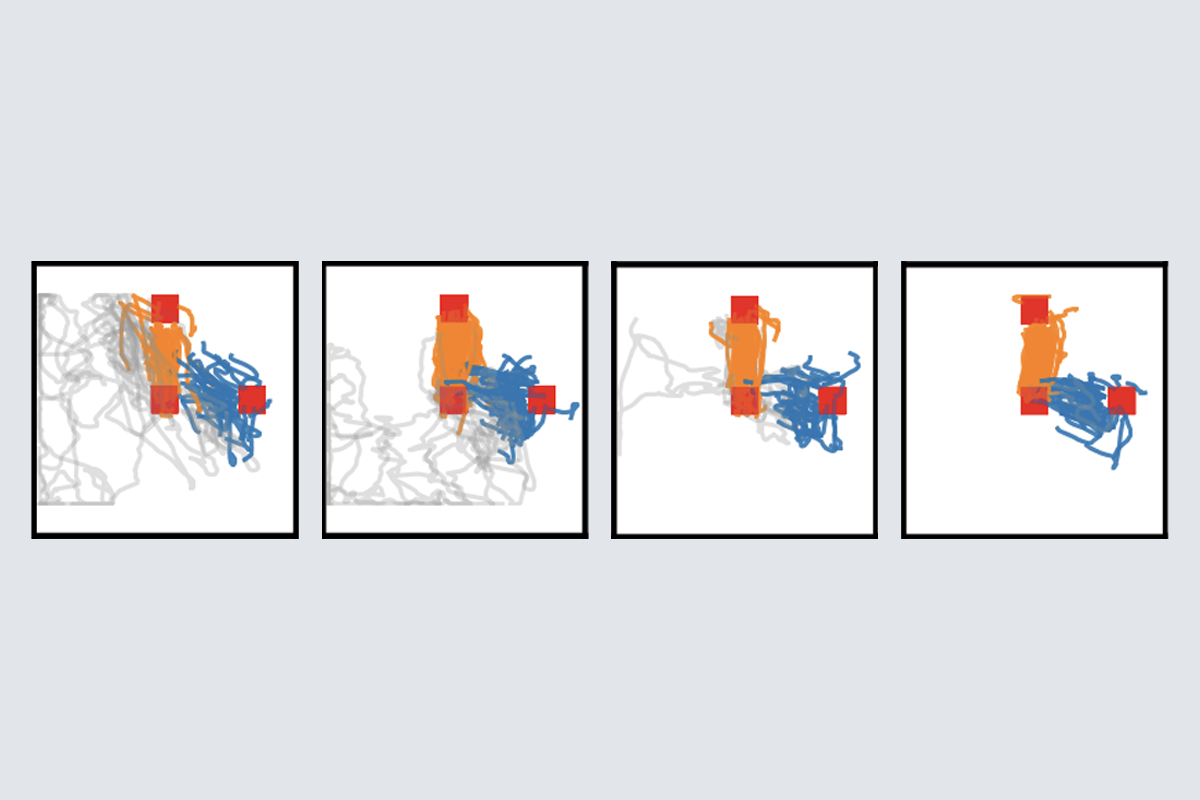
A 96-electrode array brain-computer interface implanted in the motor cortex of three macaques, with one electrode dedicated to controlling the movement of a cursor on a screen, helped Slutzky and his colleagues to explore further. After one or two days of training, the macaques could independently modulate levels of high gamma activity and of local spiking registered by the cursor electrode, using the former to move the cursor up or down and the latter to move the cursor left or right.
The decoupling of these two processes offers “a clear demonstration that they can’t be one and the same thing,” says Rich, who was not involved with the work.
“You can get a particular neuron to fire differently from the high gamma activity. So high gamma activity doesn’t reflect the firing of one or a few neurons,” says Supratim Ray, professor of neuroscience at the Indian Institute of Science in India, who also was not associated with the study.
During high gamma activity trials, neurons at the cursor electrode did not increase their firing, whereas neurons across the entire array, even those just millimeters away from the electrode, did. Spike leakage could not explain such a widespread signal, Slutzky says. “It’s way too far to have an effect.”
The study helps clarify a source of confusion in the field, Ray says. “The idea that [high gamma activity is] the population of spikes—not individual spikes—is still not grasped properly. And this study brings it out in a nice way.”
T
he activity at the cursor electrode was better explained by neurons co-firing across electrodes, a measure of coordinated or synchronized neural activity, than by the spiking, the team found. This pattern suggests that the synchronized activity of neuronal populations drives the signal.High gamma activity peaked at around 10 and 12 milliseconds after spiking rates increased in other electrodes, a delay consistent with the estimated timing between presynaptic spikes and the postsynaptic potentials they evoke, the study shows. That result shows that it is not the spikes themselves, but rather the postsynaptic potentials, that form the high gamma activity signals, Slutzky says. Other types of activity beyond postsynaptic potentials, such as calcium or dendritic spikes, could also contribute and need to be investigated, he adds.
Despite the evidence showing that high gamma activity reflects a broader population activity, it is still unclear just how broad that might be, Rich says. “How far do you go until it doesn’t contribute anymore, or are there contributions from neurons coming into the area from remote locations?”
Future research could try to examine co-firing and single-unit spiking further to understand how high gamma activity arises and how they might contribute differently to information processing, she adds. As for using high gamma activity as a proxy, she says that the findings do not “negate any studies that report on high gamma [activity] as a marker of function in an area. It just adds a layer of interpretation of what that activity is actually doing.”
But, Slutzky warns, “people should be more cautious and less glib about what they attribute high gamma to, and it may affect the interpretation of some studies, both past and future.”