Sex differences in brain activity and structure show little overlap with each other or with differences in behavior, according to a May study.
“They’re really uncoupled,” suggesting that differences in one dimension don’t necessarily cause sex differences in another, says study investigator Armin Raznahan, chief of the Section on Developmental Neurogenomics at the U.S. National Institute of Mental Health.
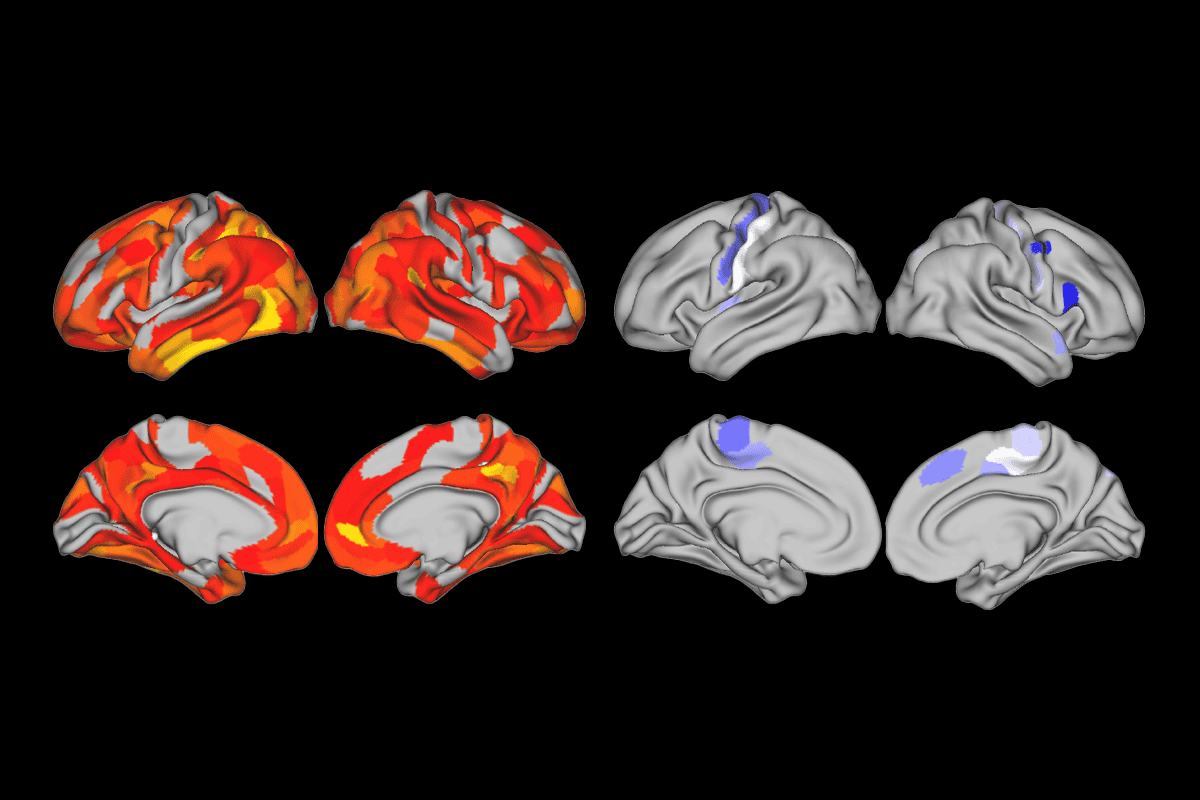
Raznahan’s team analyzed more than 700 hours of structural and functional MRI data from 455 men and 523 women, aged 22 to 37 years, collected by the Human Connectome Project. During the functional scans, participants completed seven tasks involving emotion processing, gambling, relational processing, social cognition, language, working memory and motor abilities.
The study’s size makes it “one of the most analytically rigorous and largest N analyses looking at sex differences in how the brains of males and females activate while doing the same task,” says Amy Kuceyeski, professor of mathematics in radiology and neuroscience at Weill Cornell Medicine, who was not involved in the study.
And although a lot of work has examined differences in brain structure, function, activation or behavior separately, “it’s very rare for studies to look at multiple domains at the same time,” says Elvisha Dhamala, assistant professor at the Institute of Behavioral Sciences at the Feinstein Institutes for Medical Research, who was not involved in the work. The results show that “the ways in which we think about differences needs to be potentially a lot more nuanced than they have been in the past.”
O
How much a participant’s brain activation resembled the average male or average female activation pattern changed depending on the task, the study also found. And whether a participant’s brain had typical male or female activation for one task could not predict whether their brain structure or performance on the task was more typical of one sex over another, which “goes against the thought that a person’s brain is always more male- or female-like,” Kuceyeski says.
In general, the field’s overreliance on average differences is hampering its ability to understand which differences are biologically meaningful to individuals, says Carla Sanchís Segura, associate professor of psychobiology at the Universitat Jaume I. Research tends to take large samples, reduce a measure to a single average value, compare that value between groups, and then generalize those differences to the whole population—a practice she called “the hourglass fallacy” in a recent review.
“Groups are not the same individual repeated many times,” she says.
The fact that the sex differences in the three dimensions studied here—brain activity, brain structure and behavior—do not overlap suggests they don’t reflect a single underlying biological axis, she says. It also brings into question the utility of attempts to build models that classify participants as male or female based on many variables, because two individuals can end up in the same category via different combinations of unrelated features that may not represent real biological phenomena, Sanchís Segura adds.
One solution is to move away from defining male and female as broad categories and “pin [sex] down to the variables that we think are related,” such as sex hormones, chromosomes or even societal differences, she says, whenever possible. For example, sex differences in brain structure map onto differences in hormones and X chromosome dosage, according to a study Raznahan and his team published in June.
But because activation differences did not match up with behavioral differences in the new task-based study, that means fMRI, the field’s so-called workhorse, “is not catching whatever brain signal is underpinning those behavioral differences,” Raznahan says. To that end, his team plans to explore other aspects of brain function, such as subcortical circuits—although he adds that other factors, including the amount of neurotransmitter receptors, strength of connectivity or rhythm of activity over short periods of time, might play a role. Also, activation, structure and behavior, and how they relate to one another, could be analyzed again based on measures that are different from the ones his team used.
But even apparently null results, as in the current study, are useful, Sanchís Segura says, “because it’s important to talk about when men and women are similar” in a field that is biased toward finding bias. For example, the way brain activation mapped onto behavior was largely the same for men and women, the new study found.
“You can prove that a difference exists, but you cannot prove that a difference doesn’t exist,” she says. “You can put into PubMed, ‘sex differences,’ and you will have thousands of papers, but what if I want to look for the absence of differences? We don’t even have a word.”