LISTEN TO THIS STORY:
0:00
/
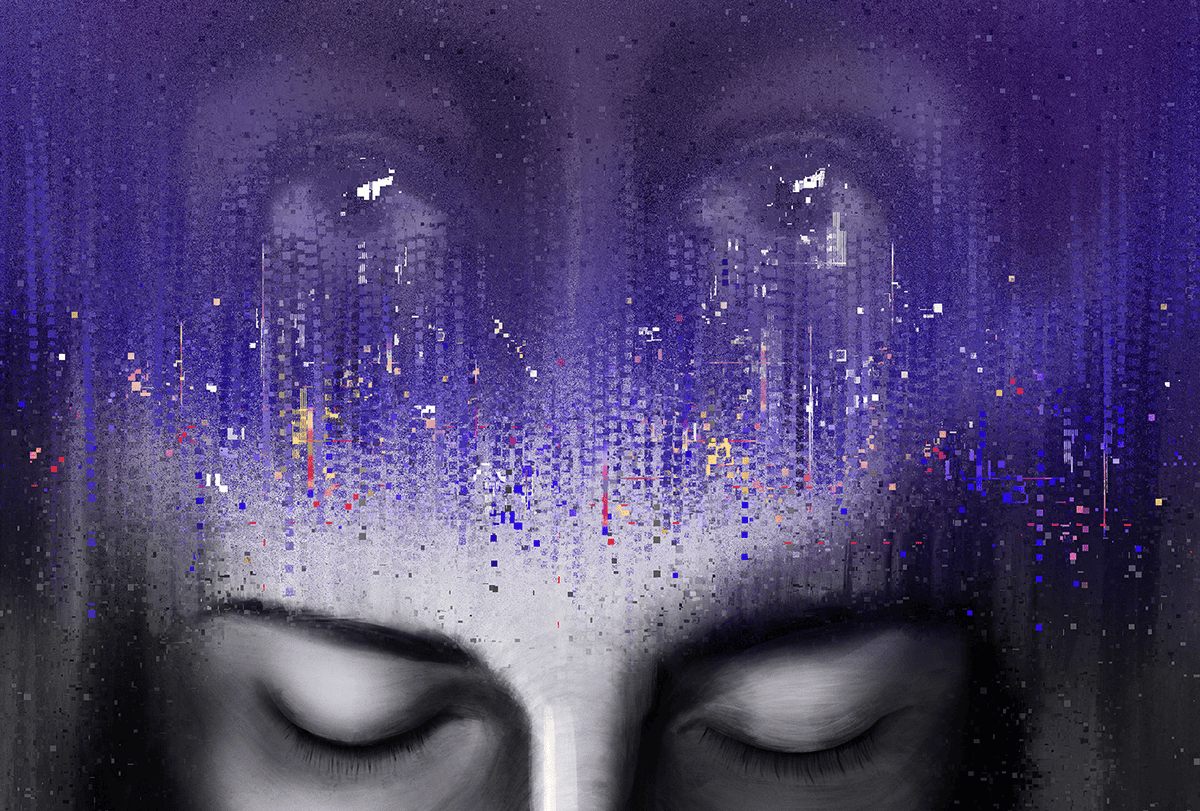
Lucid dreaming offers a rare opportunity to observe and probe perception from within.
Have you ever looked at your hands in a dream?
In waking life, your hands are among the most familiar things in the world: always there, always yours. But in a dream, if you stopped to look—really look—they might well be a little different from the ones in front of you right now. Maybe you would count six fingers, or perhaps a ring you never take off would be gone or an old scar would be missing or in the wrong place. And if you looked a second time, they would likely be different again, never quite settling into the same shape. That’s why lucid dreamers—people who can become aware that they are dreaming and can sometimes influence their dreams—often use their hands to do a reality check to assess whether they are awake or dreaming.
Hands are not the only things that misbehave in dreams. The same kinds of distortions show up again and again in lucid dream reports: Text, clocks and other details change on a second look, mirror reflections are wrong or move out of sync, scenes seem coherent at first glance but stop making sense when scrutinized. These instabilities often resemble familiar glitches in artificial-intelligence-generated images and videos: unstable features, morphing objects, repeated attempts to recreate the same image that never quite succeed. And, perhaps most famously, hands with the wrong number of fingers.
Lucid dreaming is usually seen as a curiosity. But I think it deserves to be taken more seriously: It is a natural, trainable state that can help us study how the brain generates perceptual experience—and how a world comes to feel coherent and real.
I
f we think of perception as a process in which the brain combines prior expectations with incoming sensory input, weighting each according to how reliable it is, lucid dreaming offers a setting in which external input is greatly reduced. As a result, perception is driven primarily from within, enabling us to observe the effects of internal predictions and expectations more directly, and to see how the brain’s generative model operates when it is largely unconstrained by sensory input.And we need not passively observe. The most obvious difference between a regular dream and a lucid one is a change in metacognition—the ability to monitor one’s own mental state. Other capacities, including autobiographical memory and prospective memory, become more available too: The dreamer can remember who they are and what they intended to do in the dream. Together, this enables the dreamer not only to experience an internally generated world with awareness of what it is, but also to probe it from within, making the dreaming mind experimentally accessible in ways that ordinary dreaming does not allow.
Scientists have studied lucid dreaming experimentally since the 1980s, using real-time signaling during sleep, typically through prearranged eye movements. Because the eyes are spared from REM atonia and remain under voluntary control, participants can send simple signals from within the dream while carrying out tasks, making it possible to link first-person reports to objective measures. Researchers have used this setup, for example, to probe time perception by asking lucid dreamers to count or to do squats, and to study dream vision by asking them to track moving objects with their eyes. In the latter case, the resulting smooth pursuit resembled waking vision more than voluntary visual imagery, suggesting that dream visual perception has more in common with seeing than with imagining. More recently, there have even been attempts at two-way communication with people while they are dreaming—early steps toward actual dialogue.
Much of what lucid dreaming can offer, however, lies in its phenomenology, of which visual instability is only one example. Lucid dreamers often report that to make something appear in a dream, simply wishing for it is not enough; you have to expect it into existence. One common trick is to tell yourself that the thing you want will be behind a closed door or in your pocket. Expectations reflect what the brain predicts should be there, and in dreams, where sensory input is largely absent, those predictions do not just shape perception—they can bring things into being.
This interaction can be even more explicit: Lucid dreamers sometimes prompt the dream directly, narrating what they would like to see happen or trying open-ended requests such as “show me something beautiful” and seeing what appears. (Mine once spat out pink fluffy clouds that formed a huge face of Anthony Hopkins.)
Dreamscapes and dream bodies are not only fluid and responsive to thought and expectations, they also tend to fade or dissolve when not attended to. Attention and action—visually scanning the scene, touching objects, physically engaging with the dream—often seem necessary to stabilize the dream world, suggesting a role for ongoing sensorimotor loops even in largely self-generated environments.
Lucid dreamers also describe a split between perceptual fidelity and felt meaning—things can look wrong but still feel right. Most of us can probably recall a regular dream in which something did not look like itself: Your father has the face of your neighbor, your dog is a penguin, and the room you are in is a patchwork of all your former bedrooms. But you know—you just feel—that it is your father, your dog, your childhood bedroom.
This suggests that, at least in dreams, the world being generated may be organized more around abstract forms of meaning and function and less around visual precision; in other words, the hand-ness of a hand, the fact that something belongs to your body and can be used to touch, grasp or manipulate the world, rather than the exact number or shape of the fingers. The dream body does not have to be a replica of one’s physical body either. Like the dream world, the body model can be fluid and sometimes deliberately altered. Even with those local glitches present, the scene can still feel globally coherent and real.
Though lucid dreamers may be able to control their own actions and even the form of their bodies, one thing typically resists control: other agents. Dream characters may say surprising things, disagree, tease, refuse to cooperate and even produce drawings or poems that do not feel authored by the dreamer. This suggests that this internally generated perception is not necessarily consciously authored or voluntarily controlled. Perhaps the generative processes for self, world and other agents are at least partially dissociable.
L
ucid dreaming enables us to watch the mind build a world from the inside, with many of its usual ingredients: a body embedded in an environment, often a social one, with a point of view and a sense of ownership over action. It also lets us see what happens when those ingredients selectively loosen. At the extreme, dreamers sometimes report the so-called “lucid void”: an experience of being a point of awareness floating in a vast empty space or clear light, as the model of the body and environment dissolves or fails to materialize.Experiences like this have parallels in other altered states of consciousness, including psychedelic states, some forms of deep meditation, near-death experiences and out-of-body experiences, many of which have already attracted serious neuroscientific interest, and even in clinical contexts involving altered perception or disruptions in the sense of reality, such as hallucinations, delusions or confabulations. But unlike many of these states, lucid dreaming is naturally occurring and, at least in principle, trainable. Rather than treating lucid dream reports as curiosities, we could characterize them systematically as structured phenomenological data—a source of inspiration and empirical grounding for cognitive theories, including work on how expectations, sensory evidence, action and attention interact to construct perceptual experience.
Because lucid dreaming is a setting in which the generative model runs with very little external constraint, some of its normally hidden workings may become easier to see—in the kinds of instabilities that arise and whether they are noticed or explained away, for example, and in how specific expectations shape what appears. This approach could help us ask whether these patterns vary across individuals and conditions, and how that variation might shape the world each of us wakes up to every day.