It’s November 2023, and I’m sitting in my hotel room in Los Angeles late at night, going over the slides for tomorrow’s lecture. I am supposed to talk about how brain connectivity can predict post-traumatic stress disorder symptoms. A clean story, a clear figure of the brain. My eyes drift to the buzzing phone. More news updates from home. Tomorrow I will be on stage at a major international conference on traumatic stress, and I am still not sure what to say—and what not to say.
That hesitation has followed me ever since the 7 October massacre in Israel in 2023, because it points to a problem in trauma neuroscience that is easier to feel than to name. We use increasingly precise tools to study how traumatic experience changes threat learning, memory and decision-making. We build models that try to predict who will recover and who will not. But we have much less language for talking about what happens when lived trauma enters the scientific room through the researchers themselves. That question matters beyond any one country: Wars, displacement, disasters and public-health crises can shape not only the people we study but also the people doing the studying. This includes Israeli and Palestinian scientists and clinicians, whose lives and work are being shaped by acute trauma, loss, displacement and professional disruption, as well as Iranian, Ukrainian and other scientists working amid ongoing war and violence.
Fifteen minutes before I give my talk, I look again at the opening slide: “Connectome-based predictive modeling of PTSD development in recent trauma survivors,” a talk about patterns of brain connectivity that can predict future PTSD symptoms. I go over the rest of the slides. There is one extra slide after the “Thank you” slide. I still do not know if I will use it.
People close to me have told me not to. “It’s too risky.” “No one will understand.” “It will hurt you professionally.” I understand them, I really do. I also know that careful language matters, especially in moments of crisis. But careful language is not the same as silence. It is a conference about trauma, yet in the rooms I enter, nobody is talking about this trauma. Most of my Israeli colleagues cannot make it; there are no flights from Israel at this time because of the war. Others choose to stay quiet, for a variety of reasons.
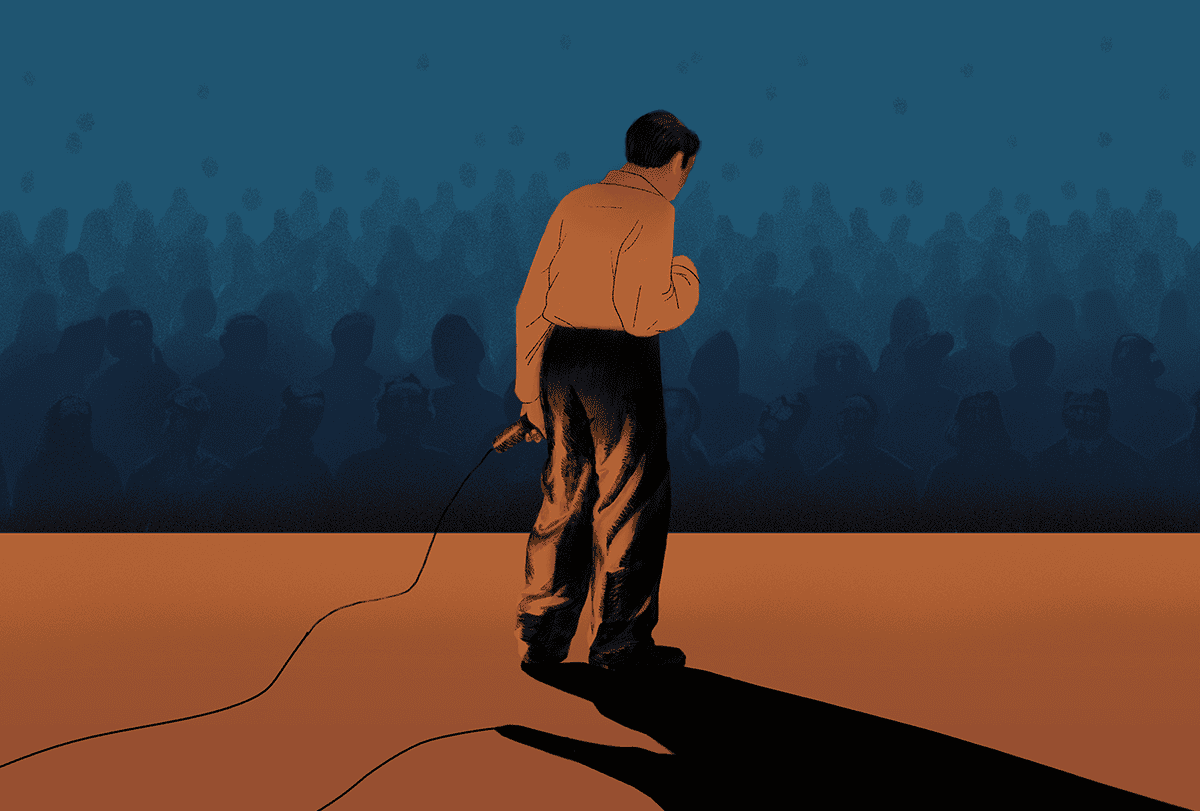
Laptops are open. People type. Someone takes a sip of coffee. The speaker continues. I hear my name.
I finish my talk in 12 minutes. Three minutes left. I click past the “Thank you” slide. An Israeli flag made of 1,400 faces appears. The victims of 7 October 2023. I planned to give only a scientific talk. But I can’t. I try to acknowledge the complexity without turning the session into a political debate. I talk about that Saturday morning, just under a month earlier. Afterward, I do not remember exactly what I said. I remember the faces in the crowd instead. At the end, there is silence. No one moves.
In the weeks that follow, something feels different. Eye contact holds a beat too long, or not at all. A few colleagues embrace me. Others don’t. Someone I don’t know tells me I was brave. Some reactions focus less on what I said than on whether such an acknowledgment belonged in a scientific talk at all. I was even invited to a conversation with the conference organizers after several people complained about what I did.
I start to feel like I am representing the country on my passport, rather than just being a scientist or even a person. I have my own views about my government, but others do not seem to make that separation. Other researchers seem able to remain separate from their countries. But I am not given that same distance. To some people, I am Israel.
I
still do not know whether I made the right choice. That uncertainty matters. I do not want scientific meetings to become political rallies. I do not want evidence replaced by testimony, or data replaced by identity. My own work depends on the opposite: careful measurement, transparent methods and the slow accumulation of evidence. But trauma science cannot pretend that lived reality always stays outside the lecture hall.The question is especially acute in neuroscience because our field often translates private experience into public evidence: signals, scans, models and mechanisms. That translation is essential. It is also incomplete. The brain measures we study do not exempt us from having bodies in rooms, families in danger and histories that shape what feels speakable. Objectivity should discipline how we make claims. It should not require us to pretend we are untouched by the phenomena we study.
This is especially true for fields that study human suffering during war, displacement, disasters, racism, violence and public health crises. In some places, trauma research becomes impossible precisely when it feels most urgent: Laboratories close, clinics are overwhelmed, participants are displaced, and researchers become caregivers, reservists, evacuees or mourners. These events do not only shape study populations. They shape the people asking the questions and the rooms in which those questions are discussed. Pretending otherwise does not make science more objective. It can simply make the human context invisible.
I am arguing for something narrow but important. Trauma researchers need professional norms that allow brief, humane acknowledgment when acute trauma directly affects a scientific community, without demanding ideological agreement and without turning every session into a debate. At meetings held during major crises, organizers could make explicit room for such acknowledgments, and for support outside formal scientific sessions. Organizers could encourage speakers to distinguish acknowledgment from advocacy, and evidence from testimony, while still naming the reality that shapes the room. None of this resolves political conflict. It simply recognizes that silence is not always neutrality.
Almost three years later, I am back in Israel. I study trauma while living it. I try to understand stress resilience when sometimes I feel I cannot deal with this stress anymore. In the past month and a half, we have been in and out of the bomb shelter several times each day and night. But I am still a working scientist. I still write grants, analyze data, study the brain mechanisms of trauma and go to conferences when the sky is not closed for me.
I am sitting at my desk at home. The phone is still buzzing with notifications, but this time it is useless—I can already hear the sirens outside. Time to run to the shelter again. I think about the version of myself who gave that talk almost three years ago. He would not believe that it has been so long and that we are still at war. He would not believe that I still do not know what to say—and what not to say.
I wake up every day and try to be a good scientist and a good person. I also wonder what kind of scientific culture asks us to choose between these. I try to be both, between one alarm and another.