Activity flows are the movements of activity between neural populations. These dynamic neural processes are nothing short of the animating force of the brain, the very essence of what makes the brain function. Indeed, activity flows appear to be a primary integrative mechanism in neural computation, constituting the main conduit through which diverse biophysical processes converge to generate mental functions. Mental functions are synonymous with cognition and encompass our experience, our abilities, our memories, and our goals. We will be focusing on how activity/brain flows generate the most fundamental aspects of the mind (such as learned associations and goal pursuit) in the first half of the book, focusing on more complex functions (such as consciousness, intelligence, and creativity) in the second half of the book. Beyond evidencing the simple fact that brain flows compose the human mind, I will share an account of how brain flows go about generating functionality despite the computational challenges we face as we pursue goals in a complex world.
Despite the centrality of brain flows to cognitive functionality, someone reading the recent neuroscience literature would be forgiven for thinking brain flows play only a minor role in neural processing. Rather than playing a central role in hypothesis development, data analyses, and data interpretation, activity flows are typically relegated to background knowledge only vaguely related to the main conclusions of most neuroscientific studies.
Most contemporary neuroscience studies focus instead on either mapping functions to brain regions or mapping connectivity between brain regions. While helpful, such activity and connectivity estimates are the mere correlates of brain flows, and thus do not address the brain’s core functionality. Brain activity flows are fundamental to neural processing and have the potential to unify efforts to map brain functions and connectivity into rich explanatory accounts of brain functions. This journey to the essence of brain function begins with the action potential.
From slugs to mice to monkeys to humans, and from anatomy to computational models, the action potential (or spike) has been shown to be central to neural processing. This pivotal role starts in the periphery, with every sensory modality communicating with the brain via action potentials. These electrical signals flow rapidly along neurons’ axons, triggering the release of chemicals (neurotransmitters) that in turn trigger action potentials in the next group of neurons in the chain. This flow of action potential rate increases—activity flows—eventually enters the brain, where much less is known. For instance, not much is known about perception of simple patterns like circles, and even less for perception of complex mythical creatures like unicorns. However, we do know that, if a stimulus causes a motor response, coming out the “other side” are more action potentials from the brain that trigger muscle movements.
G
iven the functional centrality of the flow of action potential rate increases outside the brain, one would assume it would be important within the brain as well. And indeed this has been a core feature of many neural theories. The relegation of this dynamic flow process to peripheral “background” theory for most empirical neuroscience studies is like we’ve been doing neuroscience research with our hands tied behind our backs. Yet this presents us with a substantial opportunity for improving our understanding of brain function by shifting to the brain flow perspective, and away from more standard activity-amplitude-centric and connectivity-centric views. Luckily for us, activity flows can be estimated as the combination of connectivity and task-related activity, both of which are being mapped via thousands of neuroscience studies every year. We can therefore leverage this vast and ever-expanding knowledge in our quest to understand the essence of brain function.Consider this salient example of mapping a brain function, which is a starting point for understanding more complex cases (e.g., representations of mythical creatures like unicorns): There appears to be a sort of “module” in the human visual system for processing faces. This brain region is termed the fusiform face area, and it is more active when a participant sees a face relative to seeing other visual categories (such as a house or tool). While this region does more than just process faces, decades of research has established that this chunk of cortex buried within the temporal lobe really is more active in response to faces than any other category, even scrambled faces (i.e., stimuli with the same low-level features). Can we use the brain flow perspective to gain additional insight into this localized function?
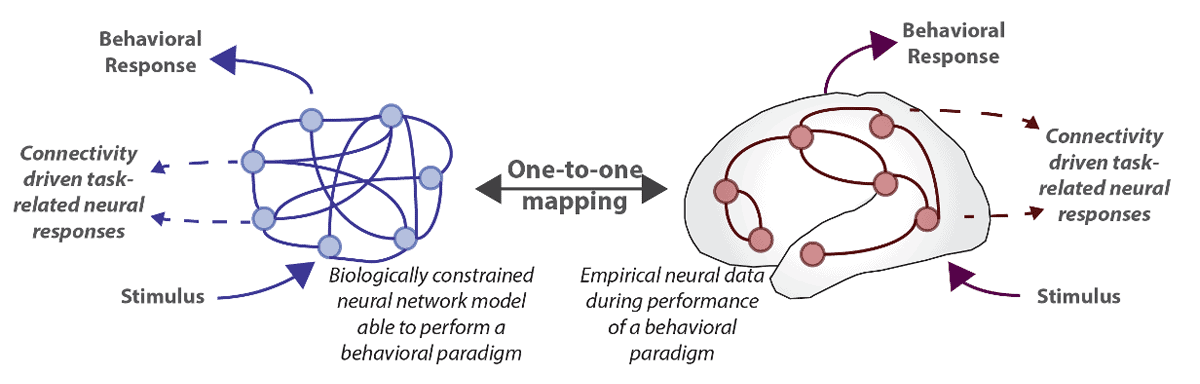
Let’s begin by considering what an activity-flow-based account of the fusiform face area would look like, in principle. Importantly, an activity-flow-based account would not replace function maps or connectivity maps. Rather, activity flow modeling builds on this knowledge, mixing maps of task-evoked activity with connectivity maps to estimate activity flows. In the case of the fusiform face area, an activity flow model would utilize this region’s unique connectivity pattern to identify which other regions contribute to its functionality. It would then simulate the flow of activity from those regions to the fusiform face area as it generates the function of interest—here elevated activity in response to faces (face selectivity). Given that the model generates the function of interest (while being highly empirically constrained) we can consider this to be a generative understanding of face selectivity. This generative understanding goes well beyond the function map and the connectivity map that we began with, demonstrating a highly plausible mechanism by which a function of interest emerges in this brain region. Notably, this generative perspective from generative network neuroscience is highly related to neuroscientific encoding models—wherein a basis set (e.g., a set of simple visual features) is used to account for a complex neural response (e.g., visual responses to a movie), then used to test for generative sufficiency in independent data. Activity flow modeling can be thought of as connectivity-based encoding modeling.
The brain flows framework suggests information processing in the brain may occur primarily via information transformations between brain regions rather than within them. This perspective has recently been strongly supported by the success of activity flow models—simulations of task-performing brain functionality based on empirical connectivity and activity estimates. In these digital twin brain models (Figure 1), we can see how cross-region projections between brain regions generate unique functionality. This contrasts with how most cognitive neuroscientists (including myself at one point) interpret task-evoked brain activity: as unknown within-region processing. The brain flow framework suggests that each brain region contains one or more information “spaces”—such as representations in a retinotopic or egocentric spatial coordinate system—with its activity flows to/from other brain regions actively converting information between these information spaces. Thus, the low-level visual feature information space in V1 containing an entire rich scene is transformed via activity flows into a complex face-and-other-objects representation space in the fusiform face area. We can imagine taking a “V1-eyed view” and a “parietal cortex-eyed view” of a scene. While the V1-eyed view would be in a retinotopic frame and therefore jump around as you move your eyes, the parietal cortex-eyed view would be in an egocentric frame and therefore would not jump around as you move your eyes. A wide variety of parallel processing streams involving other brain regions, each with their own spaces, simultaneously process other aspects of the scene.