In Frameshift, neuroscientists with careers outside the lab discuss their work and how they made the transition.
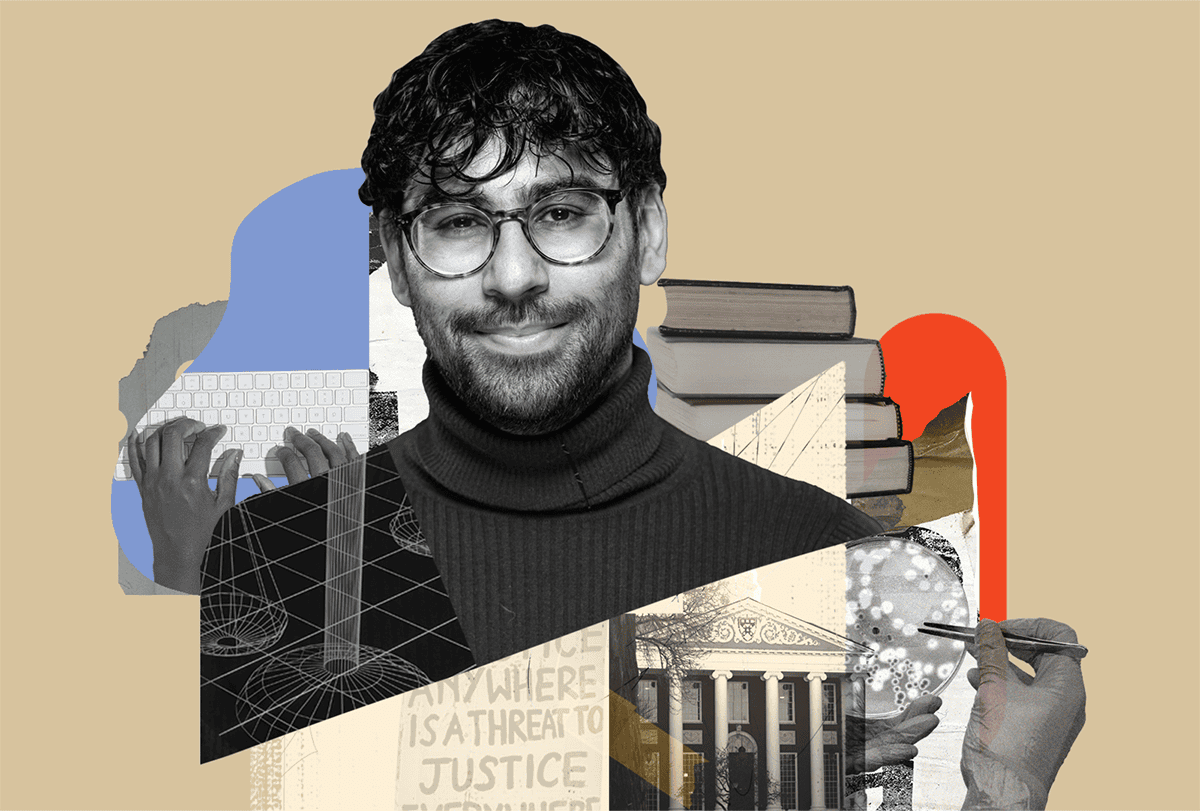
Lab life: Mayank Chugh works with students in the lab and matches them with mentors for research projects.
Illustration by
Michela Buttignol
Add us as a Preferred Source on Google
Set us as a Preferred Source to see The Transmitter more prominently in your Google Search results.
Training graduate students as a teaching professor
Mayank Chugh instructs graduate students in a range of molecular biology techniques at the University of Maryland and carves out time to do metascience research as well.
By
Katie Moisse
20 November 2026 | 7 min read
As a teaching professor in biology at the University of Maryland, Baltimore County, Mayank Chugh trains graduate students in a range of molecular biology techniques and co-supervises their master’s projects. He spends his spare time studying the structures and systems that keep careers in academia financially out of reach for many.
This interview has been lightly edited for length and clarity.
The Transmitter: Teaching professors typically teach undergraduate students in lecture halls, but you work with graduate students in the lab. That sounds like a pretty unique position.
Mayank Chugh: Yes, it’s a very unique position. I lead a lab of graduate students in an accelerated master’s program called Applied Molecular Biology. It’s an intense one-year program that starts with a 10-week boot camp in which the students work with me to learn the techniques they’ll need for their research projects—techniques such as cloning, protein purification, protein characterization and more. At the end of the 10 weeks, I match students with faculty members for their research projects and serve as a co-supervisor on those projects. It’s great because I get to be in the lab, teaching what I’ve been trained to do, and mentoring students and being a part of their career journey.
TT: It sounds like this position keeps you more connected to research than some teaching professor roles might.
MC: Yes. I wanted to do research. I wanted to be a principal investigator and mentor students, but I also wanted stability and a change of pace and some calm for my nervous system. And I’ve always enjoyed teaching in the lab setting. As far back as my master’s, I was training students. There are teaching roles in which you’re in a teaching laboratory for undergraduates but I’m really happy about where I’ve landed.
TT: Do you regret not pursuing a research faculty position?
MC: I would want to focus my research on something we don’t currently have space for in academia: the science of doing science, or “metascience.” I’ve always been interested in the intersection of science and social justice. During my postdoctoral work at Harvard University, I started a small research group called The ReForm Lab. We ask questions like “Who gets to produce knowledge?” and “Who gets to share knowledge?” This kind of questioning happens in sociology departments, education schools, business schools and law schools, but it rarely happens in science. You can’t do this type of research as a tenure-track faculty member in biology—they would have no idea how to evaluate your contributions to the field. And you can’t be appointed in sociology or education without a Ph.D. in sociology or education. There’s just no place for metascience, unfortunately.
TT: Can you give an example of your metascience research?
MC: While I was chair of the Harvard Postdoctoral Association, we started looking at compensation for postdocs. The National Institutes of Health extramural scale works as a standard for the minimum postdoc salary in the United States, but it doesn’t account for the wide disparity in the cost of living. To expect a postdoc in their mid-30s to survive on $65,000 in one of the major research hubs, like New York City, Boston or Atlanta on the East Coast, or Los Angeles or San Diego on the West Coast, is absurd.
We surveyed about 1,100 postdocs about how they live in Boston on their salaries, including whether they have a partner, whether they have children and, if they do have children, how much they pay for childcare. We found that most Harvard Medical School postdocs were making less than living wages needed to live in Boston. Certainly, such pressure can push postdocs out of academia. Within about two months of us publishing our data in Nature Biotechnology, some Harvard campuses, the Massachusetts Institute of Technology and Boston University changed their salary scales to increase compensation for postdocs. The Howard Hughes Medical Institute, a funder of postdocs across the U.S., also increased its baseline salary and added a cost-of-living adjustment. More recently, we analyzed data on international postdocs and identified an invisible tax of U.S. visa bureaucracy. Seeing the impact of this type of metascience research is amazing. When you gather data and build an evidence-based argument for change, you can inform policy.
TT: How do you make space for this type of research without the structure of a faculty position?
MC: My teaching professor appointment is nine months of the year, but my ReForm Lab research continues in the background, with summer months serving as dedicated time for doing research. I can also do this research in the winter as long as I’m training students, which I am. I’m training students to think about these complex, important problems that are very relevant to many of them. I apply for small grants to support the students, and the grants help me in my career progression, too.
TT: Are you expected to serve on university committees, too?
MC: Yes, I serve on departmental committees, and, because of the kind of work I do with the ReForm Lab, I have an affiliation in the College of Arts, Humanities, and Social Sciences. I’m connected to a program called Human Context of Science and Technology, which is embedded in the philosophy department. I’m creating undergraduate courses such as “The Future of Scientific Research” and “From Lab to Governance,” which bridge disciplines. I’m on the governing committee for this interdisciplinary program.
I also serve as an early-career adviser at the journal eLife. Sometimes this means chatting one-on-one with a postdoc about their career options, and sometimes it means giving a talk to a group of Ph.D. students about my career path. I take every opportunity to connect with the scientific community, and I think this kind of consulting connects really well to metascience because early-career researchers can be part of the conversations that question and challenge how we do science.
TT: Did you go straight from your postdoc into your teaching professor role?
MC: No, I took a little segue after my postdoc at Harvard and went to William and Mary for one year. I went there thinking that a small liberal arts school would better understand the interdisciplinarity of metascience than one of the bigger universities. But I realized it didn’t matter—people are so married to the idea of disciplines and evaluating someone’s contributions the same way we always have. Hopefully, metascience can help to challenge this.
TT: What advice do you have for Ph.D. students and postdocs who are unsure what’s next?
MC: My best advice would be to get a mentor who sees you and lets you be you. Mine was my postdoc supervisor, Sean Megason. Even though he was paying me to work as a biologist in his lab, he was so open about my strengths and so supportive of career exploration. He encouraged me to pursue all kinds of professional development opportunities. I took a mini-MBA at the Harvard Biotech Club, taught by Harvard Business School professors, to build my leadership skills, and I took courses on innovation at Harvard Medical School to explore what a job in industry might be like.
The other piece of advice is to work on your science communication skills—writing, giving presentations, distilling concepts. I tell my students that no matter what they do in their lives, they will be writing.
Explore more from The Transmitter
Loss of Angelman-linked UBE3A gene triggers stress response in neurons
By
Sarah Thau
19 November 2026 | 4 min read
What makes computation possible in brains?
By
Paul Middlebrooks
18 November 2026 | 1 min read
Fish brains follow swimming friends to avoid foes
By
Madeline Shaw
18 November 2026 | 4 min read
Cite this article: