Bence Ölveczky headshot.

Bence Ölveczky

Professor of organismic and evolutionary biology
Harvard University

Bence Ölveczky is professor of organismic and evolutionary biology at Harvard University. His lab examines how the brain learns and generates complex behaviors, including motor skills. He and his team study this in rodents, generalist motor learners with the capacity to master a variety of different tasks. The lab has developed a unique experimental infrastructure to address these questions, including a fully automated high-throughput training system for rodents that can be combined with continuous long-term neural and behavioral recordings. They use this together with sophisticated circuit dissection tools to arrive at mechanistic descriptions of how the mammalian brain learns and executes motor skills.

A mechanical engineer by training, Ölveczky earned his Ph.D. in neuroscience at Harvard, working with Markus Meister on motion processing in the retina. As a junior fellow in the Harvard Society of Fellows, Ölveczky worked with Michale Fee at the Massachusetts Institute of Technology on the neural mechanisms of vocal learning in songbirds.
Explore more from The Transmitter

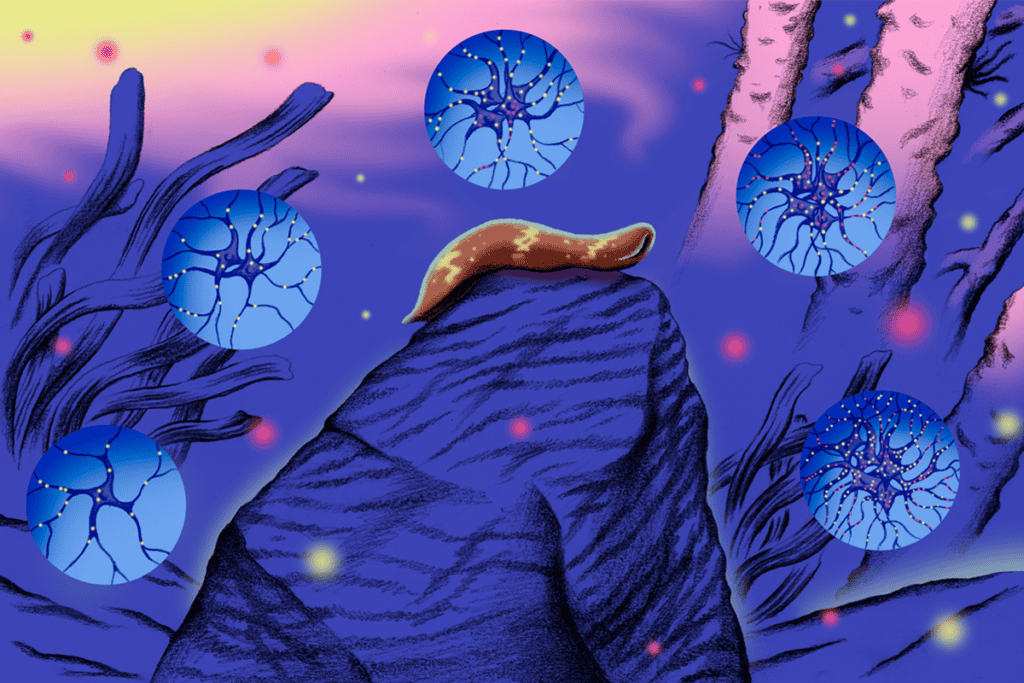
Illustration of worm on top of a purple rock with neurons in the background.

The three-banded panther worm is rewriting the story of brain evolution

The animal has a brain structure all its own, according to a 2026 preprint. The finding hints that brains could have evolved centralization before regionalization.

By Sarah DeWeerdt
4 November 2026 | 7 min read

Does cognition happen in brain areas or between them?

Michael Cole explains how "brain flows" are the fundamental units of brain function and cognition.

By Paul Middlebrooks
4 November 2026 | 1 min read
Brain Flows book cover

‘Brain Flows: How Network Dynamics Compose the Human Mind,’ an excerpt

In his new book, published today, Michael W. Cole examines how the movement of neuronal activity between neuronal populations shapes free will, intelligence and creativity. In this excerpt from Chapter 1, Cole explores why activity flows could unify efforts to map brain functions and connectivity.

By Michael W. Cole
3 November 2026 | 9 min read