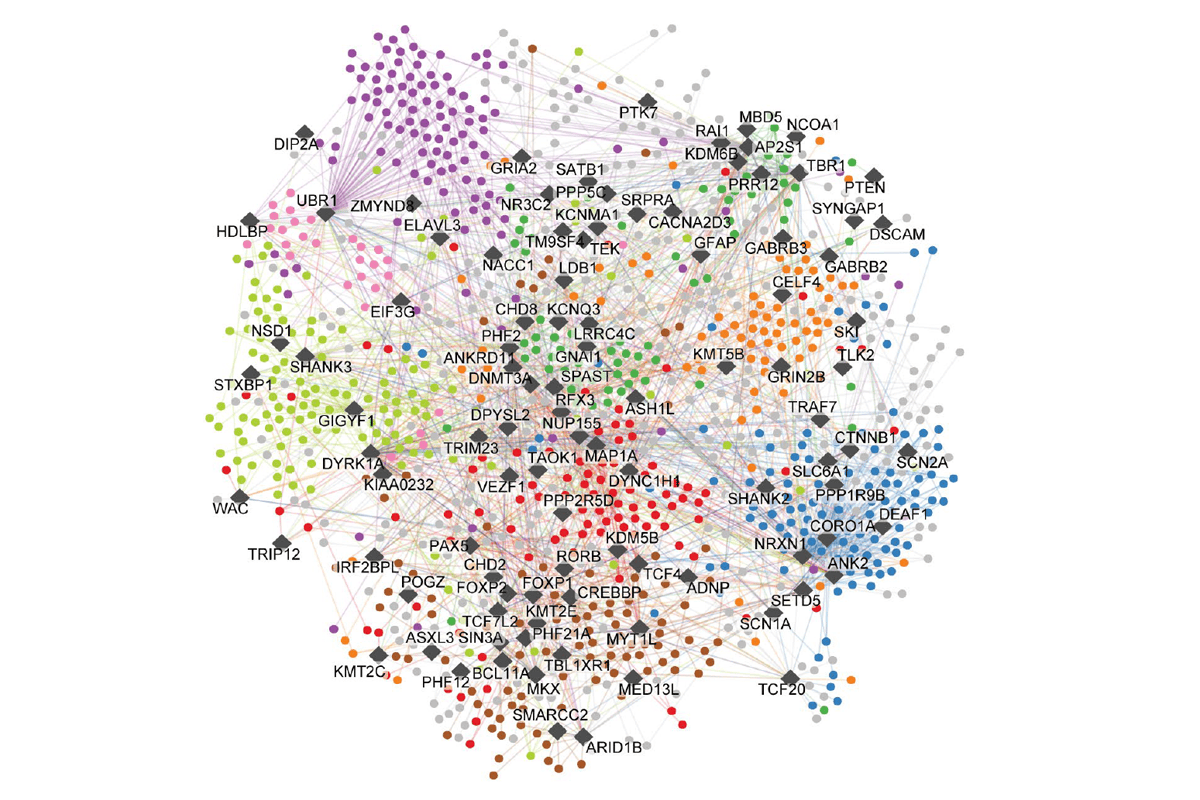
The proteins encoded by 100 genes involved in autism form an interconnected network consisting of multiple protein complexes that serve different cellular functions, according to a study published today in Science. Autism-associated variants may cause this network to rewire, the study also found.
Even though autism is a genetically heterogeneous condition, “when you look at the proteins encoded by the genes, and also the specific mutations and the interfaces of protein interactions, the biology starts to converge,” says Kasper Lage, managing director of the Novo Nordisk Foundation Center at the Broad Institute, who was not involved in the work. Many of the proteins the study considered converge on complexes already associated with autism and that are involved in processes such as neural progenitor proliferation and differentiation and neuronal migration, the researchers found.
The idea behind the work was to go beyond the genetic studies, which have linked about 250 genes to autism, says study investigator Belinda Wang, assistant professor of psychiatry at the University of California, San Francisco. “Genes can tell us where autism risk begins, but proteins do a lot of the work inside the cells, and so by studying autism at the protein level, maybe this can give us a more direct view of the underlying biology.”
Previous network analyses did not reach this magnitude, Lage says. “When you get to the scale that they’re doing in this paper, you can start to do really interesting secondary analysis and pathway and discovery.”
One of the convergence hubs, anchored by an interactor protein called DCAF7, connects multiple autism proteins, including DYRK1A, AUTS2 and SKI. Perturbing this complex by deleting the gene that encodes DCAF7 disrupts neural progenitor proliferation and neurogenesis in Xenopus frog embryos and in human neural progenitors in culture, the study showed.
This example “illustrates what you can get out of looking at these diseases at the network level,” Lage says. “Genetics alone wouldn’t tell you that.”
T
o scale up the study of protein-protein interactions, the researchers expressed each of the 100 autism-linked proteins, one by one, in human kidney cells grown in culture and used affinity purification-mass spectrometry to identify all the other proteins each one physically interacts with. Compiling the data in a single interaction map shows more than 1,800 interactions across all 100 proteins; about 87 percent of those interactions have not been previously reported.“This is really a detailed molecular diagram of the networks that are underlying autism that are showing connections at the protein level,” Wang says. “It turns out this really diverse set of risk genes actually becomes quite organized at the protein level.”
Knocking out components of one previously unreported complex—made up of DCAF7, DYRK1A and KIAA0232—led to reduced brain size in Xenopus frog embryos and increased cell death in human neural progenitor cells, pointing to potential mechanisms in autism biology.
Researchers made the same interaction maps for each of 54 autism-linked variants. Comparing them with the control map revealed that similar sets of biological pathways and complexes are affected by each variant.
For example, three different FOXP1 variants weaken its interaction with the transcription factor FOXP4 in the same way. Even though these variants are in different domains of the protein, all three had similar effects, the study showed.
Variants in FOXP1 did not cause FOXP4 to lose its normal function; rather, they led it to bind to genomic locations where it normally would not, effectively changing which genes it could regulate, the study found. And organoids carrying FOXP1 variants showed aberrant differentiation of excitatory cortical neurons, particularly in the deep layers, the study also showed. Knocking out FOXP4 reversed these issues, which suggests that increased FOXP4 function accounts for the cortical neurogenesis defects seen in organoids with FOXP1 variants.
This finding fills in a mechanistic gap in the field’s understanding of how variants can impact function, says study investigator Rasika Vartak, associate researcher at the University of California, San Francisco. The team previously posted the findings in a preprint.
Earlier protein studies have relied on knocking down or knocking out a gene of interest, and many assumed that all of these are loss-of-function variants, Vartak says. In this case, FOXP1 variants led to a loss of affinity for FOXP4 but a gain of function in its capacity as a transcription factor, the study showed.
“What we show is a much more complicated mechanistic scene,” Vartak says. “This is not just a very simple loss-of-function mechanism. This is a more complicated loss and gain of function, and that’s something that opens more doors to what could actually be biologically happening.”
One of the limitations of the study is that human kidney cells do not reflect a neuronal population, which may have distinct protein-protein interaction networks, especially at synapses, Lage says. “Cells are just cells, and tissues have completely different functions and architectures, and that is definitely represented in their protein networks,” he says.
The researchers are now moving into in-vitro neuronal systems, in which they tag endogenous proteins to study their interactions, Vartak says.
But looking at protein networks in vivo is the ultimate goal, Lage says. “Doing that in a complex brain tissue where you’re really getting the interconnections between the neurons and the synapses and all these things—that would be [where] the field is going to be heading.”